Cart
0
You may also like
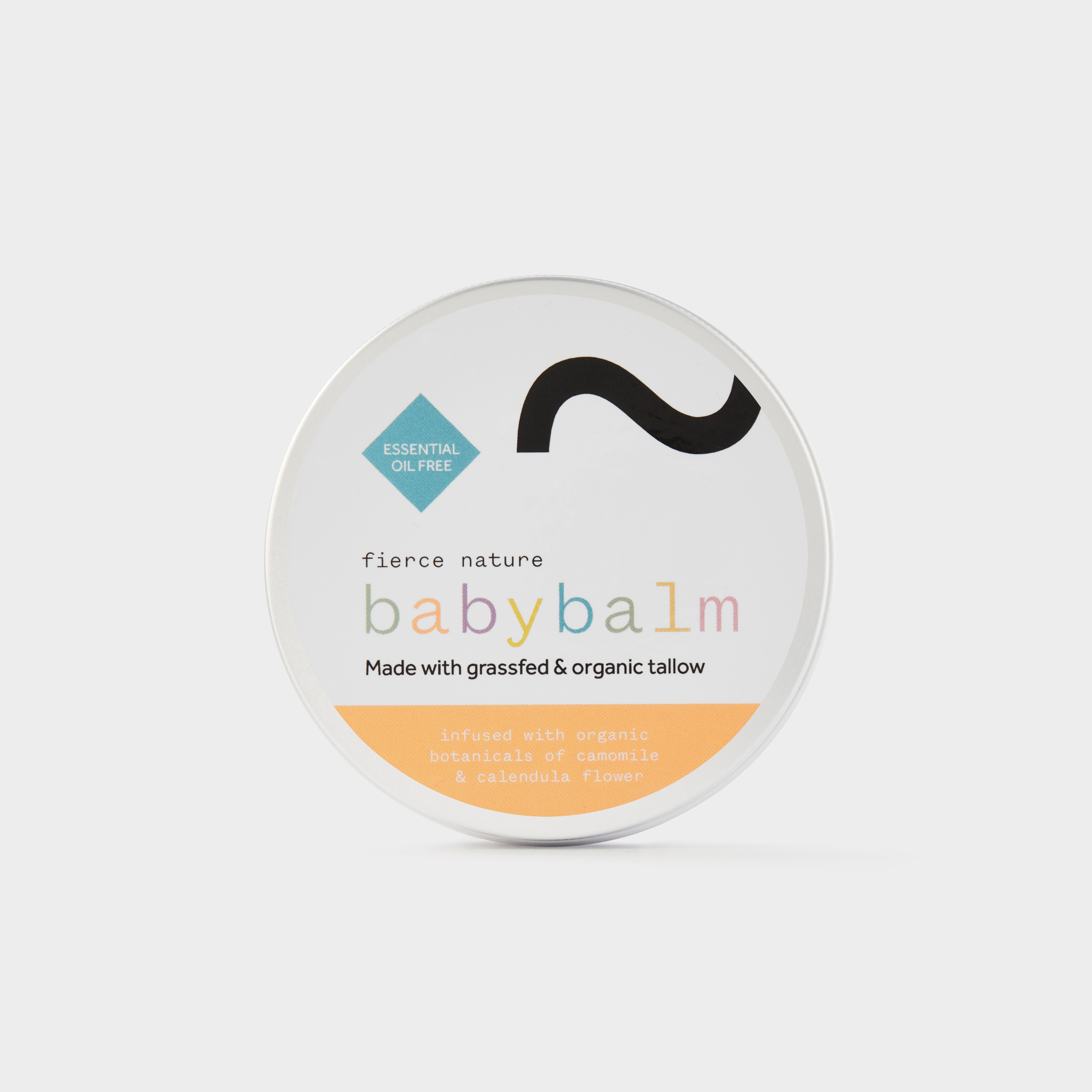
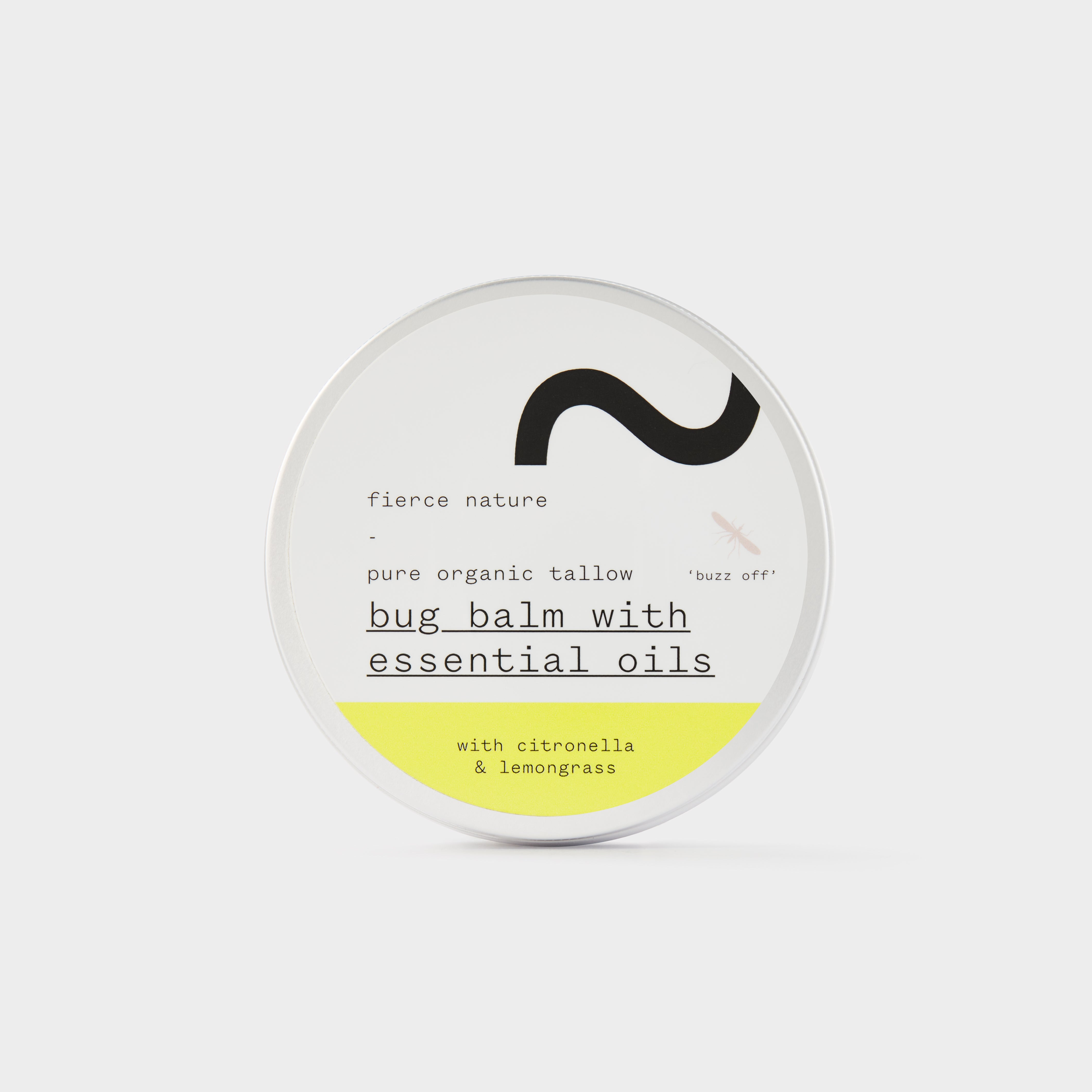
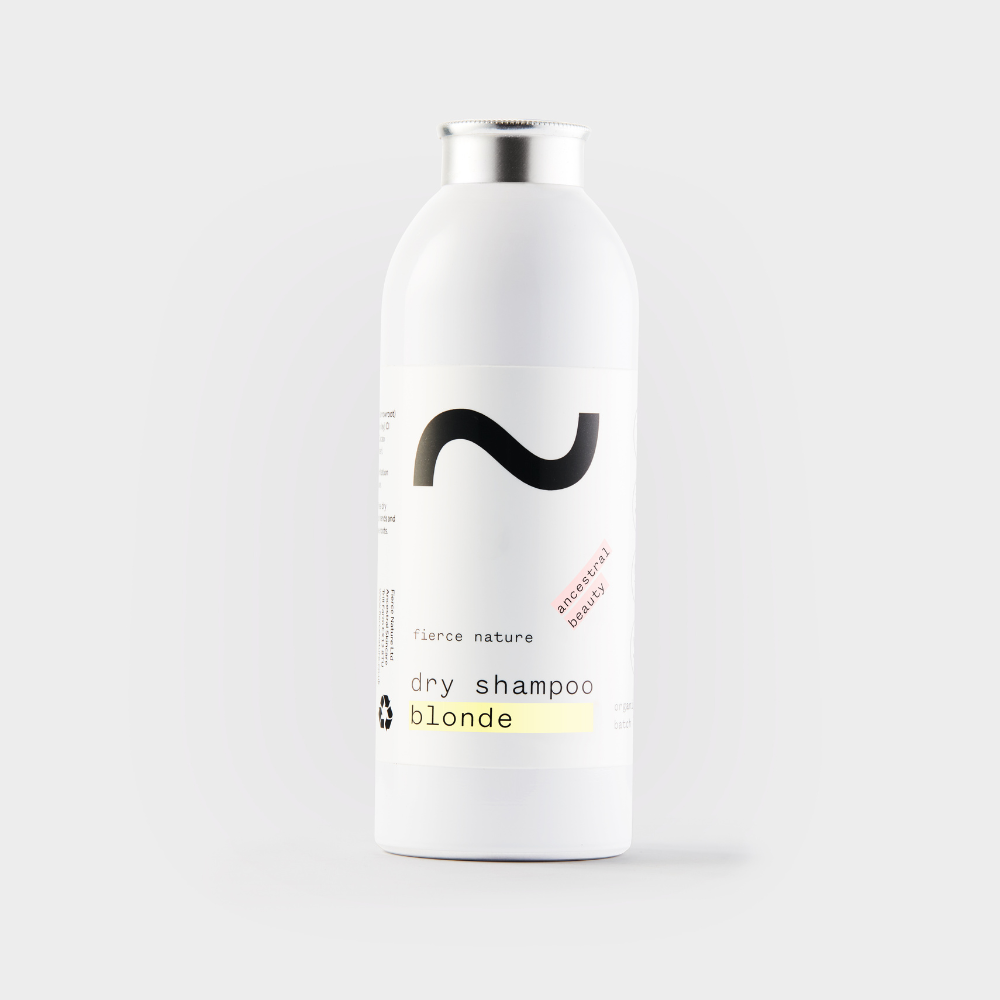
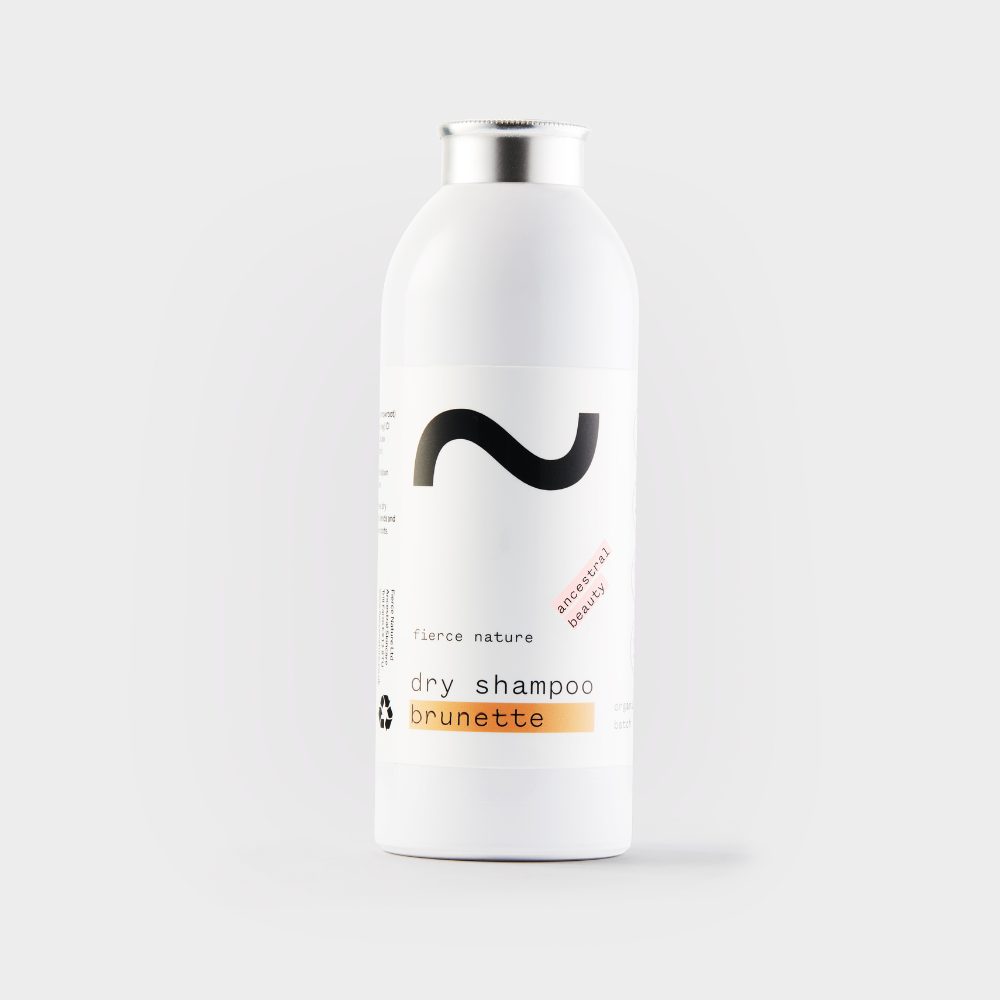





Plastic free skincare means a product made without synthetic polymers, microbeads or intentionally added microplastics, checked at the ingredient level rather than the packaging. If a label lists entries ending in “polymer” or “siloxane”, it isn’t plastic free, however recyclable the bottle looks. The fastest way to check is to scan the INCI list before you buy. The rest of this guide shows you exactly what to look for.
TL;DR:
- Avoid products containing ingredients ending in “polymer,” “copolymer,” “siloxane,” or with prefixes like PEG or PPG, as they are synthetic microplastic derivatives.
- Synthetic polymers persist environmentally and can cause skin irritation, making natural alternatives like tallow, cellulose, and starch microparticles better choices.
- The EU plans to restrict microplastic ingredients in rinse-off cosmetics by 2027, but many leave-on products may still contain plastic‑derived ingredients.
- “Natural” labels are unreliable without checking the ingredient list, as many products mix natural extracts with synthetic polymers or film-formers.
- Always verify transparency by reviewing full ingredient lists, asking brands for detailed INCI data, and patch testing new products before regular use.
Plastic free skincare, in the sense that matters for your skin and the environment, is about what’s inside the formula, not what it’s sold in. A jar made from recycled glass can still contain synthetic polymers. A plastic tube can (in theory) hold a completely polymer‑free balm. The two issues get muddled constantly, and it’s worth untangling them properly.
Here, “plastic free” means the formula contains no synthetic polymeric ingredients, no microbeads, and no intentionally added microplastics of any kind, whether they’re there to thicken a cream, bind a foundation, or scrub away dead skin cells. That’s an ingredient‑level definition, and it’s the one that has real consequences for your skin and for what washes down the drain.
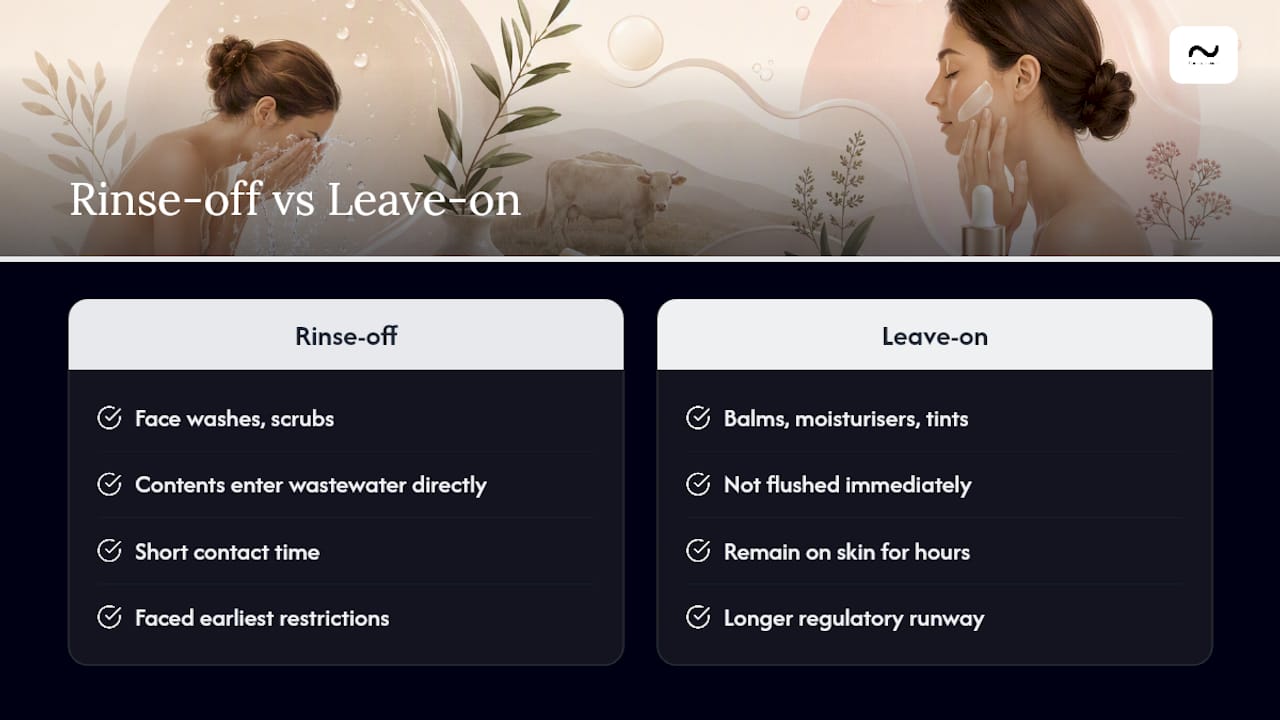
Regulators treat this differently depending on whether a product rinses off or stays on. Rinse‑off products, such as face washes and scrubs, send their contents straight into wastewater, which is why they’ve faced the earliest restrictions. Leave‑on products, including balms, moisturisers, and skin tints, get a longer regulatory runway, even though the ingredients sit on your skin for hours. That gap between rinse‑off and leave‑on rules is exactly why label literacy matters more than trusting a category to be automatically safe.
Synthetic polymers don’t disappear once they’re washed off or worn away. They persist in soil and waterways for years, and reviews of cosmetic formulations describe them turning up in marine environments long after the product itself is gone. Some formulations use polymers in small percentages by weight, which can add up significantly across an industry using them in everything from mascara to moisturiser.
The skin health side is less discussed but just as relevant. Complex synthetic polymers can sit awkwardly on sensitive or reactive skin, and formulators increasingly favour simpler, whole‑ingredient formulas because they tend to be better tolerated. That’s a meaningful shift for anyone who has spent years blaming their own skin for reactions that were arguably down to the formula.
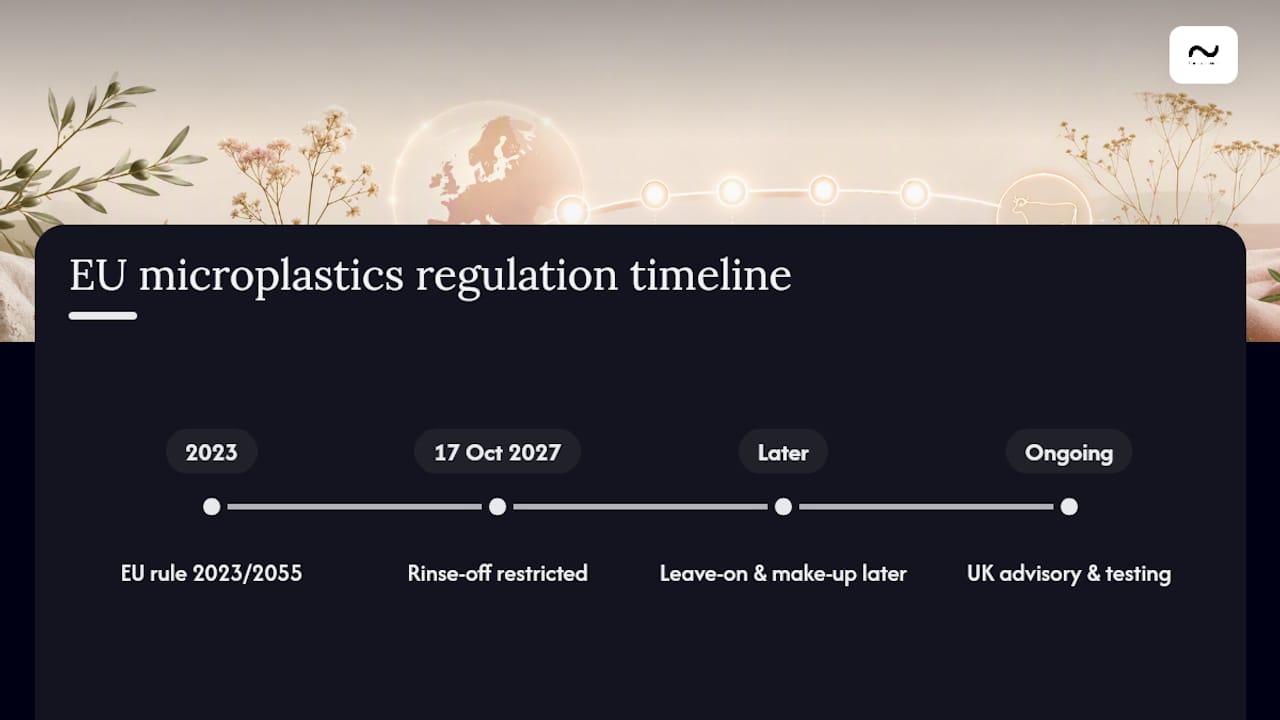
Regulatory shift: Commission Regulation (EU) 2023/2055 restricts the intentional addition of synthetic polymer microbeads, with phased deadlines. Many rinse‑off categories face a cut‑off of 17 October 2027, with leave‑on and make‑up categories following later.
That timeline tells you something useful: even regulators accept this problem can’t be fixed overnight, which is exactly why checking your own labels now is worth the five minutes it takes.
INCI names look intimidating, but plastic‑derived ingredients follow recognisable patterns once you know what you’re scanning for. You don’t need a chemistry degree, just a habit of pausing before you buy.
Watch for these signals on any ingredient list:
By contrast, entries like tallow, cellulose, starch, and xanthan gum are naturally derived and not part of this problem. The tricky bit is vague trade names. A brand might list a proprietary blend under a name that gives you no clue what’s inside, and trade secrecy sometimes hides small amounts of polymeric additives behind exactly that kind of label.
Pro Tip: If a label uses a trade name you can’t decode, email the brand and ask for the full INCI or a technical data sheet. A brand confident in its formula will hand it over without hesitation.
Reputable third‑party ingredient databases can help you cross‑check unfamiliar names too, but a direct answer from the brand is still the most reliable route.
Every function a synthetic polymer performs, thickening, film‑forming, exfoliating, has a natural counterpart. The formulation world has simply been slower to adopt them at scale, partly because plastics are cheap and partly because habits in an industry take time to shift.
Tallow does more heavy lifting than people expect. As a bioavailable lipid, it absorbs into skin’s own structure rather than sitting on top like a film, giving it a texturising and emollient role that many synthetic polymers were originally designed to mimic. Traditional use and modern research both point to improved hydration and barrier support from natural lipids like this, which is a large part of why tallow is often described as nature’s skin superfood.
Other natural substitutes worth knowing:
None of these are drop‑in replacements in every formula. A rheology modifier that works beautifully in a lightweight serum might behave differently in a dense balm, which is exactly why formulation experience matters as much as the ingredient list itself.
Before anything goes in your basket, run through this in under a minute:
A brand that publishes lab testing results or a clear ingredient philosophy alongside its products is giving you something to verify. One that only offers glossy claims about “purity” without backing them up is asking you to trust marketing instead of a formula.
You don’t need a twelve‑step routine to go genuinely plastic free. You need the right handful of products, chosen with the checklist above.
Morning:
Evening:
Pro Tip: If you have very reactive or eczema‑prone skin, introduce one new product at a time and wait a week before adding the next. That way, if a reaction happens, you’ll know exactly what caused it.
If irritation persists despite a clean, simple routine, that’s a sign to speak with a dermatologist rather than keep swapping products on your own.
The clearest sign that this issue has moved from niche concern to mainstream policy is Commission Regulation (EU) 2023/2055, which restricts the intentional addition of synthetic polymer microparticles, commonly called microbeads, across a wide range of consumer products including cosmetics.
The regulation doesn’t ban everything overnight. It sets a phased timeline, with many rinse‑off product categories facing restrictions from 17 October 2027, while leave‑on and make‑up categories are given longer transition periods. That staggered approach reflects a practical reality: reformulating a leave‑on cream that relies on a polymer for texture is a slower job than swapping plastic beads out of a face scrub.
UK advisory work has tracked similar concerns for years. Reports from bodies examining the marine environment have flagged microbeads as commonly used across rinse‑off products, while noting that leave‑on products can still contain plastic‑derived ingredients that receive far less scrutiny. Analytical testing for these substances is genuinely complex, which is part of why enforcement lags behind the policy intent.
For UK shoppers, this regulatory direction matters even where local rules diverge slightly from the EU’s. Understanding why UK skincare regulations differ from EU frameworks helps explain why some products marketed as “compliant” only meet the bare minimum rather than a genuinely plastic‑free standard. The direction of travel, in both jurisdictions, is toward tighter restriction, not looser.
“Plastic free” has become one of the more abused phrases in the beauty aisle, and recognising the common tricks saves you from paying a premium for very little.
The most frequent sleight of hand is conflating packaging with formula. A brand proudly stating “plastic‑free packaging” is making a true claim, just not the one you assumed you were reading. It says nothing about whether the cream inside contains a polymer thickener or a siloxane for slip. These are genuinely separate issues, and a brand that wants you to blur them is banking on you not checking the INCI.
Another tactic is the selective claim: “no microbeads” prominently displayed, while a synthetic film‑former or polymer binder sits quietly further down the ingredient list. Technically true, meaningfully misleading. Vague trade names for proprietary blends serve a similar purpose, letting a brand avoid spelling out that an ingredient is, in fact, a polymer.
Watch too for the assumption that “natural” automatically means “plastic free.” Plenty of products blend natural extracts with synthetic polymers to hit a texture or shelf‑life target, and a botanical‑sounding name on the front of the bottle guarantees nothing about what’s mixed in behind it.
The shift towards natural skincare has been genuine and industry‑wide, but demand for the label has outpaced demand for the substance in plenty of cases. Reading the actual ingredient list remains the only real safeguard.
We built Fierce Nature because mainstream cosmetics gave us rashes and reactions for years without ever explaining why. A decade spent understanding toxic load and gut health taught us that most beauty promises are built on marketing, not formulation honesty.
Every product is handmade with organic tallow as the base rather than a synthetic filler. Tallow’s biocompatibility with human skin cells is precisely why we built around it instead of reaching for the polymer shortcuts the rest of the industry defaults to.
— Fierce Nature
If you want a starting point that already matches everything covered in this guide, the Biohacking bundle brings together our tallow‑based essentials in one plastic‑free, whole‑ingredient kit rather than leaving you to piece a routine together product by product. Every formula is handmade in the UK with a short, honest ingredient list you can check against the patterns covered above.
Before you commit, run the checklist yourself: look at the INCI, confirm there’s nothing hiding behind a vague trade name, and patch test as you would with any new product on sensitive skin. We’d rather you verify it than simply trust our word for it, and the same goes for the environmental case explored in our piece on the environmental benefits of tallow‑based products. If ingredient regulation is a subject you want to go deeper on, how and why certain fragrance ingredients get restricted is a useful companion read. When you’re ready, the bundle is one click away.
No. Plastic free skincare, as used here, refers to the formula itself containing no synthetic polymers or microplastics, which is entirely separate from whether the packaging is recyclable or compostable.
Watch for suffixes like “‑polymer,” “‑copolymer,” and “‑siloxane,” along with nylon, polyethylene, polypropylene, polymethyl methacrylate, and PEG or PPG prefixes.
Yes. Tallow is a naturally derived animal lipid with no synthetic polymer content, and it’s used in Fierce Nature formulas specifically for its bioavailability and emollient properties.
Commission Regulation (EU) 2023/2055 phases in restrictions from 17 October 2027 for many rinse‑off categories, with leave‑on and make‑up products following on a later timeline.
Yes. Some formulations combine natural extracts with synthetic polymers or film‑formers, so a natural‑sounding label doesn’t guarantee an ingredient list free of plastic‑derived additives.

Zero waste soap is a solid bar sold with little or no plastic, wrapped in compostable or recyclable material instead. The best way to buy it is simple: pick bars with short, transparent ingredient lists, clear sourcing, and packaging you can actually compost or recycle at home. Fierce Nature builds every tallow bar around that exact standard, handmade in the UK.
TL;DR:
Genuine zero waste soap minimizes waste through simple, biodegradable packaging, including paper wraps, refill systems, or loose bars, that local recycling or composting can handle.
Bars made with organic oils or tallow are more effective and nourishing, especially for sensitive or dry skin, and avoid harsh chemicals like SLS and unverified palm oil.
Verify eco claims by checking if packaging is home compostable, recyclable, and not plastic-laminated, and confirm the manufacturer’s transparency about sourcing and ingredients.
Properly drying and rotating soap bars can double their lifespan, reducing environmental impact and stretching the sustainability benefits of each purchase.
In hard water areas, adding citric acid to soap formulations helps improve lather and cleanliness, especially for those with sensitive skin using richer, tallow-based formulas.
How do you verify eco-packaging claims and dispose of soap waste?
Which soap formulation works best for hard water and sensitive skin?
The phrase gets thrown around loosely, so it helps to be precise. Genuine zero waste soap minimises waste at three points: the ingredients (nothing wasted or synthetically padded), the manufacturing process, and the packaging you throw away or compost after use.
Packaging is where most brands either prove themselves or fall short; for guidance on responsible packaging choices, see these ethical purse shopping steps. Look for:
Bare bars with no wrapping at all, sold loose or in bulk bins.
Paper or card wraps that go straight into your recycling bin.
Compostable film or wrap, which breaks down at home or via council composting.
Refill systems, where you return or reuse a container rather than binning it.
Not every “eco” claim holds up. A label saying “recyclable” only counts if your local council actually accepts that material. Simpler recycling guidance from the UK government is pushing councils towards more consistent collection rules, which makes it easier to check before you buy rather than after the packaging lands in general waste.
A short ingredient list is usually a good sign. Bars built on olive oil, coconut oil, sunflower oil, or pure organic tallow tend to clean effectively without stripping the skin’s natural barrier. Tallow in particular has centuries of history as a soap base and skin emollient, prized for how easily it penetrates and nourishes rather than sitting on the surface.
Avoid bars padded with:
Sodium lauryl sulfate (SLS), a harsh foaming agent linked to irritation on sensitive skin.
Synthetic preservatives and fragrances, which often trigger reactions in people who already struggle with rashes or eczema.
Palm oil from unverified sources, tied to deforestation unless the supply chain is transparently traceable.
Ethical Consumer’s shopping guidance flags exactly this combination: ingredient transparency and honest palm-oil sourcing separate genuinely ethical bars from ones dressed up to look that way. Formulation also affects performance. A fragrance-free soap tends to suit facial skin better than a heavily scented body bar, and richer, tallow-based formulas generally moisturise more than a stripped-back glycerin bar, which foams differently and feels lighter on the skin.
Pro Tip: If a soap ingredient list reads like a chemistry exam, that’s usually your cue to put it back on the shelf.
Compostable and recyclable claims are only useful if you can act on them. Look for wording that specifies home compostable versus industrial compostable (the latter needs a council or commercial facility, not your garden heap), and check whether wraps are plastic-laminated, which quietly defeats the purpose.
Practical end-of-life steps:
Compost paper wraps and genuinely compostable films at home or via council collection.
Recycle card boxes and check your council’s current list before assuming a material qualifies.
Reuse tins, pouches, or boxes as travel containers rather than binning them.
Some makers even wrap bars in plantable seed paper, so the packaging becomes a small patch of wildflowers instead of landfill.
The UK’s plastic packaging tax gives smaller manufacturers a direct financial reason to favour paper, card, and refill systems over lightweight plastic, which is part of why so many independent soap makers have shifted away from shrink wrap in recent years.
A bar left sitting in a puddle of water dissolves fast, wasting both money and material. A few small habits change that dramatically:
Use a draining soap dish or pouch so the bar dries fully between uses instead of sitting in water.
Cut large bars in half and store one half away, dry, until needed.
Rotate two bars rather than leaving one permanently wet in the shower.
Try a soak-to-lather approach with a washcloth or muslin cloth, which uses less soap per wash than rubbing the bar directly.
If a bar turns mushy or slippery, it’s almost always excess moisture, not a fault of the soap itself. Move it somewhere drier and it usually firms back up within a day or two. These habits do more than save money. They stretch the environmental benefit of every bar you buy, since a soap that lasts twice as long effectively halves its packaging and shipping footprint per wash.
Hard water changes how soap behaves. Calcium and magnesium ions react with soap’s fatty acids to form insoluble salts, the sticky “soap scum” that clings to skin and tubs and makes lather feel thin no matter how much you use. This is basic water chemistry, not a flaw in natural soap, but it does mean some bars perform better than others depending on where you live.
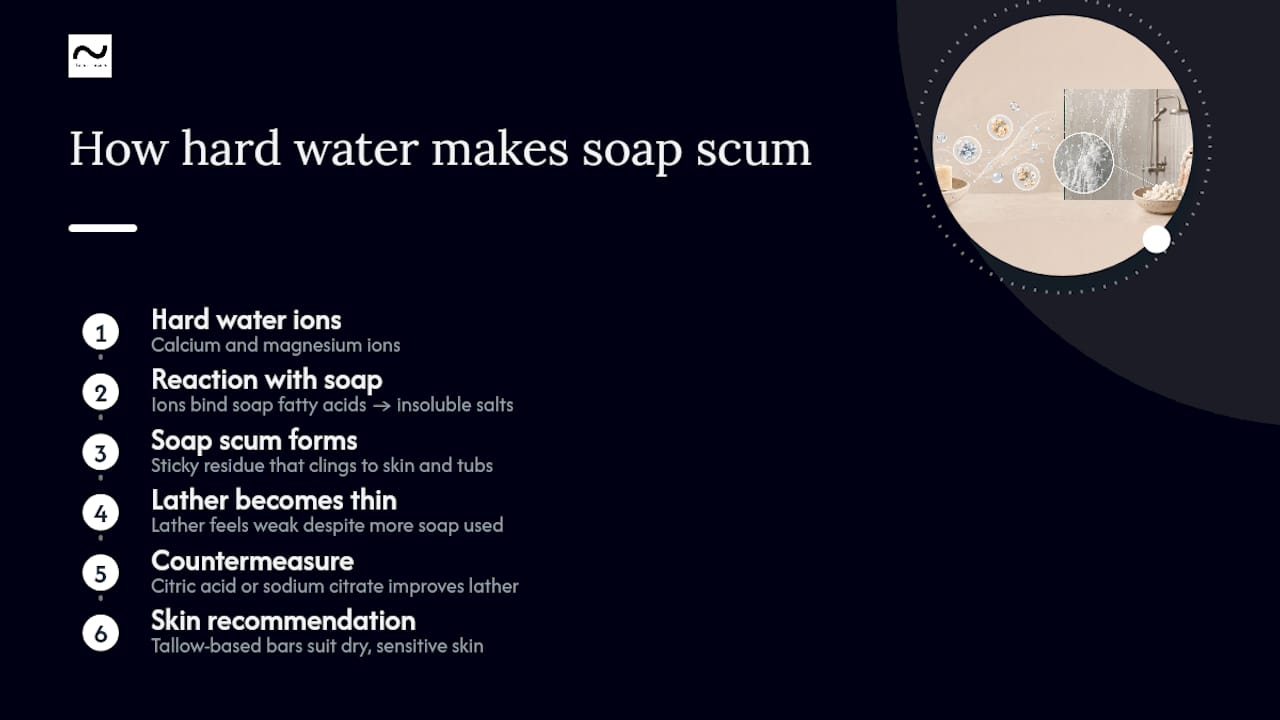
Formulators sometimes add citric acid or sodium citrate to counter this, improving solubility and lather even in mineral-heavy water. If you’re in a hard-water area, rinse a little longer than feels necessary and consider a bar with these additions rather than assuming all natural soap lathers poorly.
For skin type, richer tallow-based bars tend to suit dry, sensitive, or eczema-prone skin better than stripped, high-lather formulas, which can leave a tight, dry feeling behind.
Fierce Nature was built on one frustration: mainstream cosmetics that promise glowing skin while quietly loading it with irritants. Growing up battling unexplained rashes with no real answers led to a deeper look at what actually nourishes skin rather than just coating it, and organic tallow kept coming back as the answer.
Tallow’s bioavailability makes it a deep-penetrating skin food. It has been used for centuries in soap making and as a skin emollient, precisely because it works with the skin rather than sitting on top of it.
Every Fierce Nature bar is handmade in the UK, palm-oil free, and free from SLS and synthetic fillers, with ingredient lists published in full so you’re never guessing. Packaging stays plastic-free wherever possible, in line with everything covered above. You can read more on the environmental benefits of tallow-based products and how that sourcing decision shapes the whole range.
Before buying, run through a short checklist:
Does the brand publish a full ingredient list, not just marketing copy?
Is the packaging genuinely plastic-free, and does it say where it can be composted or recycled?
Can you trace where the soap is made and who makes it?
What’s the price per use, not just the shelf price?
Are sensitivity claims backed by an actual ingredient breakdown?
A typical natural soap bar lasts several weeks of regular use and, with proper care, tends to be more cost-effective per wash than bottled body wash when considering water content and packaging. Fierce Nature’s natural soap bars are built to meet every point on that checklist without you having to take it on faith.
I started Fierce Nature because I was tired of soap that promised glowing skin and delivered rashes. Every bar we make is handmade in the UK, sourced honestly, and wrapped without needless plastic. If you’re new to tallow soap, start small. Try one bar before you commit to a bundle.
— Fierce Nature
Fierce Nature is the practical route to genuinely plastic-free, skin-nourishing soap, not a brand chasing a trend. The Multi-Use Tallow Bar (Unscented) suits sensitive skin and daily face-and-body use, while the Multi-Use Tallow Bar (Scented) offers the same nourishment with a gentle fragrance for those who want it. Families can turn to the Non-toxic Baby Skin Essentials and Baby Balm for gentler formulations, and anyone wanting a fuller routine can pair a bar with the Nourish Balm (Unscented) or the Luxe Balm for face-specific care. For a broader introduction to tallow-based skincare, the Biohacking bundle brings several products together at once.
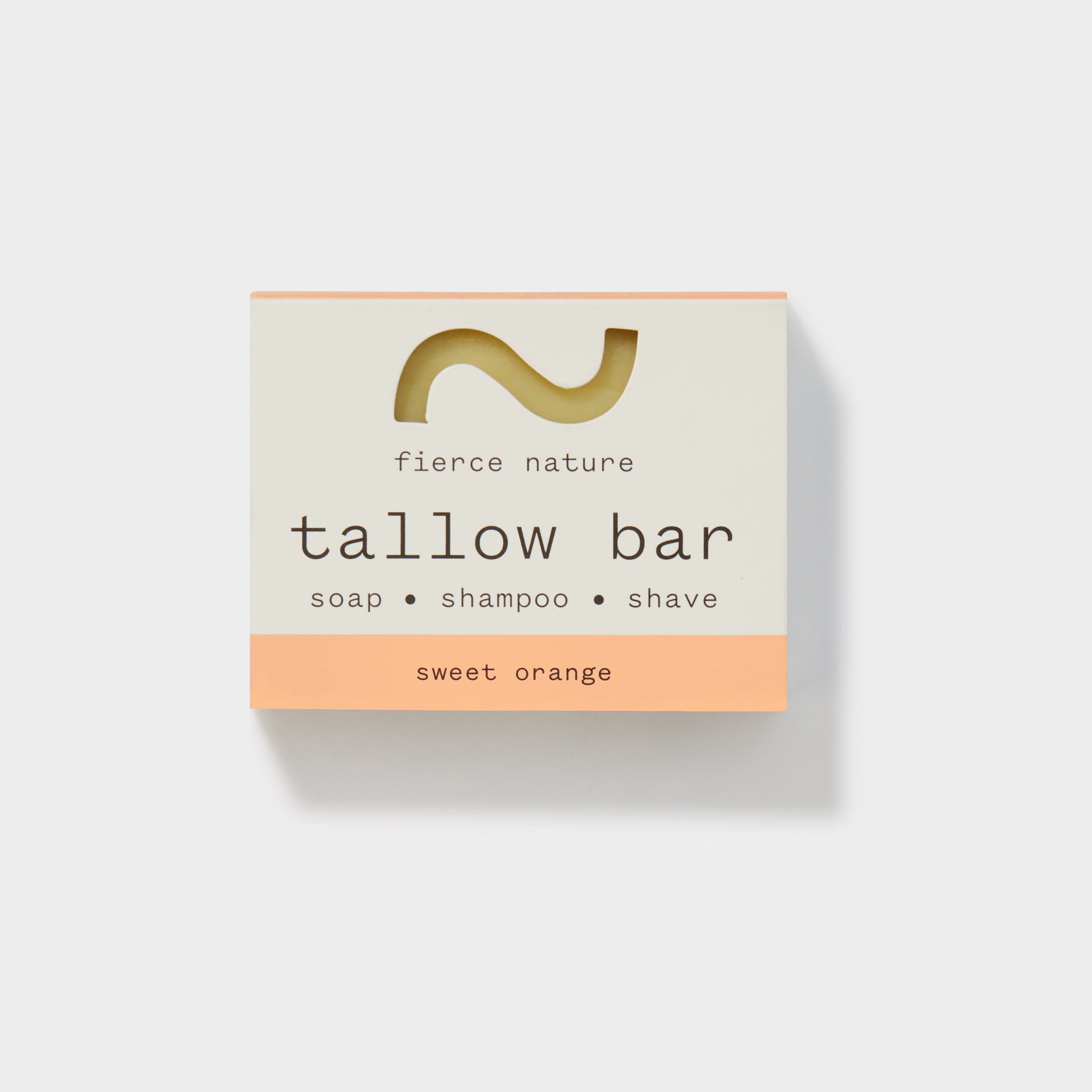
Every product ships in plastic-free packaging with a full ingredient list published on the page, so there’s no guesswork about what you’re putting on your skin or throwing away afterwards. Visit the Fierce Nature shop to browse the full range and find the bar that fits your routine, or head straight to the Multi-Use Tallow Bar if you’re ready to make the switch.
It means a solid soap bar sold with minimal or no plastic packaging, using compostable, recyclable, or reusable materials, alongside transparent, minimally processed ingredients.
The most environmentally friendly bars combine plastic-free packaging with palm-oil-free, sustainably sourced ingredients such as tallow or organic plant oils, and are made close to where they’re sold to reduce transport waste. Fierce Nature’s tallow bars are built around exactly this combination.
There’s no publicly verified answer to this, since royal households don’t routinely disclose personal toiletry choices, and any claims circulating online tend to be unsubstantiated marketing rather than confirmed fact.
Used soap slivers can be pressed together to form a new bar, composted if they’re free from synthetic additives, or donated whole to shelters and charities that accept toiletries.
It can, though hard water reduces lather because calcium and magnesium react with soap to form scum. Formulations with citric acid or sodium citrate, or simply rinsing a little longer, largely solve the problem.

If you flare up in the sun, the single most useful thing you can do is switch to a fragrance-free, SPF 50+ sun product formulated with allergy-prone skin in mind, and pair it with proper clothing and shade cover. Fierce Nature’s Sun Balm SPF 50 was built for exactly this: no fragrance, no harsh chemical load, just barrier support layered under sun protection. Specialist formulas that pair high-factor filters with antioxidant ingredients tend to calm the reaction pathway behind polymorphous light eruption (PLE), not just block the light.
TL;DR:
The most effective sun protection for allergy-prone skin includes SPF 50+ formulas that neutralize reactive oxygen species in addition to blocking UV rays.
Fragrance-free, mineral or antioxidant-enriched sunscreens, like the Sun Balm SPF 50, are recommended for those with sensitive or reactive skin to minimize irritation.
Starting sun protection early in spring, before UV index peaks, helps prevent initial PLE flares by gradually building skin tolerance.
Proper application involves generous, layered, and timely reapplication, especially after water exposure or sweating, with attention to UVA protection details.
Using barrier-supporting emollients like organic tallow alongside sunscreen enhances resilience and reduces the likelihood of inflammation during UV exposure.
Fierce Nature’s approach to sun-safe, allergy-conscious skin care
Our take: the antioxidant layer is the part most guides skip
Where to buy sun-safe skin care built for allergy-prone skin
You don’t need eight different products to protect allergy-prone skin properly. You need the right few, chosen for what your skin is actually doing that day. Here’s how Fierce Nature’s range breaks down for sun allergy sufferers looking for a genuinely non-irritating sunscreen UK routine.
Non-toxic Baby Skin Essentials — best for babies and parents who want ultra-gentle, fragrance-free protection alongside general skin care. Infant skin has a thinner barrier and reacts faster to synthetic additives, so this bundle sticks to minimal, recognisable ingredients throughout. Shop the bundle.
Sun Balm SPF 50 — the core recommendation for anyone managing PLE or general photosensitivity. It’s built around organic tallow rather than a synthetic emulsion base, which changes how the product sits on reactive skin.
Selfie Stick Dew and Selfie Stick Natural — best for face and everyday wear, where you want a balm texture that doubles as a cosmetic finish rather than an obvious sunscreen layer. Selfie Stick Natural is the unscented option for those who react to fragrance specifically.
Multi-Use Tallow Bar (Unscented) — best for body use when you need fragrance-free emollient support underneath or alongside sun protection, particularly on areas prone to dryness or eczema-type patches. See the unscented bar.
Multi-Use Tallow Bar (Scented) — the same formulation with a gentle scent added, suited to those without a fragrance sensitivity who still want the barrier benefits.
Luxe Balm and Selfie Stick Pearl Shimmer — daily face care options where nourishment and light coverage matter more than heavy SPF, ideal for the mornings you’re indoors most of the day but still want barrier support.
Pro Tip: Keep one fragrance-free product on hand even during a flare-free spell. Reintroducing a scented formula only when your skin is already irritated makes it much harder to tell which ingredient caused the reaction.
PLE is the most common sun allergy in the UK, and it isn’t really an allergy in the strict sense. It’s an inflammatory reaction that shows up as an itchy, bumpy rash, usually on the chest, arms, or lower legs, typically within hours of the first strong sun exposure of the year. Fair-skinned adults, particularly women in their twenties and thirties, are most often affected, and the pattern tends to ease as the season goes on because skin partially “hardens” with repeated exposure.
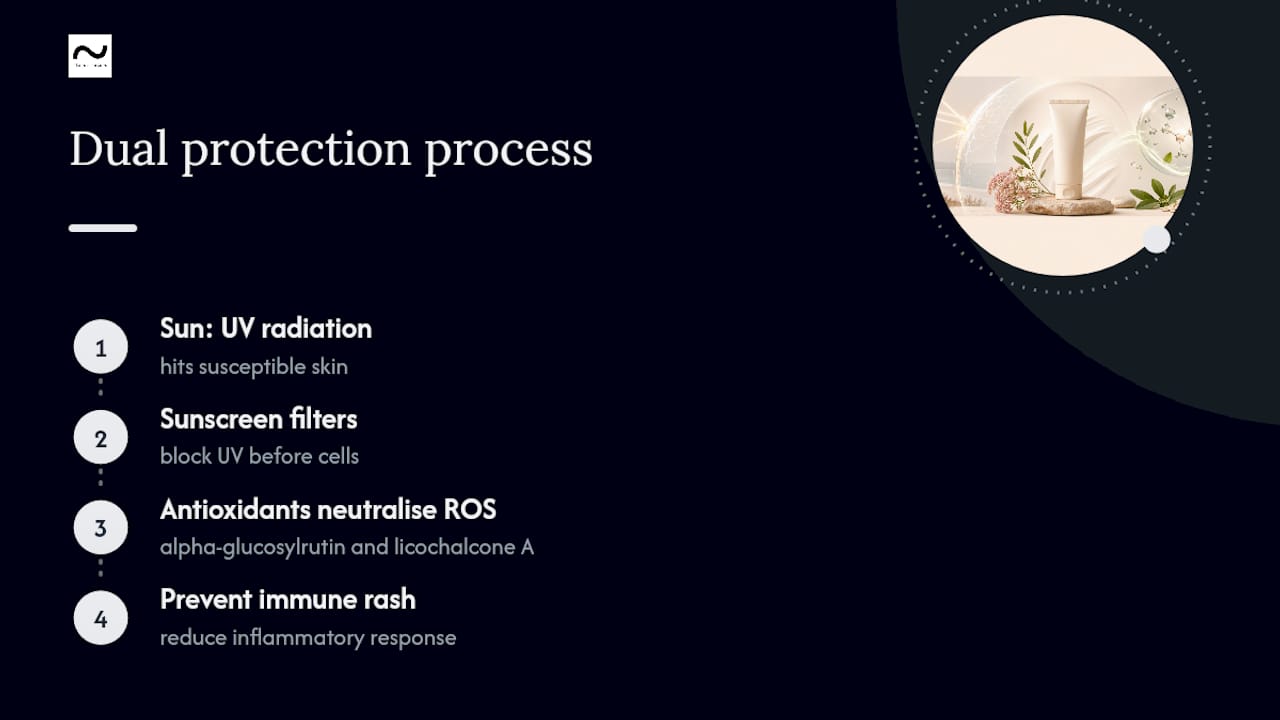
The mechanism matters for choosing a product. UV radiation striking susceptible skin generates reactive oxygen species, and in people prone to PLE, this oxidative cascade triggers an immune response that shows up as the rash. That’s why dermatologists increasingly point toward sunscreens that do two jobs at once: block the UV filters before they hit skin cells, and neutralise the reactive oxygen species that get through anyway. Formulas built around alpha-glucosylrutin and licochalcone A were developed specifically for this dual approach, and it’s a meaningfully different strategy from a standard high-street sunscreen that only addresses the filter side.
Barrier support plays a role too. Skin that’s already dry or compromised reacts more readily to UV stress, so a base rich in emollients, such as organic tallow, isn’t just a nice extra. It’s part of why some allergy-prone users find balm-based formulas more tolerable than thin chemical lotions, which can sting on skin that’s already reactive.
Not every “sensitive skin” label means much. Here’s what actually separates a sunscreen worth trusting from one that just says the right things on the front of the bottle.
SPF 50+ with strong UVA protection. Look for a UVA star rating or a high UVA-PF figure on the packaging. UVB causes burning, but UVA drives much of the deeper skin stress linked to PLE flares.
Fragrance-free, not just “unscented.” Fragrance is one of the most common triggers in reactive sunscreens, and it’s often disguised inside a botanical blend rather than listed plainly.
Dermatologically tested for sensitive skin, ideally with a named certification such as AllergyCertified, which some UK products like Riemann P20’s sensitive-skin range carry. Certification lowers the odds of a reaction; it doesn’t eliminate them, so still check the ingredient list yourself.
Antioxidant ingredients where relevant. Vitamin E, licochalcone A, and alpha-glucosylrutin all support the skin’s own defence against UV-triggered oxidative stress, which is the mechanism behind many PLE flares.
Mineral filters when chemical filters cause stinging or breakouts. A 100% mineral formula sits on the skin’s surface rather than being absorbed, which many people with chemical sensitivities tolerate better, though it can leave more of a white cast.
Avoid perfumed products and long, unfamiliar ingredient lists. A formula with a dozen botanical extracts might sound wholesome, but each one responds a fresh chance for a reaction if you don’t already know how your skin responds to it.
Pro Tip: If a product doesn’t list its UVA-PF or star rating clearly, that’s usually a sign it wasn’t formulated with photosensitive skin in mind. Move on.
Getting the product right only helps if the application is right too.
Apply generously, and apply first. For the face, roughly a five-pence-sized amount; for the body, more than most people use. Apply 15 to 20 minutes before you go outside so the formula has time to settle.
Layer in the right order. Sunscreen goes on after your moisturiser and before makeup or a balm-based tint. Give each layer a minute to absorb rather than rubbing them together.
Reapply every two hours, and immediately after swimming, sweating heavily, or towel-drying, regardless of how “water-resistant” the label claims.
Start early in the season. PLE flares are worst at the first strong UV exposure of spring, so begin daily protection in March or April rather than waiting for a heatwave. Checking the UK Met Office UV index is a genuinely useful habit here, since UV can be high on a cool, overcast day.
Don’t ignore indoor and travel exposure. UVA passes through car and office windows, so anyone photosensitive should apply on long drives or near south-facing windows, not just on beach days.
For babies, use a fragrance-free formula sparingly on exposed skin only, and rely on shade, hats, and clothing as the primary defence, since infant skin tolerates far less product overall.
Most PLE flares settle with better protection and a bit of patience, but some signs mean it’s time to get checked rather than push through it.
See a GP or dermatologist if you notice a severe or blistering rash, any systemic symptoms such as fever or fatigue alongside the skin reaction, or flares that keep happening despite using a high-SPF, fragrance-free product correctly. A clinician will usually ask about your photosensitivity history and may arrange phototesting to confirm PLE against other conditions. Treatment options range from topical steroids for a bad flare to supervised phototherapy that builds tolerance before summer, and occasionally prescription-strength sunscreens or oral adjuncts.
Before the appointment, it helps to have a rough record: when flares happened, what product you were using, and photos of the rash at its worst. It saves time and gives the clinician something concrete to work from.
Fierce Nature’s founder grew up battling unexplained skin rashes and reactions through her teenage years, long before understanding that the mainstream cosmetics and shaving products around her were part of the problem. That experience shaped a simple rule for every product since: if an ingredient can’t be explained plainly, it doesn’t belong in the formula.
Everything is handmade in the UK, built around pure organic tallow rather than synthetic emulsifiers or fillers. Tallow’s bioavailability lets it penetrate the skin’s surface more readily than many conventional bases, which is part of why fragrance-free tallow formulas tend to sit more comfortably on already-reactive skin.
Fragrance-free formulations reduce one of the most common irritant exposures in daily skin care, a principle covered in more depth in Fierce Nature’s guide to fragrance-free balms.
Barrier-supporting bases matter as much as the SPF filter itself, since compromised skin reacts more readily to UV stress in the first place.
Full ingredient transparency is available on every product page, so allergy-prone shoppers can check exactly what they’re applying rather than trusting a marketing claim.
Readers wanting the fuller picture on natural filters and how they behave in UK conditions can read Fierce Nature’s guide to natural sunscreens.
PLE gets most of the attention, but it isn’t the only sun-related reaction UK residents deal with. Photoallergic contact dermatitis happens when a substance on the skin, often a fragrance, an ingredient in sunscreen itself, or even certain medications, reacts with UV light to cause a rash. This is particularly relevant if you’ve reacted to a sunscreen before: the product itself may have been the trigger, not the sun exposure alone.
Solar urticaria is rarer but more dramatic, producing hives within minutes of sun exposure rather than hours. It needs a different management approach, often involving very gradual light exposure under clinical supervision rather than just better sunscreen.
Actinic prurigo is a chronic, more persistent condition that can appear on skin not directly exposed to sun and tends to run in families, more commonly seen in people with darker skin tones. Chronic actinic dermatitis, meanwhile, usually appears later in life and can eventually cause reactions even to very low light levels, including some artificial indoor lighting.
The overlap between these conditions and standard PLE means self-diagnosis has real limits. If your rash pattern, timing, or triggers don’t match the classic PLE description of an itchy rash appearing hours after the season’s first strong sun exposure, it’s worth getting a clinical opinion rather than assuming one sunscreen swap will fix it.
British summers lull people into a false sense of security. UV index can be moderate to high on a grey, overcast day in May, precisely the point in the year when unhardened skin is most likely to flare. Cloud cover blocks visible light, not UV radiation, which is exactly the gap that catches PLE sufferers out every spring.
UV intensity in the UK climbs steadily from March, peaks through June and July, and drops off through September, but the risk period for a first flare is really the shoulder season, not the height of summer. Skin that’s had zero UV exposure over winter reacts far more strongly to spring sun than the same skin will in August, once some tolerance has built up.
This seasonal pattern is why starting sun protection in early spring, rather than waiting for the first genuinely hot day, makes such a difference to flare frequency. Checking the daily UV index through the Met Office, rather than judging by temperature or cloud cover, is a more reliable habit than most people realise. A cool, breezy day at 16°C can carry a higher UV index than a muggy 22°C day with thicker cloud.
UK sunscreen products follow the Cosmetic Products Enforcement Regulations, which set out safety and labelling requirements including accurate SPF and UVA claims. SPF measures protection against UVB, the rays responsible for burning, while the UVA seal (a circled “UVA” logo) confirms the product provides at least a third of its SPF value in UVA protection, in line with the EU Cosmetics Directive recommendation that UK products still broadly follow.
Products are also tested and labelled for water resistance claims, and any claim of “very high protection” legally corresponds to SPF 50 or above. Reading past the front-of-pack marketing to the actual SPF number and UVA logo is the most reliable way to judge a product, rather than trusting words like “advanced” or “clinical” on their own.
Look, too, for whether a product discloses its full ingredient list in International Nomenclature of Cosmetic Ingredients (INCI) format, which UK regulation requires. This is where fragrance often hides under terms like “parfum,” so scanning the full list rather than the marketing panel is worth the extra thirty seconds, especially for anyone managing sun allergy skin care alongside a known fragrance sensitivity.
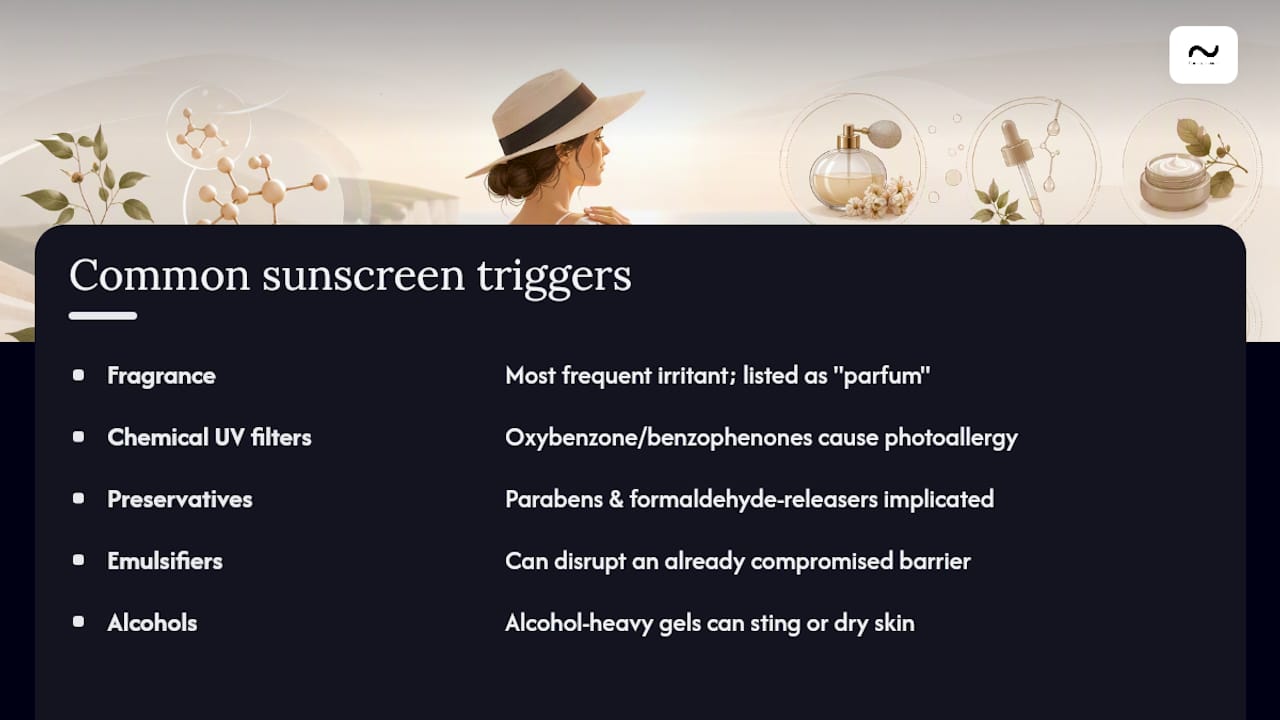
Fragrance is, by a wide margin, the most frequent irritant in sunscreens, often added purely to mask the natural smell of chemical filters. It can appear as “parfum,” “fragrance,” or hidden inside a botanical extract blend, so a product doesn’t need to smell strong to contain it.
Certain chemical UV filters, including oxybenzone and some benzophenone derivatives, are known to trigger photoallergic reactions in a subset of users, meaning the sunscreen itself becomes the allergen rather than the sun. This is one reason mineral filters such as zinc oxide and titanium dioxide are often better tolerated by people who react to standard chemical-filter sunscreens.
Preservatives, particularly certain parabens and formaldehyde-releasing agents, are another common culprit, alongside emulsifiers that can disrupt an already compromised skin barrier. Alcohol-heavy formulas, common in some gel-based sunscreens marketed for oily skin, can also sting or dry out skin that’s already reactive from a PLE flare.
The practical fix is consistent rather than complicated: fewer ingredients, mineral filters where chemical sensitivity is suspected, and a patch test on the inner arm 48 hours before applying any new product to your face or a large area of skin.
Most sun allergy advice in the UK still stops at “use high SPF and stay out of the sun,” which is true but incomplete. The research on PLE points to something more specific: the reaction is driven by oxidative stress once UV gets past the filter, which means the filter alone was never going to be the whole answer.
That’s the gap specialist antioxidant-paired formulas were built to close, and it’s also why a rich, barrier-supporting base matters more than most sensitive-skin marketing admits. A sunscreen that irritates the skin it’s meant to protect is working against its own purpose. We’d argue the ingredient list deserves as much scrutiny as the SPF number on the front of the bottle, particularly the fragrance line that so many “gentle” products still quietly include.
Prioritise, in this order: a fragrance-free formula, genuine UVA strength, and a base your skin already tolerates well. Everything else, including texture and finish, is secondary to those three.
— Fierce Nature
You don’t need to hunt across five different brands to build a sun-safe routine that won’t fight your skin. Fierce Nature’s Sun Balm SPF 50 is fragrance-free, made in the UK, and built on organic tallow rather than a synthetic base, which is precisely the combination this guide has pointed to throughout. Pair it with the Non-toxic Baby Skin Essentials bundle for little ones, or the Multi-Use Tallow Bar (Unscented) for extra barrier support on dry, reactive patches elsewhere on the body. Every product ships within the UK with full ingredient transparency listed on the product page itself.
Always patch-test a new product on the inner arm before applying it more widely, and if reactions persist despite correct use, that’s your cue to speak with a GP rather than switch products again. Ready to build your routine? Start with the Sun Balm SPF 50 product page and add what your skin needs from there.
This article is general information, not a substitute for advice from a qualified doctor. Consult a qualified healthcare professional about your own circumstances before acting on anything here.
A fragrance-free, SPF 50+ formula with strong UVA protection tends to work best, ideally one that also includes antioxidant ingredients such as vitamin E to address the oxidative stress behind PLE flares. Fierce Nature’s Sun Balm SPF 50 follows this exact profile using a tallow-based, non-toxic formulation.
Look for products combining high UVA protection with antioxidant ingredients like alpha-glucosylrutin, licochalcone A, or vitamin E, since these target the reactive oxygen species that trigger PLE rashes. Fragrance-free, mineral-leaning formulas are generally best tolerated during an active flare.
A mineral or fragrance-free formula with a dermatological testing claim, or a recognised certification such as AllergyCertified, is the safest starting point. Always check the full ingredient list rather than relying on front-of-pack claims alone.
Most people notice symptoms within a few hours of the first strong sun exposure of the season, typically as an itchy, bumpy rash on the chest, arms, or lower legs. It tends to ease as the summer progresses and skin builds some tolerance.
Sunscreen reduces the risk significantly but doesn’t guarantee prevention for everyone, particularly early in the season. Combining a high-SPF, fragrance-free product with protective clothing, shade, and early spring use gives the most reliable protection against PLE.

In practice, a sunscreen labelled “reef safe” usually means it leaves out oxybenzone and octinoxate, the two chemical filters most heavily linked to coral bleaching and larval damage. No government or standards body regulates the term, though, so the words on the front of a bottle guarantee nothing on their own. The safest move is to skip the marketing claim entirely and check the ingredients list for non-nano zinc oxide or titanium dioxide as the active filter, since a peer-reviewed review of sunscreen pathways and a formulator’s understanding of skin-friendly ingredients both point the same way.
TL;DR:
Most “reef safe” sunscreens exclude oxybenzone and octinoxate, but without regulation, check ingredients for non-nano zinc oxide or titanium dioxide instead.
Verification requires examining full ingredient lists for unstudied preservatives and avoiding vague claims like “natural UV blockers” that lack transparency.
Mineral sunscreens with non-nano zinc oxide are generally safer, but added stabilisers or other ingredients still require scrutiny due to limited research.
Up to 50% of sunscreen active ingredients wash off during water activities and enter wastewater systems that are not equipped to filter them out.
Behavior changes like applying sunscreen 15 minutes before swimming, avoiding sprays, and wearing protective clothing significantly reduce environmental impact.
What people mean by “reef safe” and why the term is unreliable
Which sunscreen ingredients studies link to coral and marine harm
Why mineral sunscreens are commonly recommended, and their caveats
How sunscreen chemicals reach reefs and the scale of the issue
The ecological impact and mechanisms by which harmful sunscreen ingredients damage coral reefs
Limitations of existing certifications and how to interpret them carefully
Most shoppers assume “reef safe” is a checked box, like “organic” or “cruelty-free”. It isn’t. Conservation groups and outdoor retailers generally use it to mean a formula free of oxybenzone and octinoxate, and they recommend non-nano mineral filters instead. But nothing stops a brand printing “reef safe” on a bottle that contains ten other unstudied chemicals, because there’s no enforcement body checking the claim before it hits the shelf.
That gap is exactly where greenwashing creeps in. A product can drop the two most notorious chemicals and still call itself reef friendly while including other UV filters or preservatives that have barely been studied for marine toxicity. Consumer investigations into “reef safe” marketing have found the label routinely used without standardised testing behind it, which means the burden sits with you, not the brand.
A few signals tend to separate genuine transparency from a marketing sticker:
The full ingredient list is printed on the packaging or product page, active and inactive.
Mineral actives (zinc oxide, titanium dioxide) are listed as non-nano.
The brand names any independent screening it has used, rather than just using the phrase “reef safe” unsupported.
There’s no vague catch-all like “natural UV blockers” hiding the actual filter used.
Three chemical filters turn up again and again in coral research, and they’re worth knowing by name rather than trusting a label to flag them for you.
Oxybenzone – Laboratory studies have linked oxybenzone to coral bleaching, DNA damage, and deformities in coral larvae, making it the filter most commonly named in regional bans.
Octinoxate – Frequently banned alongside oxybenzone; it’s implicated in similar disruption to coral reproduction and growth cycles.
Octocrylene – Less discussed publicly, but increasingly flagged by marine researchers alongside the other two as a filter worth avoiding until more is known about its breakdown products.
The 25 to 50% figure worth remembering: researchers estimate that between 25% and 50% of the sunscreen applied to skin washes off during swimming and other water-based recreation, with the rest reaching wastewater through showering or laundering, systems that aren’t built to filter UV-blocking compounds out.
It isn’t only the active filters that matter. Some stabilisers and preservatives added to keep a formula stable, along with certain synthetic fragrances, haven’t been studied nearly as closely as oxybenzone, yet they sit quietly in the inactive ingredients most shoppers skip straight past. Reading only the “active ingredient” box on the front of the bottle misses this entirely. The fuller list, usually on the back or on the product page, is where the real picture sits.
Zinc oxide and titanium dioxide work by sitting on the skin’s surface and physically reflecting or scattering UV rays, rather than absorbing them the way chemical filters do. That mechanical difference is a big part of why conservation groups and outdoor retailers point towards mineral formulas as the safer default for reef-adjacent swimming and snorkelling.
But “mineral” isn’t automatically a clean bill of health. A few things worth checking:
Non-nano matters. Nanoparticle versions of zinc oxide and titanium dioxide are small enough that questions remain about how marine organisms absorb them, so non-nano labelling is the more cautious choice.
Stabilisers can sneak back the risk. Some mineral sunscreens include additives such as butyloctyl salicylic acid or ethylhexyl methoxycrylene to help the formula hold its SPF rating, and both are currently under scrutiny for possible environmental effects.
Evidence is still developing. Minerals have a stronger safety signal than chemical filters, but researchers haven’t tested every mineral formulation at scale, so treat “mineral” as the safer starting point rather than a guarantee.
Pro Tip: A shorter ingredient list is often the more reef-conscious choice. A simple mineral lotion built on a handful of well-understood ingredients is generally a safer bet than a mineral formula padded with several stabilisers nobody has fully studied yet.
Sunscreen doesn’t need a swimmer standing directly over a reef to cause damage. It travels through three main routes: wash-off from skin during swimming, aerosol drift when sprays settle on sand and water nearby, and household wastewater after showering or laundering swimwear, which conventional treatment plants aren’t designed to strip out.
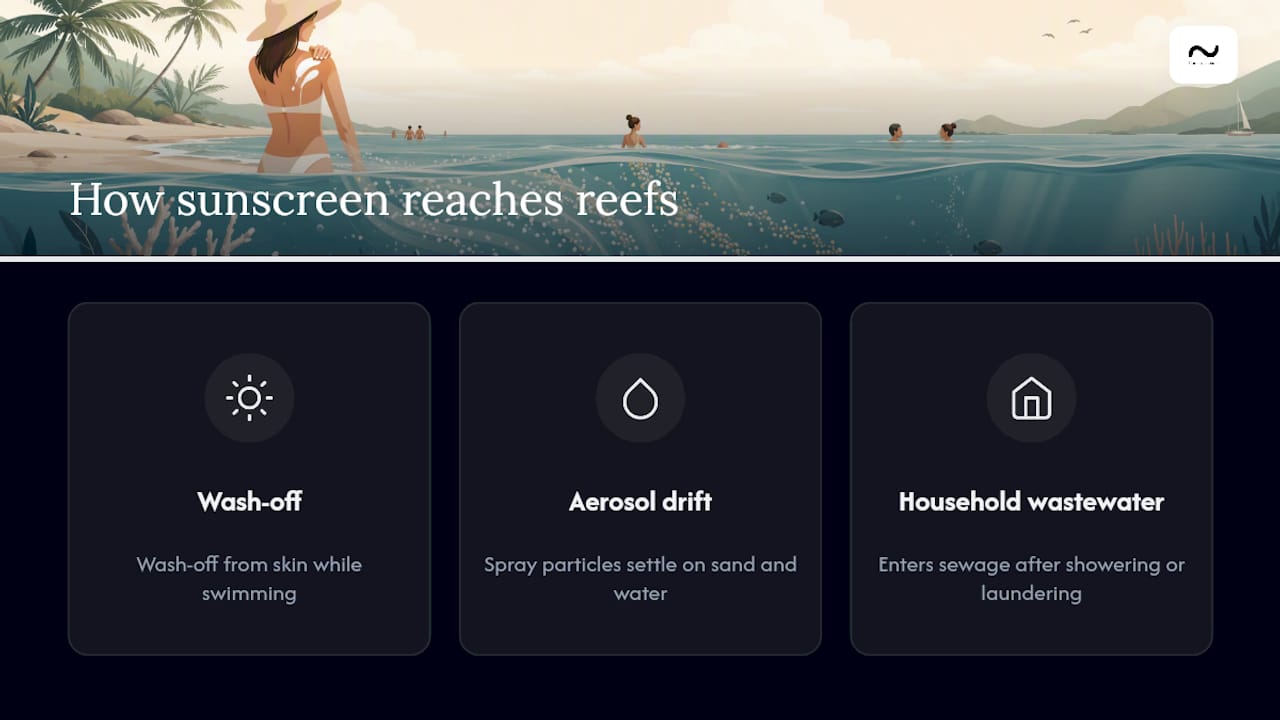
The 25% to 50% wash-off estimate mentioned earlier means popular snorkelling and diving spots effectively receive a slow, continuous dose of UV filters from every visitor in the water. Hawaii’s waters and other high-traffic dive destinations show this concentration effect clearly, which is part of why some jurisdictions have moved to restrict the worst offenders.
Sunscreen is one stressor among several. Rising sea temperatures, ocean acidification, and physical damage from anchors and careless divers all contribute to coral decline, and no single ingredient swap fixes reef health on its own. Choosing carefully still matters, because it’s one of the few reef stressors an individual can control directly.
Standing in front of a shelf of sunscreens, or scrolling a product page, it helps to have a fixed order of checks rather than relying on front-of-pack claims. Here’s the sequence we’d recommend.
Check the active ingredient first. Look for non-nano zinc oxide or non-nano titanium dioxide listed as the sole active filter. If a chemical filter is listed alongside the mineral, treat it as a chemical sunscreen with mineral marketing.
Scan the inactive ingredients. Rule out oxybenzone, octinoxate, and octocrylene immediately, then look for stabilisers such as butyloctyl salicylic acid or ethylhexyl methoxycrylene and weigh whether the brand explains why they’re there.
Pick lotion over spray. A lotion goes where you rub it; a spray drifts onto sand, towels, and water before it ever reaches your skin. Aim for SPF 30 or higher with broad-spectrum coverage, since that combination is the recognised minimum for meaningful UVA and UVB protection.
Favour full transparency and any independent screening. Brands willing to publish a complete ingredient list, and to name any third-party screening they’ve used, tend to have less to hide than ones relying purely on the words “reef safe” in bold type.
Pro Tip: If a product page doesn’t list full ingredients, that’s answer enough. Move on to one that does, even if it means paying slightly more.
Fierce Nature’s own take on how mineral and chemical formulas differ is worth a read if you want the fuller comparison, and our guide to non-toxic sun care walks through the same checklist in more depth.
What you do at the beach matters almost as much as what’s in the bottle. A few habits meaningfully cut how much sunscreen ends up in the water:
Apply at least 15 minutes before swimming, so the formula has time to bind to skin rather than sitting on the surface ready to rinse straight off.
Cover exposed skin with UPF clothing, rash vests, and wide-brimmed hats, which reduces how much sunscreen you need to apply in the first place.
Skip sprays and aerosols, and avoid heavy rubbing right before entering the water.
Rinse off away from open water where possible, and be mindful of how packaging is handled on sand or near tide lines to avoid accidental spills.
None of these swaps cost anything extra. They’re just timing and habit, and they compound with every person on the beach who does the same.
Legal action on this issue has been patchy and reactive rather than coordinated. Hawaii’s 2018 ban on the sale of sunscreens containing oxybenzone and octinoxate remains the clearest example of a jurisdiction drawing a hard legal line, and several other reef-tourism-dependent regions have since introduced similar restrictions on specific chemical filters.
What’s missing is a shared global standard. There’s no single body, in the UK or internationally, that certifies a sunscreen as “reef safe” before it reaches shelves. Environmental agencies and conservation organisations issue guidance rather than enforceable rules outside the handful of local bans already in place, which means labelling stays inconsistent from one country, and one retailer, to the next.
For UK shoppers, that inconsistency cuts both ways. You won’t find a legal requirement here forcing brands to disclose reef impact, but you also won’t find false claims policed with any real rigour. The practical upshot is the same one that runs through this whole piece: read the ingredients rather than the marketing, because no regulator is currently doing that work for you at point of sale. Where local bans do exist, they’re a genuinely useful signal, since a filter serious enough to be legislated against is one worth avoiding everywhere, not just where the law happens to apply.
Coral bleaching from sunscreen exposure works through a few connected mechanisms. Oxybenzone in particular has been shown in laboratory studies to trigger coral bleaching by disrupting the symbiotic algae that live inside coral tissue and give it both colour and much of its energy supply. When that relationship breaks down, the coral turns white and starts starving.
Beyond bleaching, researchers have documented DNA damage and physical deformities in coral larvae exposed to these filters, meaning the harm isn’t limited to adult colonies. A reef that survives one bleaching event can still suffer reduced reproductive success for years afterwards if larvae keep developing abnormally in affected waters.
The damage doesn’t stop at coral itself. Reefs support an enormous share of marine biodiversity, sheltering fish nurseries, feeding grounds, and the base of food chains that extend well beyond the reef structure. Chemical UV filters accumulating in these waters put pressure on that wider web, not just the visible coral skeleton. It’s worth remembering that concentration matters here: a single swimmer’s sunscreen is negligible, but the same product used by thousands of visitors at a popular reef site, day after day, is a different story entirely.
The consensus is firmer than the marketing noise around it suggests. Laboratory studies consistently link oxybenzone to coral bleaching and developmental damage, and conservation bodies broadly agree that non-nano mineral filters carry a better safety profile than chemical alternatives. That much isn’t seriously contested.
Where genuine debate remains is scale and specificity. Some researchers argue that lab studies use sunscreen concentrations far higher than what’s realistically found even at busy reef sites, which raises fair questions about how directly those findings translate to real-world exposure. Others counter that repeated, chronic low-level exposure over years could matter just as much as a single high dose, and that we simply don’t have long-term field data to settle it either way.
There’s also unresolved uncertainty around mineral formulations. Non-nano zinc oxide and titanium dioxide have a better track record than chemical filters, but they haven’t been studied nearly as exhaustively, and the stabilisers some brands add to keep mineral formulas stable are only now coming under scrutiny. Honest science writing on this topic acknowledges that “safer” isn’t the same as “proven harmless”, and treats mineral filters as the more cautious choice rather than a fully closed case.
Sunscreen isn’t the only tool for sun protection, and leaning on other options reduces how much product you need on your skin in the first place. UPF-rated clothing, particularly rash vests and long-sleeve swim tops, blocks UV rays without any wash-off risk at all, since fabric doesn’t rinse into the water the way lotion does.
Wide-brimmed hats and UV-blocking sunglasses cover the areas most exposed during snorkelling and beach days, cutting the surface area that actually needs sunscreen. Timing your beach time around peak UV hours, generally late morning to mid-afternoon, is a free adjustment that reduces exposure without touching your skincare routine at all.
Where sunscreen is still needed, mineral-based balms formulated with non-nano zinc oxide remain the most sensible choice for skin left exposed. Fierce Nature’s own sun balm range sits in that category, built on the same principle: fewer, better-understood ingredients doing the job rather than a long list of unknowns. None of these alternatives need to work alone. Clothing, timing, and a well-chosen mineral balm layer together, and each one lowers how much chemical exposure the water around you ends up carrying.
Independent screening labels do exist, and they’re worth more than nothing. Some organisations run ingredient screening against a list of chemicals considered harmful to marine life, and a product carrying that kind of label has at least been checked against a defined criteria set rather than just slapping “reef safe” on the front.
The catch is that no single certification has industry-wide acceptance or legal backing. A product without any label on it isn’t necessarily worse than one carrying a screening badge, and a badge doesn’t guarantee every ingredient has been tested for long-term marine impact, only that it’s been screened against a particular list at a particular point in time.
Treat any certification as one data point, not a final verdict. The more reliable approach stays the one repeated throughout this piece: read the full ingredient list yourself, favour non-nano mineral actives, and use a certification as a helpful extra check rather than a replacement for that reading. Screening schemes are still catching up to the science, and until a universal standard exists, your own scrutiny remains the most consistent filter available.
Fierce Nature exists because mainstream cosmetics failed one teenage girl with sensitive skin, and that experience shaped a simple rule: fewer ingredients, better understood, always. That’s the same logic this whole piece has been building towards, and it’s why our sun balm and everyday skincare lean on organic tallow rather than a long list of synthetic fillers.
Tallow has been used for centuries as a skin emollient precisely because it’s biologically compatible with human skin, delivering nourishment without the chemical load that mainstream formulas often carry. We’re not claiming formal reef-safety certification for every product we make, that testing landscape is still developing industry-wide, but the same ingredient-simplicity principle that guides reef-conscious shopping guides our formulation bench too. When you’re checking a label for hidden stabilisers and unpronounceable additives, you’re doing exactly what we do before anything goes into a Fierce Nature balm.
— Fierce Nature
Most reef-conscious sunscreens ask you to trust a label. Fierce Nature would rather you read the ingredients and decide for yourself, our sun balm is built on non-nano mineral protection and organic tallow, with nothing hidden in a long inactive ingredients list. If sensitive skin has made you wary of conventional sunscreen in the past, that same simplicity tends to be gentler on reactive skin too. Take a look at the Sun Balm heat wave offer and check the full ingredient breakdown against the checklist in this article. If you’re building out a wider non-toxic routine, the Biohacking bundle and Luxe Balm are worth a look too, both formulated on the same fewer-better-ingredients principle.
There’s no legal definition, but the term generally means a formula excludes oxybenzone and octinoxate and relies on non-nano zinc oxide or titanium dioxide as its active filter instead.
Regular sunscreen often uses chemical filters like oxybenzone, octinoxate, or octocrylene that absorb UV rays and have been linked to coral bleaching, while reef-conscious sunscreen relies on mineral filters that sit on the skin’s surface and reflect UV rays instead.
Any brand’s specific formula needs checking against the ingredient list at the time of purchase, since “reef safe” isn’t a regulated claim and formulations change; the safest approach is verifying the active filter is non-nano mineral rather than trusting the label alone.
The most reliable indicator is a non-nano zinc oxide or titanium dioxide active filter with no oxybenzone, octinoxate, or octocrylene in the inactive ingredients, checked directly on each product’s own ingredient list rather than assumed from marketing copy.
Non-nano zinc oxide has a stronger safety profile than chemical UV filters in current research, though it’s a comparatively safer choice rather than a fully proven one, and any added stabilisers in the formula are worth checking separately.
Plastic free skincare means a product made without synthetic polymers, microbeads or intentionally added microplastics, checked at the ingredient level rather than the packaging. If a label lists entries ending in “polymer” or “siloxane”, it isn’t plastic free, however recyclable the bottle looks. The fastest way to check is to scan the INCI list before you buy. The rest of this guide shows you exactly what to look for.
TL;DR:
- Avoid products containing ingredients ending in “polymer,” “copolymer,” “siloxane,” or with prefixes like PEG or PPG, as they are synthetic microplastic derivatives.
- Synthetic polymers persist environmentally and can cause skin irritation, making natural alternatives like tallow, cellulose, and starch microparticles better choices.
- The EU plans to restrict microplastic ingredients in rinse-off cosmetics by 2027, but many leave-on products may still contain plastic‑derived ingredients.
- “Natural” labels are unreliable without checking the ingredient list, as many products mix natural extracts with synthetic polymers or film-formers.
- Always verify transparency by reviewing full ingredient lists, asking brands for detailed INCI data, and patch testing new products before regular use.
Plastic free skincare, in the sense that matters for your skin and the environment, is about what’s inside the formula, not what it’s sold in. A jar made from recycled glass can still contain synthetic polymers. A plastic tube can (in theory) hold a completely polymer‑free balm. The two issues get muddled constantly, and it’s worth untangling them properly.
Here, “plastic free” means the formula contains no synthetic polymeric ingredients, no microbeads, and no intentionally added microplastics of any kind, whether they’re there to thicken a cream, bind a foundation, or scrub away dead skin cells. That’s an ingredient‑level definition, and it’s the one that has real consequences for your skin and for what washes down the drain.
Regulators treat this differently depending on whether a product rinses off or stays on. Rinse‑off products, such as face washes and scrubs, send their contents straight into wastewater, which is why they’ve faced the earliest restrictions. Leave‑on products, including balms, moisturisers, and skin tints, get a longer regulatory runway, even though the ingredients sit on your skin for hours. That gap between rinse‑off and leave‑on rules is exactly why label literacy matters more than trusting a category to be automatically safe.
Synthetic polymers don’t disappear once they’re washed off or worn away. They persist in soil and waterways for years, and reviews of cosmetic formulations describe them turning up in marine environments long after the product itself is gone. Some formulations use polymers in small percentages by weight, which can add up significantly across an industry using them in everything from mascara to moisturiser.
The skin health side is less discussed but just as relevant. Complex synthetic polymers can sit awkwardly on sensitive or reactive skin, and formulators increasingly favour simpler, whole‑ingredient formulas because they tend to be better tolerated. That’s a meaningful shift for anyone who has spent years blaming their own skin for reactions that were arguably down to the formula.
Regulatory shift: Commission Regulation (EU) 2023/2055 restricts the intentional addition of synthetic polymer microbeads, with phased deadlines. Many rinse‑off categories face a cut‑off of 17 October 2027, with leave‑on and make‑up categories following later.
That timeline tells you something useful: even regulators accept this problem can’t be fixed overnight, which is exactly why checking your own labels now is worth the five minutes it takes.
INCI names look intimidating, but plastic‑derived ingredients follow recognisable patterns once you know what you’re scanning for. You don’t need a chemistry degree, just a habit of pausing before you buy.
Watch for these signals on any ingredient list:
By contrast, entries like tallow, cellulose, starch, and xanthan gum are naturally derived and not part of this problem. The tricky bit is vague trade names. A brand might list a proprietary blend under a name that gives you no clue what’s inside, and trade secrecy sometimes hides small amounts of polymeric additives behind exactly that kind of label.
Pro Tip: If a label uses a trade name you can’t decode, email the brand and ask for the full INCI or a technical data sheet. A brand confident in its formula will hand it over without hesitation.
Reputable third‑party ingredient databases can help you cross‑check unfamiliar names too, but a direct answer from the brand is still the most reliable route.
Every function a synthetic polymer performs, thickening, film‑forming, exfoliating, has a natural counterpart. The formulation world has simply been slower to adopt them at scale, partly because plastics are cheap and partly because habits in an industry take time to shift.
Tallow does more heavy lifting than people expect. As a bioavailable lipid, it absorbs into skin’s own structure rather than sitting on top like a film, giving it a texturising and emollient role that many synthetic polymers were originally designed to mimic. Traditional use and modern research both point to improved hydration and barrier support from natural lipids like this, which is a large part of why tallow is often described as nature’s skin superfood.
Other natural substitutes worth knowing:
None of these are drop‑in replacements in every formula. A rheology modifier that works beautifully in a lightweight serum might behave differently in a dense balm, which is exactly why formulation experience matters as much as the ingredient list itself.
Before anything goes in your basket, run through this in under a minute:
A brand that publishes lab testing results or a clear ingredient philosophy alongside its products is giving you something to verify. One that only offers glossy claims about “purity” without backing them up is asking you to trust marketing instead of a formula.
You don’t need a twelve‑step routine to go genuinely plastic free. You need the right handful of products, chosen with the checklist above.
Morning:
Evening:
Pro Tip: If you have very reactive or eczema‑prone skin, introduce one new product at a time and wait a week before adding the next. That way, if a reaction happens, you’ll know exactly what caused it.
If irritation persists despite a clean, simple routine, that’s a sign to speak with a dermatologist rather than keep swapping products on your own.
The clearest sign that this issue has moved from niche concern to mainstream policy is Commission Regulation (EU) 2023/2055, which restricts the intentional addition of synthetic polymer microparticles, commonly called microbeads, across a wide range of consumer products including cosmetics.
The regulation doesn’t ban everything overnight. It sets a phased timeline, with many rinse‑off product categories facing restrictions from 17 October 2027, while leave‑on and make‑up categories are given longer transition periods. That staggered approach reflects a practical reality: reformulating a leave‑on cream that relies on a polymer for texture is a slower job than swapping plastic beads out of a face scrub.
UK advisory work has tracked similar concerns for years. Reports from bodies examining the marine environment have flagged microbeads as commonly used across rinse‑off products, while noting that leave‑on products can still contain plastic‑derived ingredients that receive far less scrutiny. Analytical testing for these substances is genuinely complex, which is part of why enforcement lags behind the policy intent.
For UK shoppers, this regulatory direction matters even where local rules diverge slightly from the EU’s. Understanding why UK skincare regulations differ from EU frameworks helps explain why some products marketed as “compliant” only meet the bare minimum rather than a genuinely plastic‑free standard. The direction of travel, in both jurisdictions, is toward tighter restriction, not looser.
“Plastic free” has become one of the more abused phrases in the beauty aisle, and recognising the common tricks saves you from paying a premium for very little.
The most frequent sleight of hand is conflating packaging with formula. A brand proudly stating “plastic‑free packaging” is making a true claim, just not the one you assumed you were reading. It says nothing about whether the cream inside contains a polymer thickener or a siloxane for slip. These are genuinely separate issues, and a brand that wants you to blur them is banking on you not checking the INCI.
Another tactic is the selective claim: “no microbeads” prominently displayed, while a synthetic film‑former or polymer binder sits quietly further down the ingredient list. Technically true, meaningfully misleading. Vague trade names for proprietary blends serve a similar purpose, letting a brand avoid spelling out that an ingredient is, in fact, a polymer.
Watch too for the assumption that “natural” automatically means “plastic free.” Plenty of products blend natural extracts with synthetic polymers to hit a texture or shelf‑life target, and a botanical‑sounding name on the front of the bottle guarantees nothing about what’s mixed in behind it.
The shift towards natural skincare has been genuine and industry‑wide, but demand for the label has outpaced demand for the substance in plenty of cases. Reading the actual ingredient list remains the only real safeguard.
We built Fierce Nature because mainstream cosmetics gave us rashes and reactions for years without ever explaining why. A decade spent understanding toxic load and gut health taught us that most beauty promises are built on marketing, not formulation honesty.
Every product is handmade with organic tallow as the base rather than a synthetic filler. Tallow’s biocompatibility with human skin cells is precisely why we built around it instead of reaching for the polymer shortcuts the rest of the industry defaults to.
— Fierce Nature
If you want a starting point that already matches everything covered in this guide, the Biohacking bundle brings together our tallow‑based essentials in one plastic‑free, whole‑ingredient kit rather than leaving you to piece a routine together product by product. Every formula is handmade in the UK with a short, honest ingredient list you can check against the patterns covered above.
Before you commit, run the checklist yourself: look at the INCI, confirm there’s nothing hiding behind a vague trade name, and patch test as you would with any new product on sensitive skin. We’d rather you verify it than simply trust our word for it, and the same goes for the environmental case explored in our piece on the environmental benefits of tallow‑based products. If ingredient regulation is a subject you want to go deeper on, how and why certain fragrance ingredients get restricted is a useful companion read. When you’re ready, the bundle is one click away.
No. Plastic free skincare, as used here, refers to the formula itself containing no synthetic polymers or microplastics, which is entirely separate from whether the packaging is recyclable or compostable.
Watch for suffixes like “‑polymer,” “‑copolymer,” and “‑siloxane,” along with nylon, polyethylene, polypropylene, polymethyl methacrylate, and PEG or PPG prefixes.
Yes. Tallow is a naturally derived animal lipid with no synthetic polymer content, and it’s used in Fierce Nature formulas specifically for its bioavailability and emollient properties.
Commission Regulation (EU) 2023/2055 phases in restrictions from 17 October 2027 for many rinse‑off categories, with leave‑on and make‑up products following on a later timeline.
Yes. Some formulations combine natural extracts with synthetic polymers or film‑formers, so a natural‑sounding label doesn’t guarantee an ingredient list free of plastic‑derived additives.
Zero waste soap is a solid bar sold with little or no plastic, wrapped in compostable or recyclable material instead. The best way to buy it is simple: pick bars with short, transparent ingredient lists, clear sourcing, and packaging you can actually compost or recycle at home. Fierce Nature builds every tallow bar around that exact standard, handmade in the UK.
TL;DR:
Genuine zero waste soap minimizes waste through simple, biodegradable packaging, including paper wraps, refill systems, or loose bars, that local recycling or composting can handle.
Bars made with organic oils or tallow are more effective and nourishing, especially for sensitive or dry skin, and avoid harsh chemicals like SLS and unverified palm oil.
Verify eco claims by checking if packaging is home compostable, recyclable, and not plastic-laminated, and confirm the manufacturer’s transparency about sourcing and ingredients.
Properly drying and rotating soap bars can double their lifespan, reducing environmental impact and stretching the sustainability benefits of each purchase.
In hard water areas, adding citric acid to soap formulations helps improve lather and cleanliness, especially for those with sensitive skin using richer, tallow-based formulas.
How do you verify eco-packaging claims and dispose of soap waste?
Which soap formulation works best for hard water and sensitive skin?
The phrase gets thrown around loosely, so it helps to be precise. Genuine zero waste soap minimises waste at three points: the ingredients (nothing wasted or synthetically padded), the manufacturing process, and the packaging you throw away or compost after use.
Packaging is where most brands either prove themselves or fall short; for guidance on responsible packaging choices, see these ethical purse shopping steps. Look for:
Bare bars with no wrapping at all, sold loose or in bulk bins.
Paper or card wraps that go straight into your recycling bin.
Compostable film or wrap, which breaks down at home or via council composting.
Refill systems, where you return or reuse a container rather than binning it.
Not every “eco” claim holds up. A label saying “recyclable” only counts if your local council actually accepts that material. Simpler recycling guidance from the UK government is pushing councils towards more consistent collection rules, which makes it easier to check before you buy rather than after the packaging lands in general waste.
A short ingredient list is usually a good sign. Bars built on olive oil, coconut oil, sunflower oil, or pure organic tallow tend to clean effectively without stripping the skin’s natural barrier. Tallow in particular has centuries of history as a soap base and skin emollient, prized for how easily it penetrates and nourishes rather than sitting on the surface.
Avoid bars padded with:
Sodium lauryl sulfate (SLS), a harsh foaming agent linked to irritation on sensitive skin.
Synthetic preservatives and fragrances, which often trigger reactions in people who already struggle with rashes or eczema.
Palm oil from unverified sources, tied to deforestation unless the supply chain is transparently traceable.
Ethical Consumer’s shopping guidance flags exactly this combination: ingredient transparency and honest palm-oil sourcing separate genuinely ethical bars from ones dressed up to look that way. Formulation also affects performance. A fragrance-free soap tends to suit facial skin better than a heavily scented body bar, and richer, tallow-based formulas generally moisturise more than a stripped-back glycerin bar, which foams differently and feels lighter on the skin.
Pro Tip: If a soap ingredient list reads like a chemistry exam, that’s usually your cue to put it back on the shelf.
Compostable and recyclable claims are only useful if you can act on them. Look for wording that specifies home compostable versus industrial compostable (the latter needs a council or commercial facility, not your garden heap), and check whether wraps are plastic-laminated, which quietly defeats the purpose.
Practical end-of-life steps:
Compost paper wraps and genuinely compostable films at home or via council collection.
Recycle card boxes and check your council’s current list before assuming a material qualifies.
Reuse tins, pouches, or boxes as travel containers rather than binning them.
Some makers even wrap bars in plantable seed paper, so the packaging becomes a small patch of wildflowers instead of landfill.
The UK’s plastic packaging tax gives smaller manufacturers a direct financial reason to favour paper, card, and refill systems over lightweight plastic, which is part of why so many independent soap makers have shifted away from shrink wrap in recent years.
A bar left sitting in a puddle of water dissolves fast, wasting both money and material. A few small habits change that dramatically:
Use a draining soap dish or pouch so the bar dries fully between uses instead of sitting in water.
Cut large bars in half and store one half away, dry, until needed.
Rotate two bars rather than leaving one permanently wet in the shower.
Try a soak-to-lather approach with a washcloth or muslin cloth, which uses less soap per wash than rubbing the bar directly.
If a bar turns mushy or slippery, it’s almost always excess moisture, not a fault of the soap itself. Move it somewhere drier and it usually firms back up within a day or two. These habits do more than save money. They stretch the environmental benefit of every bar you buy, since a soap that lasts twice as long effectively halves its packaging and shipping footprint per wash.
Hard water changes how soap behaves. Calcium and magnesium ions react with soap’s fatty acids to form insoluble salts, the sticky “soap scum” that clings to skin and tubs and makes lather feel thin no matter how much you use. This is basic water chemistry, not a flaw in natural soap, but it does mean some bars perform better than others depending on where you live.
Formulators sometimes add citric acid or sodium citrate to counter this, improving solubility and lather even in mineral-heavy water. If you’re in a hard-water area, rinse a little longer than feels necessary and consider a bar with these additions rather than assuming all natural soap lathers poorly.
For skin type, richer tallow-based bars tend to suit dry, sensitive, or eczema-prone skin better than stripped, high-lather formulas, which can leave a tight, dry feeling behind.
Fierce Nature was built on one frustration: mainstream cosmetics that promise glowing skin while quietly loading it with irritants. Growing up battling unexplained rashes with no real answers led to a deeper look at what actually nourishes skin rather than just coating it, and organic tallow kept coming back as the answer.
Tallow’s bioavailability makes it a deep-penetrating skin food. It has been used for centuries in soap making and as a skin emollient, precisely because it works with the skin rather than sitting on top of it.
Every Fierce Nature bar is handmade in the UK, palm-oil free, and free from SLS and synthetic fillers, with ingredient lists published in full so you’re never guessing. Packaging stays plastic-free wherever possible, in line with everything covered above. You can read more on the environmental benefits of tallow-based products and how that sourcing decision shapes the whole range.
Before buying, run through a short checklist:
Does the brand publish a full ingredient list, not just marketing copy?
Is the packaging genuinely plastic-free, and does it say where it can be composted or recycled?
Can you trace where the soap is made and who makes it?
What’s the price per use, not just the shelf price?
Are sensitivity claims backed by an actual ingredient breakdown?
A typical natural soap bar lasts several weeks of regular use and, with proper care, tends to be more cost-effective per wash than bottled body wash when considering water content and packaging. Fierce Nature’s natural soap bars are built to meet every point on that checklist without you having to take it on faith.
I started Fierce Nature because I was tired of soap that promised glowing skin and delivered rashes. Every bar we make is handmade in the UK, sourced honestly, and wrapped without needless plastic. If you’re new to tallow soap, start small. Try one bar before you commit to a bundle.
— Fierce Nature
Fierce Nature is the practical route to genuinely plastic-free, skin-nourishing soap, not a brand chasing a trend. The Multi-Use Tallow Bar (Unscented) suits sensitive skin and daily face-and-body use, while the Multi-Use Tallow Bar (Scented) offers the same nourishment with a gentle fragrance for those who want it. Families can turn to the Non-toxic Baby Skin Essentials and Baby Balm for gentler formulations, and anyone wanting a fuller routine can pair a bar with the Nourish Balm (Unscented) or the Luxe Balm for face-specific care. For a broader introduction to tallow-based skincare, the Biohacking bundle brings several products together at once.
Every product ships in plastic-free packaging with a full ingredient list published on the page, so there’s no guesswork about what you’re putting on your skin or throwing away afterwards. Visit the Fierce Nature shop to browse the full range and find the bar that fits your routine, or head straight to the Multi-Use Tallow Bar if you’re ready to make the switch.
It means a solid soap bar sold with minimal or no plastic packaging, using compostable, recyclable, or reusable materials, alongside transparent, minimally processed ingredients.
The most environmentally friendly bars combine plastic-free packaging with palm-oil-free, sustainably sourced ingredients such as tallow or organic plant oils, and are made close to where they’re sold to reduce transport waste. Fierce Nature’s tallow bars are built around exactly this combination.
There’s no publicly verified answer to this, since royal households don’t routinely disclose personal toiletry choices, and any claims circulating online tend to be unsubstantiated marketing rather than confirmed fact.
Used soap slivers can be pressed together to form a new bar, composted if they’re free from synthetic additives, or donated whole to shelters and charities that accept toiletries.
It can, though hard water reduces lather because calcium and magnesium react with soap to form scum. Formulations with citric acid or sodium citrate, or simply rinsing a little longer, largely solve the problem.
If you flare up in the sun, the single most useful thing you can do is switch to a fragrance-free, SPF 50+ sun product formulated with allergy-prone skin in mind, and pair it with proper clothing and shade cover. Fierce Nature’s Sun Balm SPF 50 was built for exactly this: no fragrance, no harsh chemical load, just barrier support layered under sun protection. Specialist formulas that pair high-factor filters with antioxidant ingredients tend to calm the reaction pathway behind polymorphous light eruption (PLE), not just block the light.
TL;DR:
The most effective sun protection for allergy-prone skin includes SPF 50+ formulas that neutralize reactive oxygen species in addition to blocking UV rays.
Fragrance-free, mineral or antioxidant-enriched sunscreens, like the Sun Balm SPF 50, are recommended for those with sensitive or reactive skin to minimize irritation.
Starting sun protection early in spring, before UV index peaks, helps prevent initial PLE flares by gradually building skin tolerance.
Proper application involves generous, layered, and timely reapplication, especially after water exposure or sweating, with attention to UVA protection details.
Using barrier-supporting emollients like organic tallow alongside sunscreen enhances resilience and reduces the likelihood of inflammation during UV exposure.
Fierce Nature’s approach to sun-safe, allergy-conscious skin care
Our take: the antioxidant layer is the part most guides skip
Where to buy sun-safe skin care built for allergy-prone skin
You don’t need eight different products to protect allergy-prone skin properly. You need the right few, chosen for what your skin is actually doing that day. Here’s how Fierce Nature’s range breaks down for sun allergy sufferers looking for a genuinely non-irritating sunscreen UK routine.
Non-toxic Baby Skin Essentials — best for babies and parents who want ultra-gentle, fragrance-free protection alongside general skin care. Infant skin has a thinner barrier and reacts faster to synthetic additives, so this bundle sticks to minimal, recognisable ingredients throughout. Shop the bundle.
Sun Balm SPF 50 — the core recommendation for anyone managing PLE or general photosensitivity. It’s built around organic tallow rather than a synthetic emulsion base, which changes how the product sits on reactive skin.
Selfie Stick Dew and Selfie Stick Natural — best for face and everyday wear, where you want a balm texture that doubles as a cosmetic finish rather than an obvious sunscreen layer. Selfie Stick Natural is the unscented option for those who react to fragrance specifically.
Multi-Use Tallow Bar (Unscented) — best for body use when you need fragrance-free emollient support underneath or alongside sun protection, particularly on areas prone to dryness or eczema-type patches. See the unscented bar.
Multi-Use Tallow Bar (Scented) — the same formulation with a gentle scent added, suited to those without a fragrance sensitivity who still want the barrier benefits.
Luxe Balm and Selfie Stick Pearl Shimmer — daily face care options where nourishment and light coverage matter more than heavy SPF, ideal for the mornings you’re indoors most of the day but still want barrier support.
Pro Tip: Keep one fragrance-free product on hand even during a flare-free spell. Reintroducing a scented formula only when your skin is already irritated makes it much harder to tell which ingredient caused the reaction.
PLE is the most common sun allergy in the UK, and it isn’t really an allergy in the strict sense. It’s an inflammatory reaction that shows up as an itchy, bumpy rash, usually on the chest, arms, or lower legs, typically within hours of the first strong sun exposure of the year. Fair-skinned adults, particularly women in their twenties and thirties, are most often affected, and the pattern tends to ease as the season goes on because skin partially “hardens” with repeated exposure.
The mechanism matters for choosing a product. UV radiation striking susceptible skin generates reactive oxygen species, and in people prone to PLE, this oxidative cascade triggers an immune response that shows up as the rash. That’s why dermatologists increasingly point toward sunscreens that do two jobs at once: block the UV filters before they hit skin cells, and neutralise the reactive oxygen species that get through anyway. Formulas built around alpha-glucosylrutin and licochalcone A were developed specifically for this dual approach, and it’s a meaningfully different strategy from a standard high-street sunscreen that only addresses the filter side.
Barrier support plays a role too. Skin that’s already dry or compromised reacts more readily to UV stress, so a base rich in emollients, such as organic tallow, isn’t just a nice extra. It’s part of why some allergy-prone users find balm-based formulas more tolerable than thin chemical lotions, which can sting on skin that’s already reactive.
Not every “sensitive skin” label means much. Here’s what actually separates a sunscreen worth trusting from one that just says the right things on the front of the bottle.
SPF 50+ with strong UVA protection. Look for a UVA star rating or a high UVA-PF figure on the packaging. UVB causes burning, but UVA drives much of the deeper skin stress linked to PLE flares.
Fragrance-free, not just “unscented.” Fragrance is one of the most common triggers in reactive sunscreens, and it’s often disguised inside a botanical blend rather than listed plainly.
Dermatologically tested for sensitive skin, ideally with a named certification such as AllergyCertified, which some UK products like Riemann P20’s sensitive-skin range carry. Certification lowers the odds of a reaction; it doesn’t eliminate them, so still check the ingredient list yourself.
Antioxidant ingredients where relevant. Vitamin E, licochalcone A, and alpha-glucosylrutin all support the skin’s own defence against UV-triggered oxidative stress, which is the mechanism behind many PLE flares.
Mineral filters when chemical filters cause stinging or breakouts. A 100% mineral formula sits on the skin’s surface rather than being absorbed, which many people with chemical sensitivities tolerate better, though it can leave more of a white cast.
Avoid perfumed products and long, unfamiliar ingredient lists. A formula with a dozen botanical extracts might sound wholesome, but each one responds a fresh chance for a reaction if you don’t already know how your skin responds to it.
Pro Tip: If a product doesn’t list its UVA-PF or star rating clearly, that’s usually a sign it wasn’t formulated with photosensitive skin in mind. Move on.
Getting the product right only helps if the application is right too.
Apply generously, and apply first. For the face, roughly a five-pence-sized amount; for the body, more than most people use. Apply 15 to 20 minutes before you go outside so the formula has time to settle.
Layer in the right order. Sunscreen goes on after your moisturiser and before makeup or a balm-based tint. Give each layer a minute to absorb rather than rubbing them together.
Reapply every two hours, and immediately after swimming, sweating heavily, or towel-drying, regardless of how “water-resistant” the label claims.
Start early in the season. PLE flares are worst at the first strong UV exposure of spring, so begin daily protection in March or April rather than waiting for a heatwave. Checking the UK Met Office UV index is a genuinely useful habit here, since UV can be high on a cool, overcast day.
Don’t ignore indoor and travel exposure. UVA passes through car and office windows, so anyone photosensitive should apply on long drives or near south-facing windows, not just on beach days.
For babies, use a fragrance-free formula sparingly on exposed skin only, and rely on shade, hats, and clothing as the primary defence, since infant skin tolerates far less product overall.
Most PLE flares settle with better protection and a bit of patience, but some signs mean it’s time to get checked rather than push through it.
See a GP or dermatologist if you notice a severe or blistering rash, any systemic symptoms such as fever or fatigue alongside the skin reaction, or flares that keep happening despite using a high-SPF, fragrance-free product correctly. A clinician will usually ask about your photosensitivity history and may arrange phototesting to confirm PLE against other conditions. Treatment options range from topical steroids for a bad flare to supervised phototherapy that builds tolerance before summer, and occasionally prescription-strength sunscreens or oral adjuncts.
Before the appointment, it helps to have a rough record: when flares happened, what product you were using, and photos of the rash at its worst. It saves time and gives the clinician something concrete to work from.
Fierce Nature’s founder grew up battling unexplained skin rashes and reactions through her teenage years, long before understanding that the mainstream cosmetics and shaving products around her were part of the problem. That experience shaped a simple rule for every product since: if an ingredient can’t be explained plainly, it doesn’t belong in the formula.
Everything is handmade in the UK, built around pure organic tallow rather than synthetic emulsifiers or fillers. Tallow’s bioavailability lets it penetrate the skin’s surface more readily than many conventional bases, which is part of why fragrance-free tallow formulas tend to sit more comfortably on already-reactive skin.
Fragrance-free formulations reduce one of the most common irritant exposures in daily skin care, a principle covered in more depth in Fierce Nature’s guide to fragrance-free balms.
Barrier-supporting bases matter as much as the SPF filter itself, since compromised skin reacts more readily to UV stress in the first place.
Full ingredient transparency is available on every product page, so allergy-prone shoppers can check exactly what they’re applying rather than trusting a marketing claim.
Readers wanting the fuller picture on natural filters and how they behave in UK conditions can read Fierce Nature’s guide to natural sunscreens.
PLE gets most of the attention, but it isn’t the only sun-related reaction UK residents deal with. Photoallergic contact dermatitis happens when a substance on the skin, often a fragrance, an ingredient in sunscreen itself, or even certain medications, reacts with UV light to cause a rash. This is particularly relevant if you’ve reacted to a sunscreen before: the product itself may have been the trigger, not the sun exposure alone.
Solar urticaria is rarer but more dramatic, producing hives within minutes of sun exposure rather than hours. It needs a different management approach, often involving very gradual light exposure under clinical supervision rather than just better sunscreen.
Actinic prurigo is a chronic, more persistent condition that can appear on skin not directly exposed to sun and tends to run in families, more commonly seen in people with darker skin tones. Chronic actinic dermatitis, meanwhile, usually appears later in life and can eventually cause reactions even to very low light levels, including some artificial indoor lighting.
The overlap between these conditions and standard PLE means self-diagnosis has real limits. If your rash pattern, timing, or triggers don’t match the classic PLE description of an itchy rash appearing hours after the season’s first strong sun exposure, it’s worth getting a clinical opinion rather than assuming one sunscreen swap will fix it.
British summers lull people into a false sense of security. UV index can be moderate to high on a grey, overcast day in May, precisely the point in the year when unhardened skin is most likely to flare. Cloud cover blocks visible light, not UV radiation, which is exactly the gap that catches PLE sufferers out every spring.
UV intensity in the UK climbs steadily from March, peaks through June and July, and drops off through September, but the risk period for a first flare is really the shoulder season, not the height of summer. Skin that’s had zero UV exposure over winter reacts far more strongly to spring sun than the same skin will in August, once some tolerance has built up.
This seasonal pattern is why starting sun protection in early spring, rather than waiting for the first genuinely hot day, makes such a difference to flare frequency. Checking the daily UV index through the Met Office, rather than judging by temperature or cloud cover, is a more reliable habit than most people realise. A cool, breezy day at 16°C can carry a higher UV index than a muggy 22°C day with thicker cloud.
UK sunscreen products follow the Cosmetic Products Enforcement Regulations, which set out safety and labelling requirements including accurate SPF and UVA claims. SPF measures protection against UVB, the rays responsible for burning, while the UVA seal (a circled “UVA” logo) confirms the product provides at least a third of its SPF value in UVA protection, in line with the EU Cosmetics Directive recommendation that UK products still broadly follow.
Products are also tested and labelled for water resistance claims, and any claim of “very high protection” legally corresponds to SPF 50 or above. Reading past the front-of-pack marketing to the actual SPF number and UVA logo is the most reliable way to judge a product, rather than trusting words like “advanced” or “clinical” on their own.
Look, too, for whether a product discloses its full ingredient list in International Nomenclature of Cosmetic Ingredients (INCI) format, which UK regulation requires. This is where fragrance often hides under terms like “parfum,” so scanning the full list rather than the marketing panel is worth the extra thirty seconds, especially for anyone managing sun allergy skin care alongside a known fragrance sensitivity.
Fragrance is, by a wide margin, the most frequent irritant in sunscreens, often added purely to mask the natural smell of chemical filters. It can appear as “parfum,” “fragrance,” or hidden inside a botanical extract blend, so a product doesn’t need to smell strong to contain it.
Certain chemical UV filters, including oxybenzone and some benzophenone derivatives, are known to trigger photoallergic reactions in a subset of users, meaning the sunscreen itself becomes the allergen rather than the sun. This is one reason mineral filters such as zinc oxide and titanium dioxide are often better tolerated by people who react to standard chemical-filter sunscreens.
Preservatives, particularly certain parabens and formaldehyde-releasing agents, are another common culprit, alongside emulsifiers that can disrupt an already compromised skin barrier. Alcohol-heavy formulas, common in some gel-based sunscreens marketed for oily skin, can also sting or dry out skin that’s already reactive from a PLE flare.
The practical fix is consistent rather than complicated: fewer ingredients, mineral filters where chemical sensitivity is suspected, and a patch test on the inner arm 48 hours before applying any new product to your face or a large area of skin.
Most sun allergy advice in the UK still stops at “use high SPF and stay out of the sun,” which is true but incomplete. The research on PLE points to something more specific: the reaction is driven by oxidative stress once UV gets past the filter, which means the filter alone was never going to be the whole answer.
That’s the gap specialist antioxidant-paired formulas were built to close, and it’s also why a rich, barrier-supporting base matters more than most sensitive-skin marketing admits. A sunscreen that irritates the skin it’s meant to protect is working against its own purpose. We’d argue the ingredient list deserves as much scrutiny as the SPF number on the front of the bottle, particularly the fragrance line that so many “gentle” products still quietly include.
Prioritise, in this order: a fragrance-free formula, genuine UVA strength, and a base your skin already tolerates well. Everything else, including texture and finish, is secondary to those three.
— Fierce Nature
You don’t need to hunt across five different brands to build a sun-safe routine that won’t fight your skin. Fierce Nature’s Sun Balm SPF 50 is fragrance-free, made in the UK, and built on organic tallow rather than a synthetic base, which is precisely the combination this guide has pointed to throughout. Pair it with the Non-toxic Baby Skin Essentials bundle for little ones, or the Multi-Use Tallow Bar (Unscented) for extra barrier support on dry, reactive patches elsewhere on the body. Every product ships within the UK with full ingredient transparency listed on the product page itself.
Always patch-test a new product on the inner arm before applying it more widely, and if reactions persist despite correct use, that’s your cue to speak with a GP rather than switch products again. Ready to build your routine? Start with the Sun Balm SPF 50 product page and add what your skin needs from there.
This article is general information, not a substitute for advice from a qualified doctor. Consult a qualified healthcare professional about your own circumstances before acting on anything here.
A fragrance-free, SPF 50+ formula with strong UVA protection tends to work best, ideally one that also includes antioxidant ingredients such as vitamin E to address the oxidative stress behind PLE flares. Fierce Nature’s Sun Balm SPF 50 follows this exact profile using a tallow-based, non-toxic formulation.
Look for products combining high UVA protection with antioxidant ingredients like alpha-glucosylrutin, licochalcone A, or vitamin E, since these target the reactive oxygen species that trigger PLE rashes. Fragrance-free, mineral-leaning formulas are generally best tolerated during an active flare.
A mineral or fragrance-free formula with a dermatological testing claim, or a recognised certification such as AllergyCertified, is the safest starting point. Always check the full ingredient list rather than relying on front-of-pack claims alone.
Most people notice symptoms within a few hours of the first strong sun exposure of the season, typically as an itchy, bumpy rash on the chest, arms, or lower legs. It tends to ease as the summer progresses and skin builds some tolerance.
Sunscreen reduces the risk significantly but doesn’t guarantee prevention for everyone, particularly early in the season. Combining a high-SPF, fragrance-free product with protective clothing, shade, and early spring use gives the most reliable protection against PLE.