Cart
0
80% Also Added this





TL;DR:
- UK skincare regulations differentiate between mandatory safety requirements and voluntary organic certifications. Consumers should verify labels, Responsible Person addresses, and check government portals to ensure legal compliance. Certification logos from bodies like Soil Association or COSMOS indicate independent audits and genuine organic standards.
Skincare certifications in the UK fall into two distinct categories: mandatory legal requirements that every product must meet before sale, and voluntary third-party accreditations that go beyond the legal minimum. To decode skincare certifications UK shoppers need to understand both layers, because a product can be fully legal and still carry misleading marketing claims. The Office for Product Safety and Standards (OPSS) enforces the baseline, while bodies like the Soil Association and COSMOS set the bar for voluntary organic standards. From july 2026, new allergen thresholds and ingredient restrictions have also changed what you should expect to see on a label. Knowing the difference protects your skin and your money.

Every cosmetic product sold in the UK must have a Cosmetic Product Safety Report (CPSR) before it reaches a shelf or website. The CPSR is not a badge you see on packaging. It is a legal safety document, signed by a qualified toxicologist or pharmacist, that confirms the product is safe for its intended use.
The CPSR has two parts. Part A is a factual dossier covering ingredients, formulation, and intended use. Part B is the professional assessment, signed off by the qualified assessor, confirming the product poses no risk to human health. Without both parts completed, a product cannot legally be sold in the UK.
Alongside the CPSR, every brand must maintain a Product Information File (PIF). The PIF holds the full formulation, manufacturing method, safety data for each ingredient, and evidence of any claims made on the label. A Responsible Person (RP) is legally named on the product and accountable for keeping the PIF current and accurate.
The RP must provide a UK physical address on the label. A missing or foreign-only address is a clear red flag that the product may not meet UK compliance standards. Before a product goes on sale, it must also be notified through the government’s Submit Cosmetic Product Notification (SCPN) portal.
The UK cosmetics framework has diverged from EU rules, with new restrictions and allergen thresholds updated in mid-2026. The most significant change affects fragrance allergens. From july 2026, fragrance allergens in leave-on products must be declared on the label if present above 0.001% concentration (10 ppm). That threshold is far lower than many consumers realise, meaning ingredient lists on compliant products will now be longer and more detailed.
Mandatory label elements under UK cosmetic labelling law include:
Ingredient list in INCI (International Nomenclature of Cosmetic Ingredients) names, listed in descending order of concentration
Responsible Person name and UK physical address
Batch code for traceability
Period After Opening (PAO) symbol or best-before date
Product function if not obvious from presentation
Allergen declarations meeting the 2026 thresholds
English language for all mandatory information
Pro Tip: Check the SCPN portal directly if you want to confirm a product has been legally notified for sale in the UK. It is a free government resource and takes less than two minutes to use.
| Label element | Mandatory or voluntary? | What it tells you |
|---|---|---|
| INCI ingredient list | Mandatory | Full formulation in standardised names |
| Responsible Person address | Mandatory | Legal accountability contact |
| Batch code | Mandatory | Traceability for recalls |
| PAO or best-before date | Mandatory | Safe use period |
| Soil Association logo | Voluntary | Independently audited organic standard |
| COSMOS certification mark | Voluntary | European organic and natural standard |
| “Dermatologist tested” | Voluntary (unregulated) | Marketing claim, no standard definition |
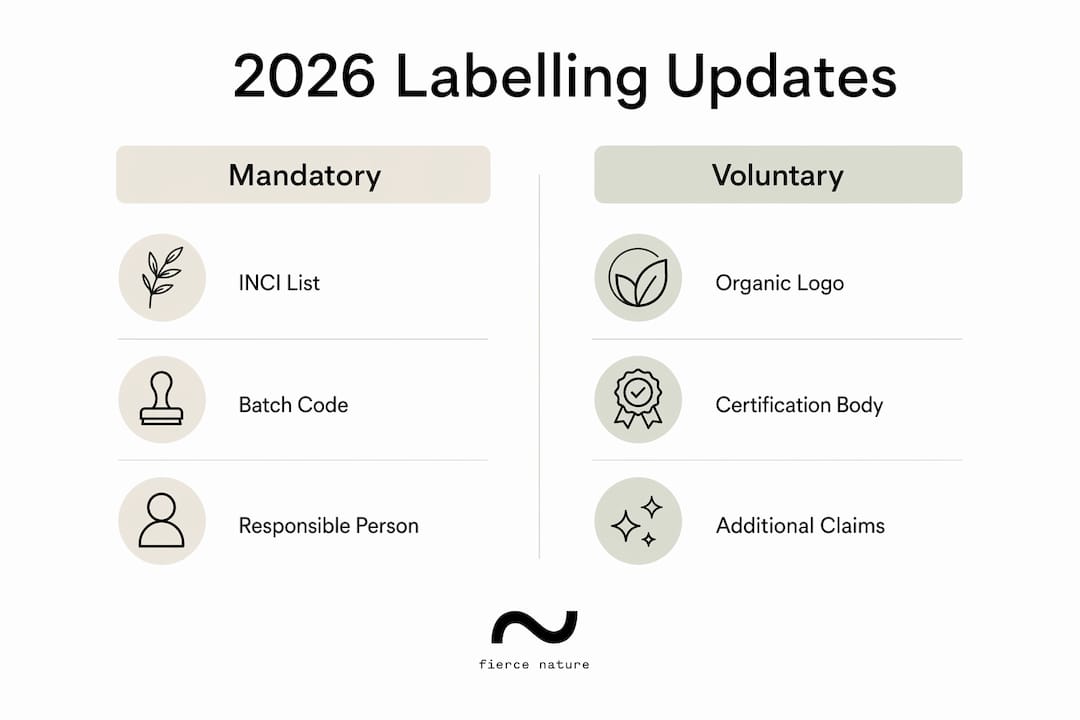
Meeting the legal minimum means a product is safe to sell. It does not mean the ingredients are natural, organic, or ethically sourced. Voluntary certifications fill that gap, but their credibility varies enormously.
The Soil Association is the UK’s most recognised organic certification body. Certified organic products undergo independent annual audits covering ingredient sourcing, manufacturing processes, and supply chains. That depth of scrutiny is what separates a genuine certification from a marketing claim printed on packaging.
COSMOS (Cosmetic Organic and Natural Standard) is another credible framework, widely used across Europe and accepted in the UK. COSMOS-certified products must meet defined thresholds for organic content and prohibit a long list of synthetic ingredients. Both Soil Association and COSMOS licences require brands to reapply and be re-audited regularly. A logo is only valid if the brand’s current formulation has passed.
Independent auditors confirm that certification audits cover ingredient sourcing, manufacturing processes, and supply chains in full. That level of scrutiny is simply not present in unregulated claims like ‘natural’ or ‘clean’. A logo from an accredited body means someone independent has checked the work.
Terms like “natural,” “clean,” or “pure” carry no legal definition in the UK. Any brand can print them on a label without meeting any standard at all. The same applies to “hypoallergenic” and “dermatologist tested.” These phrases are largely marketing claims and should not replace your own ingredient scrutiny.
Understanding what organic certified means in skincare is the fastest way to separate genuine accreditations from words chosen to sound reassuring. A certification logo backed by an independent audit body is a meaningful signal. A marketing phrase is not.
Pro Tip: Look for the certification body’s name alongside the logo, such as “Certified by Soil Association” or “COSMOS Organic.” If the logo has no named certifier, treat it with the same scepticism as any other unverified claim.
Reading a skincare label confidently starts with the INCI ingredient list. UK cosmetic labelling law requires ingredients to be listed in descending order of concentration. The first five ingredients typically make up the bulk of the formula. If water and alcohol dominate the top of the list on a product marketed as a rich botanical treatment, the label is telling you something the marketing copy is not.
INCI names are standardised internationally, which means “Butyrospermum Parkii” always means shea butter, regardless of which brand uses it. Learning a handful of common INCI names gives you a reliable way to assess what you are actually applying to your skin. Marketing terms like ‘natural’ lack any UK legal definition, so the ingredient list is the only objective source for assessing formulation safety.
No UK Responsible Person address (a foreign-only address does not satisfy UK law)
Missing batch code or PAO symbol
Certification logos with no named certifying body
Claims like “clinically proven” with no referenced study or institution
Ingredient lists that use common names instead of INCI names, making verification harder
No product function stated for products where it is not obvious
Compliance experts stress that checking for the Responsible Person’s UK address is one of the most reliable validation steps available to consumers. If a brand cannot provide a UK address, it may not have a valid CPSR in place either.
The SCPN portal is a free government resource where you can verify that a product has been legally notified for sale in the UK. Not every consumer uses it, but it takes moments and removes all doubt about a product’s legal status.
For voluntary certifications, visit the certifying body’s website directly. The Soil Association publishes a searchable directory of licensed brands. COSMOS maintains a similar database. If a brand claims certification but does not appear in the certifier’s directory, the claim is unverified.
Pro Tip: Before buying a new product, search the brand name in the Soil Association’s online directory or the COSMOS database. Genuine certification takes seconds to confirm and gives you real confidence in the label.
Patch testing remains the most personal and practical step. Apply a small amount of any new product to the inside of your wrist for 24 hours before full use. No certification replaces your skin’s own response. For guidance on selecting products that align with both UK safety standards and genuine organic credentials, the types of beauty products guide from 16th Avenue offers a useful category overview.
The most widespread misconception is that a CPSR is a quality certification badge. It is not. A CPSR is a mandatory safety document, not a mark of ingredient quality or ethical sourcing. Every product on the UK market should have one. Its presence confirms legal compliance, nothing more.
A second common mistake is assuming that “organic” on a label means the product has been independently verified. The word “organic” has no protected legal status in UK cosmetics. A brand can use it freely without holding any certification. Only logos from bodies like the Soil Association or COSMOS confirm that an independent audit has taken place.
“Dermatologist tested” is one of the most misleading phrases in skincare marketing. It carries no standardised certification and no regulatory guarantee. One test on one person technically satisfies the claim. Industry watchers advise consumers to test ingredients and products themselves rather than relying on this phrase for safety assurance.
Confusion around post-Brexit labelling is also growing. Some products still carry an EU Responsible Person address rather than a UK one. The deadline for full UK compliance is approaching, and products with EU-only RP details will not meet UK requirements. Checking for a UK physical address on the label is a simple but critical step.
The 2026 allergen threshold updates catch many consumers off guard too. A product reformulated before july 2026 may carry a different ingredient list than its current version. Always check the batch code and look for updated formulation notices if you have used a product before and notice the label has changed.
Assuming CPSR equals quality: it confirms safety, not ingredient ethics
Trusting “natural” or “clean” without checking the INCI list
Accepting certification logos without verifying them in the certifier’s directory
Overlooking the RP address as a compliance check
Ignoring updated allergen declarations on familiar products
Understanding why UK skincare regulations differ from EU rules is increasingly important as post-Brexit frameworks continue to evolve. The gap between the two systems is widening, and products compliant in the EU are not automatically compliant in the UK.
Understanding skincare certifications in the UK requires separating mandatory legal safety requirements from voluntary organic accreditations, and both from unregulated marketing claims.
| Point | Details |
|---|---|
| CPSR is a legal requirement, not a quality badge | Every UK skincare product needs a CPSR signed by a qualified toxicologist before sale. |
| Voluntary certifications require independent audits | Soil Association and COSMOS logos confirm annual third-party audits of ingredients and supply chains. |
| Marketing terms carry no legal weight | Words like “natural,” “clean,” and “dermatologist tested” have no regulated definition in UK skincare. |
| The RP address is a key compliance check | A missing or EU-only Responsible Person address signals potential non-compliance with UK law. |
| 2026 allergen thresholds changed label requirements | Fragrance allergens in leave-on products must now be declared above 0.001% concentration. |
Spending years formulating with natural ingredients teaches you something that no marketing brochure will. The gap between what a label says and what a formula actually contains can be enormous. We have seen products labelled “pure botanical” with synthetic preservatives listed third in the INCI list. We have seen “organic” claims on products with no certifying body named anywhere on the packaging.
The 2026 regulatory updates are genuinely positive for consumers. Lower allergen thresholds and stricter ingredient restrictions mean that compliant labels now carry more information than ever before. But more information only helps if you know how to read it. The CPSR requirement is the floor, not the ceiling. A brand that only meets the legal minimum has done the least it is required to do.
At Fierce Nature, we believe transparency is not a marketing strategy. It is a baseline. Every ingredient we use is chosen because it nourishes skin, not because it extends shelf life or reduces production cost. Tallow, our foundation ingredient, has been used as a skin emollient for centuries precisely because it works with skin biology rather than against it. We hold ourselves to voluntary certification standards because we think consumers deserve more than the legal minimum.
The most empowering thing you can do as a skincare buyer is learn to read an INCI list. Once you can do that, no marketing claim can mislead you. Certifications from credible bodies like the Soil Association add a layer of independent assurance, but your own ingredient knowledge is the most reliable tool you have. Regulations will keep evolving. Your ability to read a label stays with you.
— Fierce Nature
Fierce Nature crafts every product by hand in the UK, using naturally sourced ingredients and pure organic tallow as the foundation. All products are formulated to meet UK safety standards, with full CPSR documentation and transparent INCI labelling. For those wanting certified natural options, the Nourish Balms collection offers a range of deeply nourishing balms made without synthetic fillers or misleading claims. For the most sensitive skin, including babies, the Non-toxic Baby Skin Essentials set is formulated with the same rigorous ingredient standards. Every product reflects Fierce Nature’s belief that what goes on your skin should be as clean and honest as what goes in your body.
A Cosmetic Product Safety Report (CPSR) is a mandatory legal document required for every cosmetic product sold in the UK. It must be signed by a qualified toxicologist or pharmacist and submitted via the SCPN portal before the product goes on sale.
Soil Association certification guarantees that a product has passed an independent annual audit covering ingredient sourcing, manufacturing processes, and supply chains. It is one of the most rigorous voluntary organic standards available in the UK.
Neither “natural” nor “organic” has a protected legal definition in UK cosmetics. Any brand can use these words without meeting any standard. Only logos from accredited bodies like Soil Association or COSMOS confirm independent verification.
Check the label for a UK Responsible Person address, a batch code, and a PAO or best-before date. You can also search the product on the government’s free SCPN portal to confirm it has been legally notified for sale.
From july 2026, fragrance allergens in leave-on products must be declared on the label if present above 0.001% concentration. The UK also updated its list of prohibited and restricted ingredients, diverging further from EU cosmetics regulation.