Cart
0
You may also like



TL;DR:
- Reading cosmetic labels in the UK requires understanding the INCI system, which lists ingredients by concentration.
- The first five ingredients show the product’s core components, while markers like phenoxyethanol indicate ingredients below 1%.
- Thoroughly checking the bottom of the list helps identify allergens and preservatives, especially for sensitive skin.
Knowing how to read cosmetic ingredient labels in the UK is the single most useful skill you can develop as a beauty shopper. UK cosmetic labels follow the INCI system (International Nomenclature of Cosmetic Ingredients), a standardised format that lists every ingredient by its Latin or technical name in descending order of concentration. Under UK cosmetic labelling law, every product sold here must display this list alongside other mandatory details. Once you know what to look for, the label tells you far more than any front-of-pack claim ever will.
UK cosmetic labels must follow Article 19 of retained EU Regulation 1223/2009, which was carried into UK law after Brexit. This regulation sets out exactly what information must appear on every product sold to UK consumers. Missing any of these elements is a legal breach, not a minor oversight.
The following elements are legally required on every UK cosmetic product:
| Label element | Where to find it |
|---|---|
| INCI ingredient list | Back or side of pack, smallest legible text |
| Responsible Person | Back of pack, often near the barcode |
| Batch code | Base of container or crimped end of tube |
| PAO or best-before | Back of pack or base of container |
| Nominal content | Front or back of pack |
Pro Tip: If a label is too small to read in the shop, photograph it with your phone and zoom in. The INCI list is legally required to be legible, but “legible” is interpreted loosely by some brands.
Language requirements are strict. All mandatory information must appear in English for products sold in Great Britain. Products sold in Northern Ireland may also require compliance with EU rules, so bilingual labelling is common there.
Ingredients appear in descending order by weight at the time of mixing. The first ingredient listed is present in the highest concentration; the last is present in the lowest. This single rule is the most powerful tool you have when checking skincare ingredients in the UK.
The 1% rule adds a critical nuance. Ingredients present at 1% or below can be listed in any order after those above 1%. This means the bottom half of a long ingredient list may not reflect true concentration ranking at all.
Certain ingredients almost always appear at concentrations at or below 1%. Knowing these gives you a reliable reference point on any label.
Once you spot phenoxyethanol on a label, everything listed before it is present above 1%. Everything after it may be present in only tiny amounts. This matters enormously when a brand promotes an ingredient like hyaluronic acid or retinol. If either appears after phenoxyethanol, the concentration is likely too low to deliver meaningful results.
Brands sometimes list a trending ingredient near the top of the front-of-pack claims while burying it near the bottom of the INCI list. A product marketed as a “vitamin C serum” might list Ascorbic Acid (Vitamin C) after phenoxyethanol, meaning it is present below 1%. The front-of-pack claim is marketing; the INCI list is the legal record. Always verify the two against each other.
| Ingredient position | What it tells you |
|---|---|
| Top 1–5 ingredients | The formula base; present in highest concentrations |
| Middle of list | Active ingredients at meaningful levels |
| After phenoxyethanol | Present below 1%; may have limited efficacy |
| Very end of list | Trace amounts; often colourants, fragrance allergens, or preservatives |
Pro Tip: Treat the first five ingredients as the true identity of a product. If the first five are water, glycerin, and three emollients, you are holding a moisturiser regardless of what the front of the pack says.
The 26 regulated fragrance allergens must be listed individually on UK labels when present above specific thresholds. For leave-on products like moisturisers and serums, the threshold is 0.001%. For rinse-off products like shampoos and cleansers, it is 0.01%. These thresholds exist because even trace amounts of certain fragrance compounds trigger reactions in sensitive skin.
Common fragrance allergens to scan for include:
The terms “Parfum” and “Aroma” on a label indicate a fragrance blend. These terms are legally permitted to conceal the individual components of a fragrance mixture, as formulas are considered trade secrets. This means a product listing only “Parfum” could contain dozens of undisclosed compounds. For those with fragrance sensitivities, “Parfum” is a red flag worth taking seriously.
Preservatives are another category to watch. Parabens (such as Methylparaben and Propylparaben) and phenoxyethanol appear at sub-1% concentrations but can still cause reactions in reactive skin. They sit near the end of the ingredient list, which is exactly why scanning the bottom of the list first is a sound strategy for sensitive shoppers.
Shoppers with sensitive or reactive skin should scan the end of the ingredient list first. Allergens, fragrance compounds, and preservatives cluster at the bottom, and identifying them quickly is the most efficient way to protect your skin before you buy.
Pro Tip: Keep a short personal list of your known triggers on your phone. Before buying any new product, scan the INCI list against your list. It takes under a minute and saves you days of skin recovery.
For further guidance on natural skincare for sensitive skin, understanding which ingredients to avoid is the first step toward calmer, healthier skin.
Durability indicators tell you how long a product remains safe and effective. Two symbols govern this on UK labels.
Batch codes are alphanumeric references printed on the base of a container or the crimped end of a tube. They link directly to manufacturing records and are the key reference point if you experience an adverse reaction or if a product is recalled. Batch numbers are often overlooked by shoppers, but they are the fastest way to report a safety concern to the Responsible Person or to the Office for Product Safety and Standards (OPSS).
Marketing claims on cosmetic packaging carry far less weight than most shoppers assume. Terms like “dermatologically tested” and “hypoallergenic” have no strict UK legal definitions. A product can be labelled “hypoallergenic” after testing on a single panel of ten people. “Dermatologically tested” simply means a dermatologist was involved at some point; it says nothing about the outcome of that testing.
Claims worth treating with caution include:
The greenwashing of beauty products is widespread. Front-of-pack language is designed to persuade, not to inform. The INCI list is the only part of the label that is legally controlled and independently verifiable.
A repeatable process makes label reading fast and reliable. Follow these steps each time you assess a new product.
| Step | What to look for | Why it matters |
|---|---|---|
| First five ingredients | Formula base (water, oils, silicones) | Defines the product’s core character |
| Marker ingredient | Phenoxyethanol, tocopherol | Signals the 1% concentration boundary |
| Bottom of list | Fragrance allergens, preservatives | Identifies personal triggers quickly |
| Durability indicator | PAO symbol or best-before date | Confirms product is still safe to use |
| Batch code | Alphanumeric code on base or crimp | Needed for recalls and adverse reaction reports |
Reading the front of pack as fact is the most common error. A second mistake is assuming that a long ingredient list means a complex or effective formula. Length reflects the number of ingredients, not their quality or concentration. A third mistake is discarding the outer box immediately. Many products print the full INCI list on the box rather than the container, particularly for products in small or unusually shaped packaging.
Pro Tip: Use a free INCI decoder app or website to look up unfamiliar ingredient names. Many ingredients sound alarming in their Latin form but are entirely benign. Tocopherol sounds synthetic; it is simply Vitamin E.
Reading cosmetic ingredient labels in the UK means understanding the INCI format, applying the 1% concentration rule, and verifying every front-of-pack claim against the legally binding ingredient list.
| Point | Details |
|---|---|
| INCI list is the legal record | The back-of-pack ingredient list is legally controlled; front-of-pack claims are not. |
| First five ingredients define the formula | The top five INCI entries make up the bulk of any product’s composition. |
| Marker ingredients reveal concentration | Phenoxyethanol signals the 1% boundary; ingredients after it are present in trace amounts. |
| Fragrance allergens have legal thresholds | 26 allergens must be named individually above 0.001% (leave-on) or 0.01% (rinse-off). |
| Marketing claims lack legal definitions | Terms like “hypoallergenic” and “dermatologically tested” carry no standardised UK legal meaning. |
We did not build Fierce Nature around transparent labelling because it was a trend. We built it that way because we had lived the alternative. Growing up surrounded by mainstream cosmetics, the rashes and reactions were real, and the ingredient lists were incomprehensible. Nobody told us that “Parfum” could contain dozens of undisclosed compounds, or that a product marketed as nourishing could list its hero ingredient after phenoxyethanol at a concentration too low to do anything useful.
What we have observed over years of working with customers is that the gap between what a product promises and what its INCI list confirms is often significant. The UK regulatory environment has tightened since Brexit, and the OPSS has become more active in enforcement. But regulation can only do so much. The most powerful protection you have is your own ability to read the label.
One thing we would add that most guides leave out: the order of ingredients in a formula is not just a regulatory formality. It is a direct signal of a brand’s priorities. When a brand leads with active, nourishing ingredients rather than cheap fillers, that order tells you something true about their intentions. When a brand buries its headline ingredient below phenoxyethanol, that tells you something true as well.
For those with reactive skin, the bottom of the ingredient list deserves more attention than the top. Fragrance compounds and preservatives sitting at the end of a list are present in small amounts, but for sensitised skin, small amounts are enough. Checking for toxic chemicals in cosmetics before you buy is not paranoia. It is the most straightforward form of self-care available to you.
— Fierce Nature
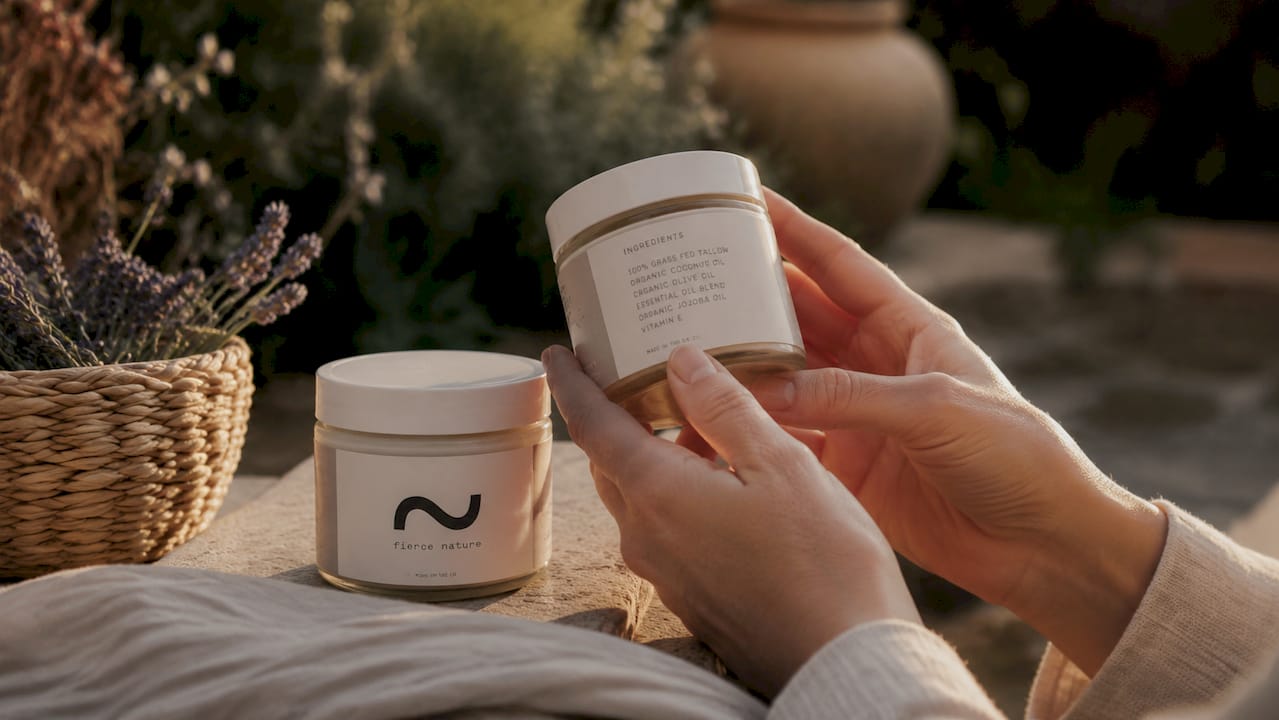
At Fierce Nature, every product label reflects exactly what is inside the container, nothing hidden and nothing inflated. Our Multi-Use Tallow Bar (Unscented) is a good example of what a short, honest INCI list looks like in practice. Pure organic tallow, a handful of supporting botanicals, and nothing else. No “Parfum,” no parabens, no filler ingredients padding out the list. The formula is designed for sensitive and reactive skin, and the label reflects that directly. If you want to practise reading a genuinely clean ingredient list, our product pages are a good place to start. Every ingredient is listed in full, and we are always happy to explain what each one does and why it is there.
INCI stands for International Nomenclature of Cosmetic Ingredients. It is the standardised system used to name cosmetic ingredients on labels across the UK and EU, using Latin or technical names to ensure consistency.
Locate a marker ingredient like phenoxyethanol on the INCI list. Any ingredient listed before phenoxyethanol is present above 1%; any ingredient listed after it is present below 1% and may not deliver meaningful results.
The 26 regulated fragrance allergens must be listed individually when present above threshold levels: 0.001% for leave-on products and 0.01% for rinse-off products. Below these thresholds, they may be included under “Parfum” without individual disclosure.
“Hypoallergenic” has no legally defined standard in the UK. It is a marketing term with no guaranteed meaning, and products carrying this label are not required to meet any specific allergen-free criteria.
The outer box often contains the full INCI ingredient list and batch code, which may not fit on the container itself. The batch code is needed to report an adverse reaction or to check whether a product has been recalled.