Cart
0
You may also like



TL;DR:
- Tallow for sensitive skin is a natural fat that forms a seal on the skin to prevent water loss and hydrate. It is suitable mainly for dry, non-acne-prone sensitive skin because of its simple, minimal ingredients and similarity to human sebum. Oily and skin conditions like acne or rosacea may worsen with tallow due to its occlusive nature.
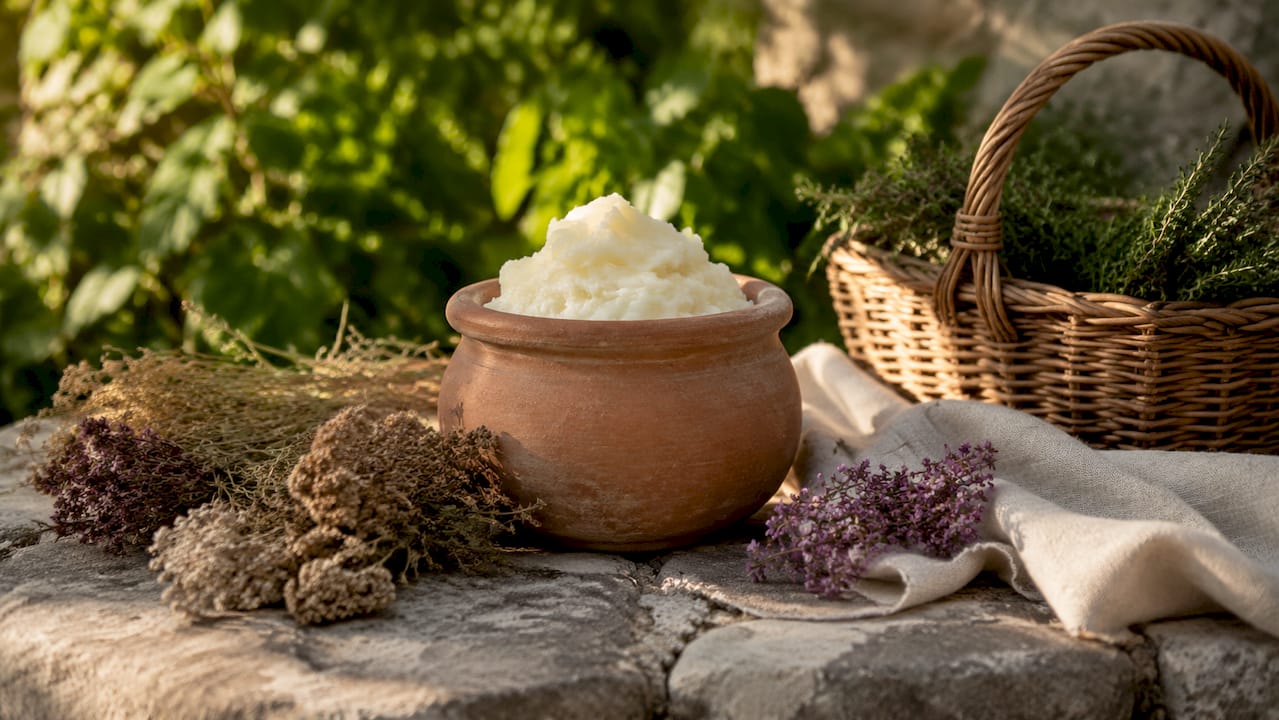
Tallow for sensitive skin is defined as a natural animal fat used topically as an occlusive moisturiser, forming a physical seal over the skin to reduce water loss. Rendered from beef suet, tallow has been used in skincare for centuries, long before synthetic emollients became the norm. Its fatty acid profile closely resembles human sebum, which is why many people with dry, reactive skin find it sits comfortably without immediate irritation. At Fierce Nature, we believe the appeal of tallow lies not in miracle claims, but in its simplicity: fewer ingredients mean fewer opportunities for your skin to react.
Tallow’s primary benefit is its occlusive action. It forms a barrier on the skin’s surface that reduces transepidermal water loss, keeping moisture locked in rather than evaporating into the air. This makes it particularly useful for dry, tight, or flaky skin that struggles to retain hydration through the day.
Its fatty acid composition is worth understanding. Tallow is rich in oleic acid, palmitic acid, and stearic acid. These are the same fatty acids found in human sebum. That similarity means tallow tends to absorb without feeling entirely foreign to the skin, and many people with sensitive skin report it feels comfortable rather than heavy.
Tallow also contains fat-soluble vitamins A, D, E, and K. However, typical topical doses do not deliver therapeutically significant levels of these vitamins to skin cells. The vitamin content is real, but it should not be the primary reason you choose tallow. Think of it as a bonus, not the headline act.
One of the most significant advantages for sensitive skin is what tallow does not contain. Most conventional moisturisers include preservatives, synthetic fragrances, emulsifiers, and stabilisers. Each of these is a potential irritant. Tallow’s minimalist composition reduces your exposure to the “cocktail effect” of layered actives, which is particularly relevant for skin prone to contact dermatitis.
Key benefits of tallow for sensitive, dry skin include:
Pro Tip: Apply tallow to slightly damp skin immediately after cleansing. The occlusive layer traps the residual moisture against your skin, giving you noticeably better hydration than applying it to completely dry skin.
Tallow suits dry, non-acne-prone sensitive skin most reliably. If your skin feels tight, rough, or reactive to fragranced products, a simple tallow balm may offer the calm, nourishing moisture it needs without triggering further irritation.
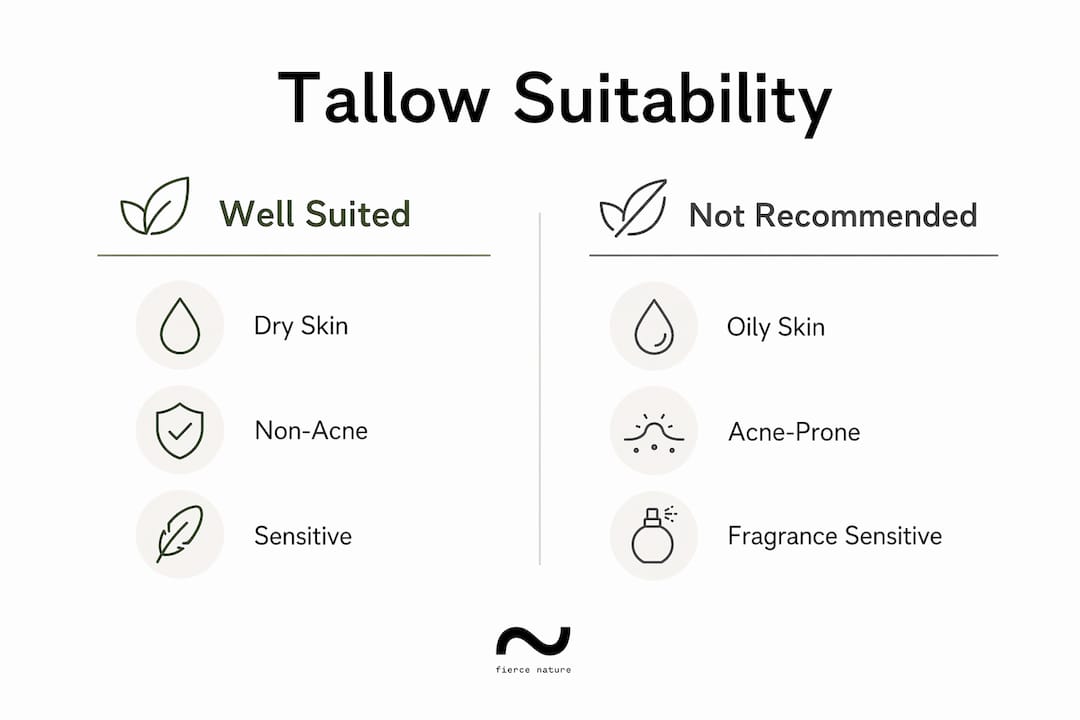
The picture changes significantly for oily or acne-prone skin. Acne-prone skin types are advised against tallow because its thick, occlusive nature can clog pores and cause breakouts. The same caution applies to those with rosacea, seborrheic dermatitis, or fungal acne. Tallow’s richness, which is a strength for dry skin, becomes a liability when pores are already prone to congestion.
For eczema and psoriasis, the situation requires nuance. Tallow can provide surface-level moisture retention that feels soothing in the short term. However, tallow lacks ceramides essential for repairing the skin barrier, which are the lipids that modern dermatology-grade moisturisers specifically include to restore barrier function. Tallow moisturises the surface; it does not rebuild what is broken underneath.
| Skin type | Tallow suitability | Notes |
|---|---|---|
| Dry, non-acne-prone | Well suited | Works as an occlusive emollient for daily moisture retention |
| Sensitive, reactive | Generally suitable | Best when fragrance-free and cosmetic-grade |
| Oily or acne-prone | Not recommended | Risk of pore congestion and breakouts |
| Rosacea or seborrheic dermatitis | Avoid | May worsen inflammation and congestion |
| Eczema or psoriasis | Use with caution | Soothes surface dryness but does not repair the barrier |
| Fungal acne | Avoid | Occlusive fats can feed fungal overgrowth |
Environmental context also matters. Cold, dry climates strip moisture from the skin rapidly. In those conditions, a tallow balm for dry skin acts as a protective shield, particularly on exposed areas like hands, lips, and cheeks. Minimalist skincare enthusiasts also find tallow appealing precisely because it replaces several products with one uncomplicated ingredient.
Safe use of tallow starts with a patch test. Before applying it to your face or a large area, test it on a small patch of skin and wait 24–48 hours to observe any reaction. This is the single most important step for anyone with reactive skin, and it applies to every new ingredient, not just tallow. Fierce Nature’s guide on testing new skincare products walks you through the full protocol clearly.
Follow these steps to introduce tallow into your routine safely:
Pro Tip: If you find tallow too heavy on its own, warm a tiny amount between your fingertips before pressing it gently into the skin. This reduces drag and helps it absorb more evenly without over-application.
The most important structural difference between tallow and modern moisturisers is the presence of ceramides. Ceramide-containing moisturisers actively restore the skin’s barrier lipids, replacing what conditions like eczema, cold weather, or over-cleansing deplete. Tallow does not repair the skin barrier. It provides a physical seal that reduces moisture loss, but it does not replenish the ceramides, cholesterol, or fatty acids that make up the barrier’s internal structure.
Modern moisturisers also typically combine three mechanisms: occlusives (to seal), humectants (to draw water into the skin), and emollients (to soften). Tallow functions primarily as an occlusive and emollient. It does not draw water into the skin the way humectants like glycerin or hyaluronic acid do. This is why layering tallow over a water-based product gives better results than using it alone.
| Property | Tallow | Ceramide moisturiser |
|---|---|---|
| Occlusive action | Yes | Often yes |
| Barrier repair (ceramides) | No | Yes |
| Humectant effect | No | Often yes |
| Fragrance-free options | Yes | Yes |
| Synthetic preservatives | No (pure tallow) | Often yes |
| Clinical evidence for eczema | Limited | Strong |
| Suitable for acne-prone skin | No | Depends on formulation |
The reason many people report improvement after switching to tallow is not always about tallow’s specific properties. Dr. Wei at Cleveland Clinic explains that improvement often comes from removing synthetic preservatives and fragrances rather than from anything intrinsic to tallow itself. That is a meaningful distinction. Tallow is not a treatment for eczema, acne, or pigmentation. It is a simple, clean moisturiser that works by doing less, not more.
For those exploring natural skincare ingredient choices, understanding this distinction helps set realistic expectations. Tallow is a supportive, nourishing ingredient. It is not a replacement for dermatologist-prescribed treatments when a clinical condition is present.
Dr. Whitney Bowe notes that simplicity and tolerance are the key priorities for sensitive, reactive skin. Tallow’s appeal sits squarely in that principle. Fewer ingredients, less reaction risk, and a texture that works with dry skin rather than against it. That is a genuine benefit, even if it is not a clinical cure.
Tallow is a natural occlusive moisturiser that benefits dry, non-acne-prone sensitive skin by reducing moisture loss and minimising irritant exposure, but it does not repair the skin barrier and is not suitable for all skin types.
| Point | Details |
|---|---|
| Occlusive, not restorative | Tallow seals moisture in but lacks ceramides needed to repair a damaged skin barrier. |
| Best for dry, non-acne-prone skin | Oily, acne-prone, rosacea, and fungal acne skin types should avoid tallow. |
| Minimalist formulation is the key benefit | Fewer ingredients reduce irritant exposure, which is the primary advantage for sensitive skin. |
| Patch test before full use | Test on a small area for 24–48 hours before applying to the face or body. |
| Source cosmetic-grade tallow only | Cooking-grade tallow carries contamination risks and is not suitable for skincare. |
The most common mistake people make with tallow is expecting it to fix a skin condition. We understand that impulse completely. When your skin is reactive, inflamed, or persistently dry, you want something that will solve the problem. Tallow is not that. What it is, is a genuinely clean, nourishing moisturiser that stops making things worse.
At Fierce Nature, we have seen the difference that removing synthetic fragrances and preservatives makes for people with sensitive skin. Time and again, the feedback we receive is not “tallow healed my eczema.” It is “my skin finally stopped reacting.” That is the real story here. The benefit is often the absence of harm rather than the presence of a cure.
We also want to be honest about variability. Not everyone responds to tallow the same way. Some people with sensitive skin find it too heavy. Others find it the only thing their skin tolerates. That variability is normal, and it is why patch testing matters so much. Your skin’s response is the only data point that counts.
If you have a diagnosed skin condition such as eczema, psoriasis, or rosacea, please consult a dermatologist before making tallow your primary moisturiser. Tallow can complement a dermatologist’s plan, but it should not replace one. We are advocates for natural ingredients, and we are equally advocates for informed, realistic choices. The two are not in conflict. You can love what nature offers and still know its limits.
Explore more about tallow and sensitive skin to understand how it fits into a broader, considered skincare approach.
— Fierce Nature
At Fierce Nature, every product starts with one principle: your skin should not have to fight what you put on it. Our unscented tallow bar is handcrafted in the UK using pure, grass-fed, cosmetic-grade tallow with no synthetic fragrances, preservatives, or unnecessary additives. It is designed specifically for people who want clean, effective moisture without the ingredient list that reads like a chemistry catalogue. If your skin has been reacting to conventional products and you are ready to try something simpler, our multi-use tallow bar offers a gentle, nourishing starting point. Visit the product pages to learn more about sourcing, ingredients, and how to use them in your routine.
Tallow is generally suitable for dry, non-acne-prone sensitive skin because its minimalist composition reduces exposure to common irritants like synthetic fragrances and preservatives. It is not recommended for oily, acne-prone, or rosacea-affected skin.
Tallow can provide surface moisture retention that feels soothing, but it lacks the ceramides needed to repair the skin barrier, which is the primary goal in eczema management. It is not a clinical treatment for eczema and should not replace dermatologist-recommended products.
Apply a small amount of tallow to the inner arm or behind the ear and leave it for 24–48 hours. If no redness, itching, or swelling appears, it is generally safe to use on a wider area.
Tallow acts as an occlusive and emollient, sealing moisture into the skin’s surface. Ceramide moisturisers actively restore the lipids within the skin barrier itself, making them more effective for barrier repair in conditions like eczema.
Only cosmetic-grade, grass-fed tallow from a reputable supplier is appropriate for skincare. Cooking-grade tallow carries contamination risks and is not formulated or tested for topical use.