Cart
0
You may also like




TL;DR:
- Tallow is biocompatible with human skin because its fatty acid profile mirrors natural skin lipids, aiding moisturization and barrier support. Its molecular similarity allows it to integrate seamlessly into the skin’s lipid matrix, providing occlusion and emolliency for dry or compromised skin. However, it may clog pores and worsen conditions like acne or rosacea in oily skin types.
Tallow is biocompatible with human skin cells because its fatty acid profile closely mirrors the skin’s own natural lipids, making it an effective moisturiser and barrier support. The term “biocompatibility” in this context refers to the ability of a substance to integrate with living tissue without causing harm or rejection. For tallow, this means its primary components, oleic acid, palmitic acid, and stearic acid, are the same fatty acids found in the human stratum corneum and sebum. Fierce Nature builds its entire skincare range on this principle, using pure organic tallow as the foundation for nourishing, non-toxic formulations crafted in the UK.
Tallow’s compatibility with skin cells comes down to one core fact: its lipid composition resembles skin lipids in a way that most synthetic and plant-based alternatives do not. The human stratum corneum, the outermost layer of skin, is built from a precise mixture of ceramides, cholesterol, and free fatty acids. Tallow delivers oleic, palmitic, and stearic acids that slot naturally into this structure.
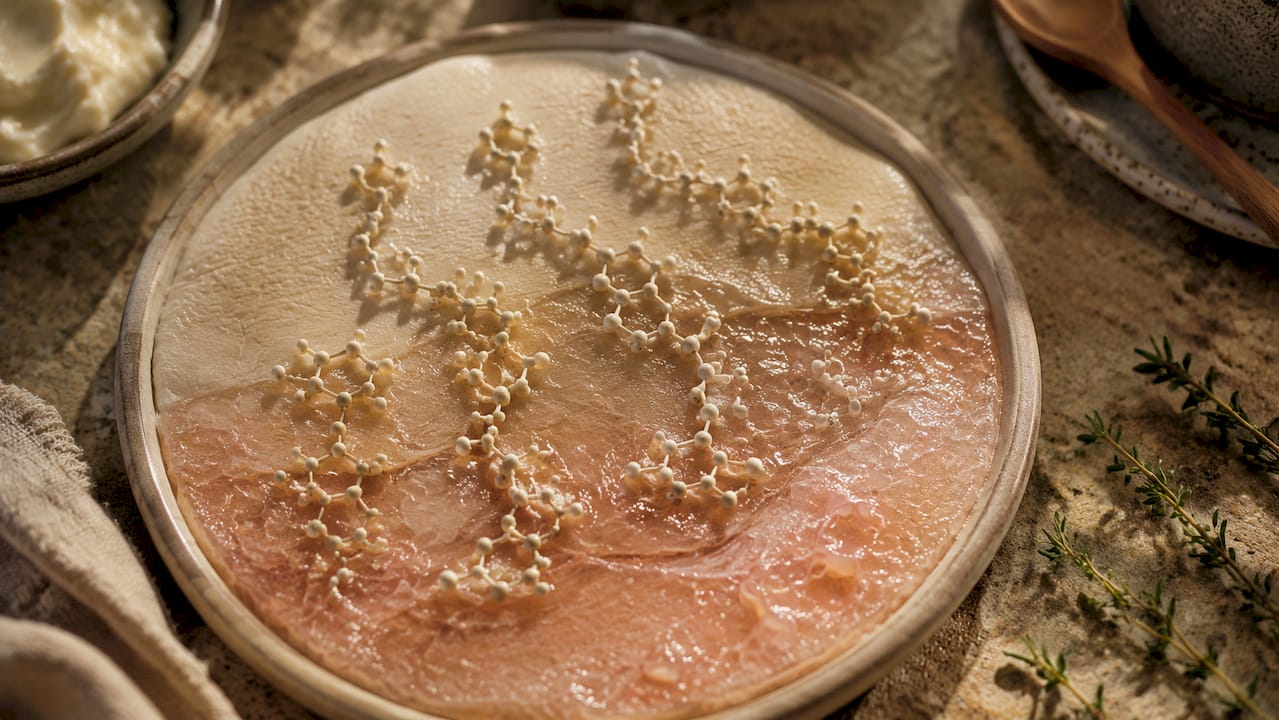
Oleic acid makes up a significant portion of both tallow and human sebum. Palmitic acid is one of the most abundant fatty acids in the skin barrier. Stearic acid supports the structural integrity of cell membranes. Together, these three acids give tallow its reputation as a skin-compatible ingredient rather than a foreign substance.
This compatibility is why tallow has been used for centuries as a skin emollient, long before the cosmetics industry existed. The skin recognises these lipids and absorbs them readily, which is what Fierce Nature means when it describes tallow as a “deep penetrating skin food.” The bioavailability of tallow is not a marketing claim. It is a direct result of molecular similarity.
Tallow is composed predominantly of saturated and monounsaturated fatty acids. Oleic acid (C18:1) typically accounts for the largest share, followed by palmitic acid (C16:0) and stearic acid (C18:0). Polyunsaturated fatty acids (PUFAs) such as linoleic acid are present only in small amounts.
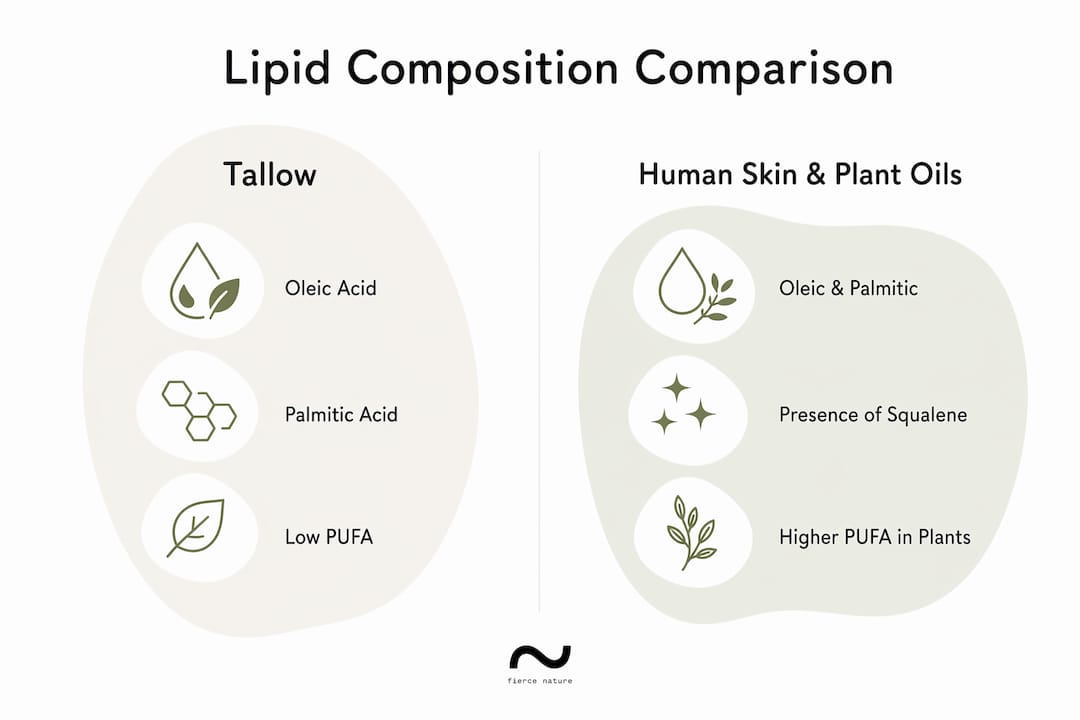
Human sebum contains a similar distribution, with oleic acid, palmitic acid, and stearic acid as primary components. The stratum corneum lipid matrix also relies heavily on these same fatty acids, alongside ceramides and cholesterol. The overlap between tallow and skin lipids is not coincidental. Both come from mammalian biology.
Tallow’s oxidative stability is a direct result of its low PUFA content. High-PUFA seed oils such as rosehip, sunflower, and evening primrose oxidise under UV and ambient oxygen exposure, producing damaging aldehydes. Tallow resists this oxidative cascade, making it more stable on the skin over time. This is a meaningful advantage for anyone using a moisturiser daily.
The table below compares the approximate fatty acid profiles of tallow, human sebum, and two common plant oils.
| Fatty acid | Tallow | Human sebum | Jojoba oil | Sunflower oil |
|---|---|---|---|---|
| Oleic acid (C18:1) | ~47% | ~25% | ~11% | ~25% |
| Palmitic acid (C16:0) | ~26% | ~23% | ~1% | ~6% |
| Stearic acid (C18:0) | ~14% | ~3% | ~1% | ~5% |
| Linoleic acid (C18:2) | ~3% | ~3% | ~1% | ~60% |
| Saturated fat total | ~50% | ~40% | ~15% | ~13% |
The contrast with sunflower oil is striking. Sunflower oil is roughly 60% linoleic acid, making it far more prone to oxidation than tallow. Jojoba is technically a liquid wax rather than a triglyceride oil, which explains its unusual fatty acid distribution. Tallow sits closest to human sebum in its overall saturated and monounsaturated balance.
Tallow supports skin barrier function through two primary mechanisms: occlusion and emolliency. These are distinct but complementary actions.
Occlusion means tallow forms a physical film on the skin surface that slows transepidermal water loss (TEWL). Occlusive agents reduce skin water loss and support barrier repair in compromised or dry skin. This is the same principle behind petrolatum (Vaseline), which dermatologists have used for decades in wound care and eczema management. Tallow achieves a similar occlusive effect through its saturated fat content.
Emolliency is different. Emollients work by filling the gaps between skin cells with lipids, softening the texture and improving flexibility. Because tallow’s fatty acids are structurally similar to the skin’s own lipids, they integrate into the stratum corneum rather than simply sitting on top of it. This is the distinction between a true emollient and a surface coating.
Key benefits of tallow for skin barrier support include:
Dermatologists position tallow primarily as an occlusive and basic moisturiser rather than a clinical treatment. This is an honest and useful framing. Tallow works best as a daily barrier support for dry or very dry skin, not as a replacement for prescribed dermatological care.
Pro Tip: Always choose cosmetic-grade, suet-rendered tallow for skincare. Tallow rendered from kidney fat (suet) is purer and more stable than general cooking-grade beef fat. Fierce Nature uses premium, naturally sourced tallow in all its formulations for exactly this reason.
Tallow is not universally suitable for every skin type. Its occlusive nature, which is a strength for dry skin, becomes a liability for oily or acne-prone skin. Tallow’s thickness can clog pores, leading to blackheads, whiteheads, and breakouts in people who already produce excess sebum.
Conditions that may worsen with tallow use include:
Beyond skin type concerns, product quality is a genuine safety issue. Improperly rendered or stored tallow may spoil or harbour bacteria, posing risks for sensitive or compromised skin. Many tallow products sold online lack formal microbial and stability testing. This is not a minor concern. Applying a contaminated product to broken or eczema-affected skin can introduce infection.
Tallow is also not a complete sebum replacement. Tallow lacks squalene and wax esters, two components that are central to human sebum function. This means tallow supports the barrier as a lipid source and occlusive, but it does not replicate everything the skin naturally produces. Claims that tallow is “identical to human sebum” overstate the science.
Pro Tip: Avoid tallow products that contain added fragrances, essential oils, or unverified herbal extracts. These additions increase the risk of sensitisation, particularly on reactive or compromised skin. Unscented, single-ingredient tallow is the safest starting point for anyone new to tallow skincare.
The comparison between tallow, synthetic moisturisers, and plant-based oils reveals meaningful differences in biocompatibility, stability, and practical performance.
Synthetic occlusives such as petrolatum and dimethicone are highly effective at reducing TEWL. They are also inert, meaning they do not interact with skin biology at all. Tallow, by contrast, provides occlusion and delivers lipids that the skin can actually use. This is the core argument for tallow’s superiority over purely synthetic options for people seeking a more natural approach.
Plant oils rich in PUFAs, such as rosehip and evening primrose, are often marketed for their linoleic acid content. Linoleic acid does play a role in skin barrier function, but high-PUFA oils oxidise under UV exposure, producing aldehydes that can damage skin cells. Tallow’s saturated fatty acid profile avoids this problem entirely.
The table below summarises key criteria across the three categories.
| Criterion | Tallow | Synthetic (petrolatum) | Plant oil (rosehip) |
|---|---|---|---|
| Lipid similarity to skin | High | None | Moderate |
| Oxidative stability | High | Very high | Low |
| Occlusive strength | High | Very high | Low |
| Biocompatibility | High | Neutral | Moderate |
| Vitamin content | Trace | None | Variable |
| Risk for oily skin | High | Moderate | Low |
| Clinical evidence | Limited | Strong | Moderate |
The honest conclusion is that tallow occupies a useful middle ground. It is more biologically relevant than petrolatum and more stable than most plant oils. However, the clinical evidence for tallow’s benefits beyond basic moisturisation remains limited. The Cleveland Clinic notes that fat-soluble vitamins in tallow are present in trace amounts only, and there is no evidence for sun protection qualities. Tallow is a strong moisturiser. It is not a multi-function therapeutic agent.
Applying the science of tallow’s biocompatibility to real skincare decisions requires a clear framework. The following steps guide researchers and skincare enthusiasts through responsible tallow use.
Select cosmetic-grade tallow. Source tallow that has been rendered from suet, tested for microbial contamination, and produced under controlled conditions. Fierce Nature uses premium, naturally sourced tallow in its UK-crafted formulations. You can read more about tallow balm safety and suitability for UK skin on the Fierce Nature blog.
Match tallow to the right skin type. Tallow is best suited to very dry, normal, or mature skin. Avoid applying it to oily, acne-prone, or seborrhoeic skin without dermatologist guidance.
Patch test before full application. Apply a small amount to the inner arm and wait 24 hours. This is standard practice for any new topical ingredient, and tallow is no exception.
Complement tallow with validated ingredients. Tallow provides occlusion and emolliency. For additional barrier repair, pair it with niacinamide, ceramides, or hyaluronic acid, which address different aspects of skin health. Tallow does not replace these ingredients; it works alongside them.
Address ethical and lifestyle considerations. Tallow is an animal-derived ingredient. It is not suitable for vegans or those following plant-based lifestyles. This is a practical reality that formulation researchers and consumers need to factor into product development and personal choices.
Conduct empirical testing for formulation work. Researchers developing tallow-based products should conduct stability testing, patch testing panels, and TEWL measurements to validate performance claims. Anecdotal evidence, however compelling, does not replace controlled assessment.
Tallow is biocompatible with human skin cells because its oleic, palmitic, and stearic acid profile closely matches the skin’s own barrier lipids, making it an effective occlusive and emollient for dry or compromised skin.
| Point | Details |
|---|---|
| Lipid similarity drives compatibility | Tallow’s fatty acids mirror human stratum corneum lipids, enabling natural integration with the skin barrier. |
| Occlusion reduces water loss | Tallow forms a physical film that slows transepidermal water loss, supporting hydration in dry skin. |
| Not suitable for all skin types | Tallow’s occlusive nature can clog pores and worsen acne, rosacea, or seborrhoeic dermatitis. |
| Oxidative stability is a key advantage | Low PUFA content means tallow resists oxidation better than most plant oils, reducing skin damage risk. |
| Clinical evidence remains limited | Tallow’s benefits beyond moisturisation, including vitamin delivery, lack strong clinical proof. |
The conversation around tallow in skincare has become polarised. On one side, influencers claim it cures everything from eczema to ageing. On the other, some dermatologists dismiss it entirely as a trend. Neither position serves you well.
What we know at Fierce Nature, from years of formulating with tallow and hearing from our community, is that tallow is genuinely effective for the right person with the right skin type. It is not magic. It is biochemistry. The reason it works is straightforward: the skin recognises its lipids and uses them. That is a meaningful advantage over a synthetic film that simply sits on the surface.
What concerns us is the lack of quality control across the wider tallow skincare market. Rendering matters enormously. Storage matters. The source of the fat matters. A poorly rendered tallow product is not the same as a carefully crafted cosmetic-grade formulation. When people try a low-quality product and experience breakouts or irritation, they conclude that tallow does not work. Often, the problem is the product, not the ingredient.
We also think the vitamin story needs to be told honestly. Tallow does contain trace amounts of vitamins A, D, E, and K. That is real. But the evidence that these vitamins are absorbed in therapeutically meaningful quantities through topical application is not there yet. We do not build our claims on that. We build them on what the science actually supports: nourishment, barrier support, and deep moisturisation for skin that is genuinely dry and depleted.
The future of tallow in skincare lies in better research, better standardisation, and better consumer education. We are committed to all three.
— Fierce Nature
Fierce Nature’s multi-use tallow bar is crafted from pure, cosmetic-grade tallow with no synthetic additives. It is designed specifically for skin barrier support and deep moisturisation, making it a practical choice for dry, depleted, or mature skin. The unscented version is ideal for sensitive skin or anyone patch testing tallow for the first time. For those who prefer a light natural scent, the scented tallow bar uses only naturally sourced fragrance. Every product in the Fierce Nature range is handmade in the UK, non-toxic, and built on the same principle: nourishment from the land, not the lab.
Tallow contains oleic, palmitic, and stearic acids that closely match the fatty acids found in the human stratum corneum and sebum. This structural similarity allows tallow to integrate with the skin barrier rather than sitting on top of it as a foreign substance.
Tallow is not identical to human sebum. It lacks squalene and wax esters, which are key components of sebum. Tallow is best understood as a barrier-supporting lipid source rather than a complete sebum substitute.
Yes, tallow can cause breakouts in oily or acne-prone skin. Its occlusive nature can trap sebum and bacteria beneath the skin surface, leading to blackheads, whiteheads, and spots. It is most suitable for dry, normal, or mature skin types.
Tallow is more oxidatively stable than most plant oils because it contains very low levels of polyunsaturated fatty acids. High-PUFA oils such as rosehip and sunflower oil can oxidise on the skin and produce damaging compounds, whereas tallow’s saturated fat profile resists this process.
Tallow contains trace amounts of fat-soluble vitamins A, D, E, and K. However, clinical evidence for meaningful therapeutic vitamin absorption through topical tallow application is currently limited, and tallow should not be relied upon as a primary source of skin vitamins.