Cart
0
You may also like




TL;DR:
- Sensitive skin product testing involves using a minimal routine and structured patch tests to identify reactions. It requires patience, careful observation over several days, and skepticism toward unverified marketing claims like “hypoallergenic.” Professional testing offers more accurate diagnosis when reactions are severe or persistent.
Sensitive skin product testing is the practice of systematically introducing new skincare to your routine in controlled steps to identify reactions before they spread across your face. For people whose skin flares at the slightest provocation, this is not optional caution. It is the only reliable way to build a skincare routine for sensitive skin that actually works. The term “hypoallergenic” sounds reassuring, but as we will cover shortly, it carries no legal weight. What protects your skin is a structured testing method, not a marketing claim.
The single most important preparation is stripping your routine back to a minimal core. A simple core routine of a gentle cleanser, a barrier moisturiser, and a mineral SPF reduces the number of active variables in your routine. That reduction matters enormously. When your skin reacts, you need to know which product caused it. If you are using eight products simultaneously, you will never be certain.
Before you introduce anything new, gather these basic tools:
Cotton pads or gauze squares for applying the test product to a small area without spreading it
Hypoallergenic tape (such as surgical micropore tape) to hold a patch in place if you are doing a covered test
A clean test area on the inner forearm or along the jawline, both of which are sensitive enough to show reactions without being as exposed as the central face
A simple diary or notes app to record the date, product, area tested, and any observations over the following days
Unscented, fragrance-free baseline products already in use, so you are not introducing multiple unknowns at once
Reading ingredient lists is more reliable than trusting front-of-pack claims. Ingredients like foaming sulphates, synthetic fragrance, and essential oils are common irritants in sensitive skin routines. A product labelled “natural” can still contain high concentrations of essential oils that trigger reactions in reactive skin. Learning to read the INCI (International Nomenclature of Cosmetic Ingredients) list puts you in control.
Professional patch testing, carried out by a dermatologist or allergist, differs from at-home testing in one critical way. Clinicians apply standardised allergen panels under controlled conditions and read results across multiple days. At-home tests are useful for screening new products, but they cannot diagnose a specific allergy. Knowing that distinction helps you decide when to self-test and when to seek professional advice.

Pro Tip: Start with a natural skincare guide to identify which ingredients your skin already tolerates well before introducing anything new. This gives you a reliable baseline.
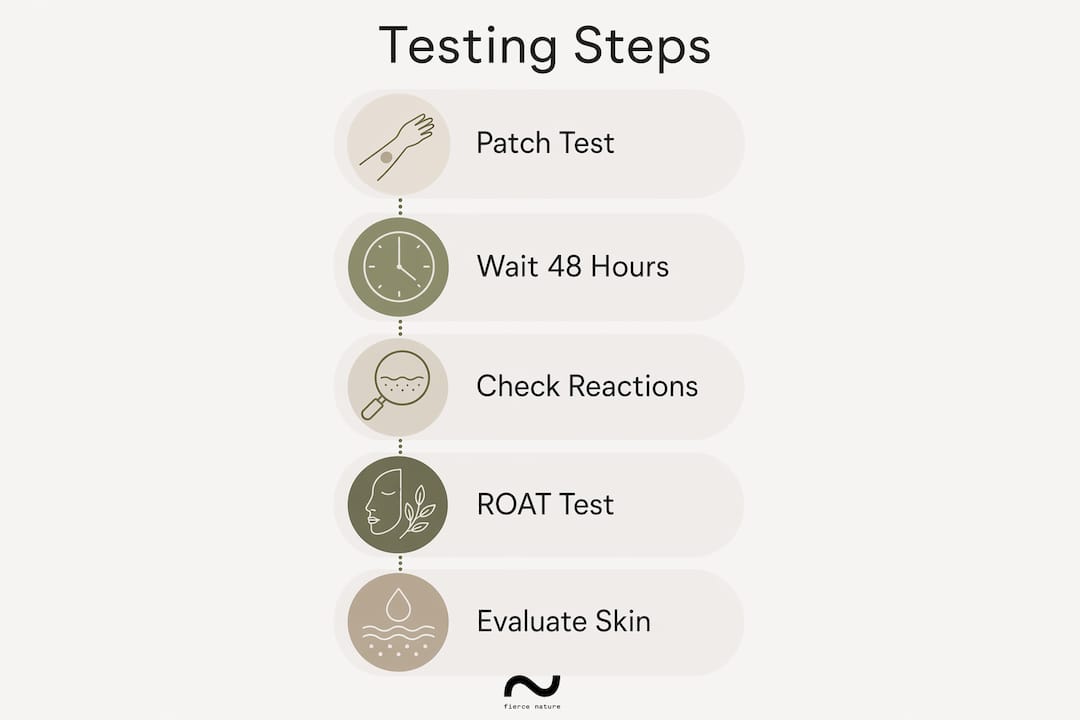
Patch testing at home follows a clear sequence. Skipping steps or shortening observation windows is where most people go wrong.
Cleanse the test area. Wash the inner forearm or jawline with your usual gentle cleanser. Pat dry and leave for 20 minutes.
Apply a small amount of the product. Use a cotton pad or clean fingertip to apply a pea-sized amount to a 2 cm patch of skin.
Leave it undisturbed for 24 hours. Avoid washing the area. Note any immediate sensations such as tingling, burning, or tightening.
Read at 48 hours. Check for redness, raised bumps, itching, or swelling. A 48-hour reading is the standard first checkpoint in professional allergen testing.
Read again at 72–96 hours. This second reading is critical. Approximately 30% of positive allergic reactions are missed when only a single 48-hour reading is performed. Delayed-type hypersensitivity reactions can appear up to 96 hours post-exposure, so patience is not optional.
Record your findings. Note the exact appearance of the skin, any sensation, and whether symptoms are improving or worsening.
If the patch test shows no reaction, move to the Repeated Open Application Test, known as ROAT. This test is closer to real-world use and catches reactions that a single patch test misses.
The ROAT method involves applying the product twice daily to a small area of skin, typically the inner forearm, for 7–14 days. You do not cover the area. You simply apply it as you would in normal use and observe. ROAT identifies whether the full product formula causes a cumulative reaction over time. Its limitation is that it cannot pinpoint which specific ingredient is responsible if a reaction does occur.
Watch for these signs during both tests:
Redness or erythema that was not present before
Itching or stinging that persists beyond a few minutes of application
Small raised bumps or papules appearing within or around the test area
Dryness or flaking that worsens rather than improves with continued use
Pro Tip: If you notice a doubtful reaction, meaning mild redness that is not clearly a positive or negative result, stop using the product and wait 48 hours before reassessing. A reaction that fades quickly is more likely irritant in nature. One that intensifies points toward an allergic response and warrants professional review.
At-home tests are genuinely useful for screening. They are not a substitute for professional diagnostic testing when you suspect a true allergy. If reactions are severe, recurring, or spreading, a dermatologist can apply standardised allergen panels and provide a definitive diagnosis.
Clinical validation of skincare products goes well beyond a simple patch test. The most credible approach combines ingredient screening, standardised patch testing, and real-world consumer trials. The HypoSense® model, an industry standard developed for substantiating hypoallergenic claims, uses all three layers. Its Safety-In-Use study runs for four weeks on sensitive skin populations, which is long enough to capture delayed and cumulative reactions that shorter tests miss.
Clinical researchers measure skin responses using instruments rather than relying solely on visual assessment. The table below outlines the key measurements used in sensitive skin studies.
| Measurement | What it assesses | Why it matters |
|---|---|---|
| Corneometry | Skin hydration levels | Confirms whether a product supports or disrupts the moisture barrier |
| TEWL (transepidermal water loss) | Barrier function | A rising TEWL reading signals barrier damage from a product |
| Erythema index | Degree of redness | Quantifies inflammation that may not be visible to the naked eye |
| Clinician evaluation | Overall skin tolerance | Adds qualitative context to instrumental data |
| Validated questionnaires | Consumer-reported sensation | Captures stinging, tightening, and itching that instruments cannot measure |
These instrumental endpoints are what separate a genuinely rigorous clinical study from a loosely worded marketing claim. When a brand states “dermatologist tested,” the meaningful question is: tested for what, on how many people, and over what duration? A study measuring TEWL and erythema index over four weeks on reactive skin tells you something real. A single-day assessment on ten volunteers tells you very little.
The word “hypoallergenic” is perhaps the most misunderstood term in skincare. The FDA has confirmed that hypoallergenic has no legal definition and no required testing or certification. A brand can print it on any product without conducting a single allergy-risk study. That does not mean every brand using the term is being dishonest. It means you cannot rely on the word alone. Look for brands that publish their testing methodology, specify study duration, and name the skin types included in their trials.
Leave-on cosmetics carry a higher sensitisation risk than rinse-off products. A moisturiser or serum sits on the skin for hours, giving potential irritants prolonged contact time. A cleanser is rinsed away within seconds. This distinction is worth keeping in mind when prioritising which products to test most carefully. Your leave-on products deserve the most rigorous testing window.
Understanding UK skincare regulations also helps you interpret label claims with greater confidence, particularly since post-Brexit rules now differ from EU standards in several areas.
The most damaging mistake in sensitive skin product testing is introducing more than one new product at a time. When your skin reacts, you have no way of knowing which product is responsible. The result is either a false accusation against a product that was perfectly fine, or continued use of the actual culprit.
Other common mistakes include:
Adding active ingredients too soon. Retinoids, AHAs, BHAs, and vitamin C are potent. Introducing them before your skin is stable from a previous change creates overlapping variables and unpredictable reactions.
Stopping a test too early. A 24-hour patch test is a starting point, not a conclusion. Delayed reactions appear days later, and cutting the observation window short means missing them.
Testing on compromised skin. If your skin is already flaring, sunburnt, or broken, any new product will appear more irritating than it actually is. Wait until your baseline is calm and stable.
Ignoring the ingredient list. Reacting to a product and then buying a different brand with the same key irritant is a cycle many people repeat without realising it.
Confusing irritant reactions with allergic reactions. An irritant reaction is localised, appears quickly, and fades when you stop using the product. An allergic reaction can spread beyond the test area, worsen over time, and recur on re-exposure even at low concentrations.
Troubleshooting a reaction starts with stopping the suspected product immediately. Apply your barrier moisturiser to calm the skin and reduce further exposure. If the reaction is mild, wait 48–72 hours and observe whether it resolves on its own. If it spreads, blisters, or does not improve within a few days, seek medical advice.
Pro Tip: Keep a short ingredient list of every product that has caused a reaction. Over time, you will start to see patterns. A recurring ingredient across multiple reactions is almost certainly your trigger, and knowing it by name means you can screen future products before they ever touch your skin.
When reactions are frequent, unpredictable, or severe, professional patch testing is the right next step. A dermatologist can test a panel of the most common cosmetic allergens, including fragrances, preservatives, and emulsifiers, and give you a clear list of ingredients to avoid. That list is one of the most useful tools a sensitive-skinned person can have.
Reliable sensitive skin product testing requires a minimal routine, a structured patch test protocol, and scepticism toward unverified marketing claims.
| Point | Details |
|---|---|
| Start with a minimal routine | Use only a gentle cleanser, barrier moisturiser, and mineral SPF before introducing anything new. |
| Follow the full patch test window | Read results at both 48 hours and 72–96 hours to avoid missing delayed allergic reactions. |
| Use ROAT for real-world confirmation | Apply the product twice daily for 7–14 days on a small area to detect cumulative reactions. |
| Question “hypoallergenic” claims | The term has no legal definition; look for brands that publish study duration and methodology. |
| Introduce one product at a time | Testing multiple new products simultaneously makes it impossible to identify the cause of a reaction. |
We built Fierce Nature because we lived the frustration of reactive skin long before we understood its causes. Growing up surrounded by mainstream cosmetics, the rashes and reactions felt random and uncontrollable. They were not random. They were predictable responses to a toxic load that most people never question.
What we have come to understand is that simplicity is not a compromise. It is the most powerful tool you have. A minimal routine does not just reduce irritants. It gives you clarity. When your skin is calm and you introduce one new product at a time, you stop guessing and start knowing. That shift from guessing to knowing is where real skin health begins.
We are also deeply sceptical of the testing claims printed on most skincare packaging. “Dermatologist tested” without published methodology means very little. We have seen products carrying that phrase that were tested on a handful of people for a single day. That is not a safety study. That is a marketing exercise. The HypoSense® model, with its four-week Safety-In-Use study on genuinely sensitive skin populations, is the kind of rigour that actually protects people. Most brands do not come close to that standard.
The other thing we would tell anyone with reactive skin is to trust the timing. Delayed reactions are real. A product that feels fine on day one can cause a response on day four. Patience in the observation window is not overcaution. It is the difference between a safe product and a slow-burn irritant that damages your barrier over weeks.
We also believe that ingredient transparency is non-negotiable. At Fierce Nature, every product we make uses a short, readable ingredient list with nothing hidden behind vague terms. You should be able to look at what you are putting on your skin and understand it. That is not a luxury. It is a basic standard that the industry has failed to uphold for too long.
— Fierce Nature
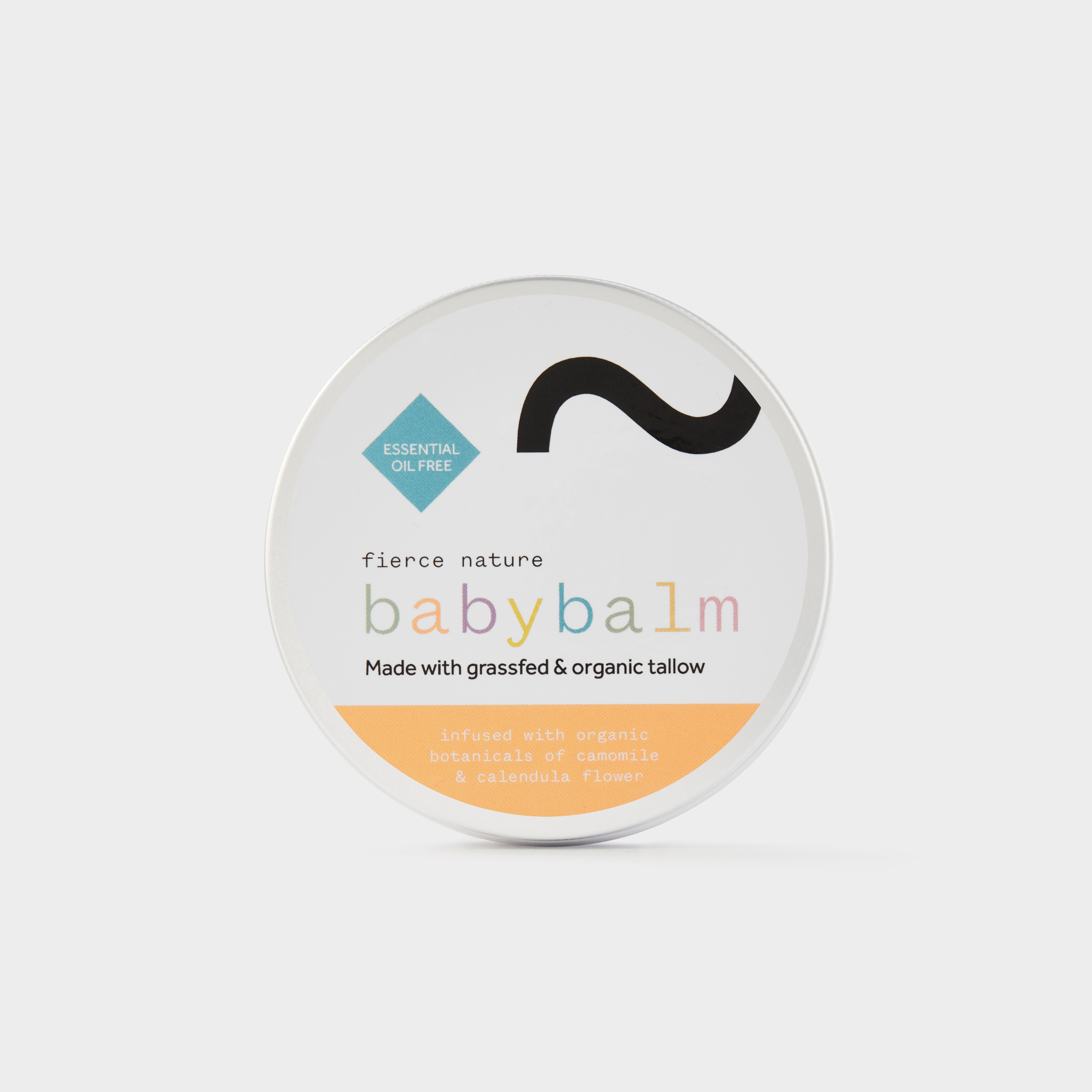
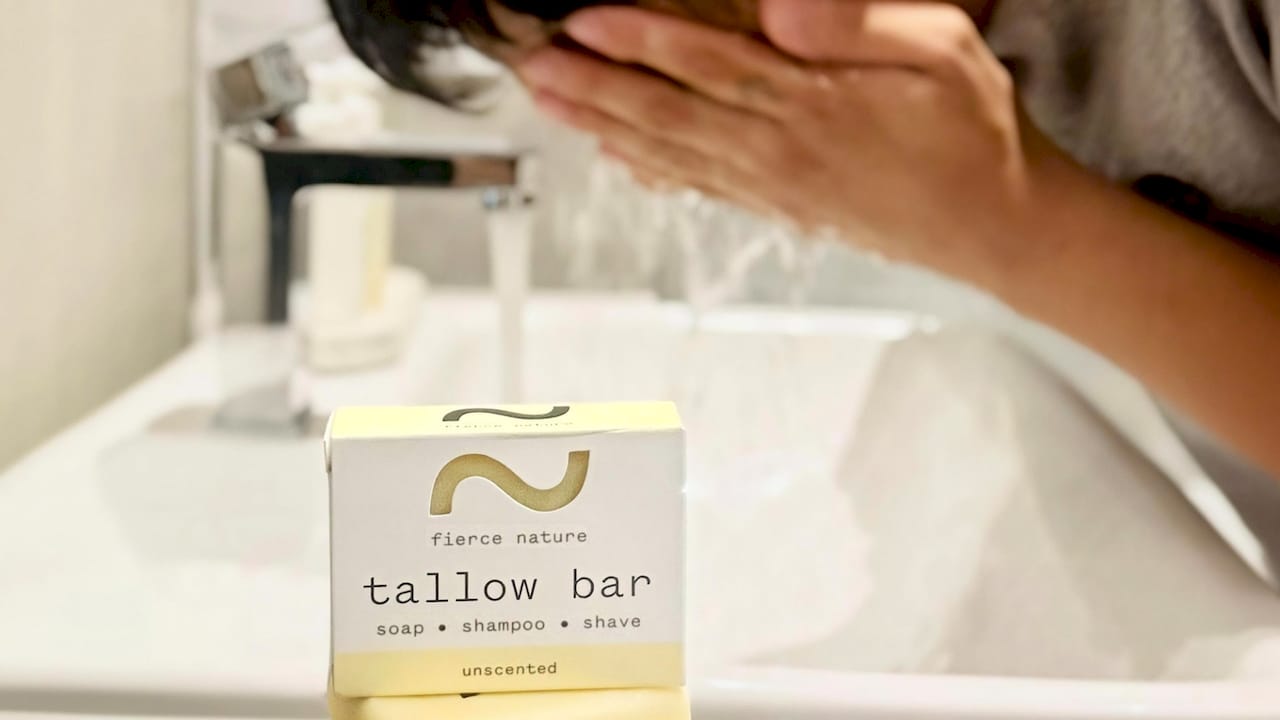
If you are building a minimal core routine to test new products safely, the foundation matters. Fierce Nature’s unscented tallow bar is formulated without synthetic fragrance, essential oils, or harsh sulphates, making it a dependable baseline cleanser and moisturiser for reactive skin. Tallow’s bioavailability means it absorbs deeply without sitting on the surface and clogging pores. For those testing with the most sensitive skin of all, our non-toxic baby skin essentials range uses the same clean ingredient philosophy. Every Fierce Nature product is handmade in the UK with a short, transparent ingredient list so you always know exactly what you are applying.
The inner forearm and the jawline are the most reliable at-home test sites. They are sensitive enough to show reactions but less exposed than the central face.
Read your patch test at 48 hours and again at 72–96 hours. A single 48-hour reading misses approximately 30% of positive allergic reactions.
No. The term has no legal definition and requires no allergy-risk testing or certification. Always look for brands that publish their testing methodology and study duration.
An irritant reaction appears quickly, stays localised, and fades when you stop using the product. An allergic reaction can spread, worsen over time, and recur on re-exposure even in small amounts.
Seek professional advice if reactions are severe, spreading, blistering, or recurring across multiple products. A dermatologist can run a standardised allergen panel to identify your specific triggers.