Cart
0
You may also like





TL;DR:
- Organic skincare ingredients are plant-derived actives that nourish, protect, and restore skin without synthetic chemicals. They deliver essential nutrients like fatty acids and antioxidants that work harmoniously with the skin’s natural biology. Choosing certified organic products supports skin health and environmental sustainability through pure, biodegradable ingredients.
Organic skincare ingredients are plant-derived actives that nourish, protect, and restore skin without the synthetic pesticides, parabens, or artificial fragrances found in conventional cosmetics. The benefits of organic skincare ingredients extend well beyond avoiding irritants. They deliver essential fatty acids, vitamins, and antioxidants that work with your skin’s natural biology rather than against it. At Fierce Nature, we believe the land provides everything your skin truly needs. This article walks you through the top advantages, the science behind specific botanicals, and how to choose products that genuinely deliver on their promises.
Organic skincare formulations reduce the likelihood of skin reactions by removing synthetic pesticides, parabens, and artificial fragrances from the equation. For anyone with sensitive or reactive skin, this is the single most meaningful difference. Conventional products often contain petrochemical stabilisers and synthetic emulsifiers that disrupt the skin barrier over time. Organic alternatives use plant-based emulsifiers that support rather than compromise your skin’s protective layer.
The deeper advantage lies in what organic ingredients actively contribute. Rosehip seed oil, for example, delivers essential fatty acids and vitamin C precursors that improve hydration and texture with consistent use. Green tea extract provides antioxidant protection against UV damage and environmental pollution. These are not passive ingredients. They feed your skin at a cellular level.
Fierce Nature builds every formulation on this principle. Pure organic tallow forms the foundation of our range because its fatty acid profile mirrors the lipids naturally present in human skin. That bioavailability means it penetrates deeply rather than sitting on the surface.
Rosehip seed oil is one of the top organic skincare ingredients for texture, tone, and hydration. It is rich in linoleic acid and oleic acid, two essential fatty acids the skin cannot produce on its own. It also contains natural precursors to vitamin A, which support cell turnover and reduce the appearance of fine lines and uneven pigmentation.

Regular use of rosehip seed oil visibly improves skin texture within four to six weeks for most skin types. The oil absorbs quickly without leaving a greasy residue, making it suitable for oily and combination skin as well as dry skin. Its anti-inflammatory properties also make it a strong choice for post-blemish recovery.
Pro Tip: Store rosehip seed oil in a dark glass bottle away from direct sunlight. Natural lipids oxidise faster than synthetic alternatives, so proper storage protects potency and extends shelf life.
Green tea extract contains epigallocatechin gallate, commonly known as EGCG, one of the most studied antioxidants in skincare science. Scientific studies document its ability to protect against free radical damage and inhibit enzymes linked to collagen breakdown. This makes it particularly valuable for anyone concerned about premature ageing or pollution-related skin stress.
Green tea extract also carries measurable anti-inflammatory properties. Applied topically, it calms redness, reduces puffiness, and supports recovery after sun exposure. For urban skin exposed to daily environmental stressors, it functions as a daily shield.
The organic sourcing of green tea extract matters here. Conventionally grown tea plants are among the most heavily pesticide-treated crops in the world. Choosing certified organic green tea extract means the antioxidant benefit arrives without a side order of chemical residue.
Aloe vera is the benchmark ingredient for soothing skin inflammation and accelerating healing in reactive or damaged skin. Its gel contains polysaccharides that form a protective film over the skin surface, locking in moisture while reducing transepidermal water loss. It also contains acemannan, a compound with documented wound-healing and antimicrobial properties.
For those with conditions such as eczema, rosacea, or post-procedure sensitivity, aloe vera provides immediate relief without the risk of further irritation. It is one of the few botanicals with a strong enough evidence base to appear in both cosmetic and clinical dermatology contexts. Fierce Nature recommends it as a cornerstone ingredient for anyone building a gentle skincare routine around sensitive skin.
Jojoba oil is technically a liquid wax rather than a true oil, and that distinction matters. Its molecular structure closely resembles the skin’s own sebum, which means it absorbs without blocking pores and helps regulate natural oil production. This makes it one of the most versatile carrier oils across all skin types.
Sunflower oil is rich in linoleic acid, a fatty acid that plays a direct role in maintaining the skin’s lipid matrix. A compromised lipid matrix leads to moisture loss, sensitivity, and increased reactivity. Sunflower oil replenishes this matrix, restoring the skin’s ability to hold water and resist environmental triggers.
Together, jojoba and sunflower oils form a strong base for any organic formulation. They carry active botanicals deeper into the skin while contributing their own nourishing properties. Fierce Nature uses both in formulations designed to feed the skin rather than simply coat it.
Organic farming practices protect soil biodiversity by avoiding synthetic pesticides, herbicides, and genetically modified organisms. Healthy soil produces more nutrient-dense plants, which in turn yield more potent botanical extracts. The environmental benefit and the skincare benefit are directly connected.
Organic cosmetic ingredients are also biodegradable. They break down naturally without releasing harmful chemical residues into waterways. Conventional cosmetic ingredients, particularly synthetic preservatives and petrochemical derivatives, persist in water systems and accumulate in aquatic ecosystems. Choosing organic is a vote for cleaner rivers and healthier oceans.
Pro Tip: Look for brands that publish their sourcing practices, not just their ingredient lists. Transparent supply chains are a reliable indicator of genuine environmental commitment.
Here is a direct comparison of the environmental impact between organic and conventional cosmetic ingredient production:
| Factor | Organic Ingredients | Conventional Ingredients |
|---|---|---|
| Pesticide use | None permitted | Synthetic pesticides applied routinely |
| Soil health | Supported through crop rotation and composting | Depleted by chemical inputs over time |
| Biodegradability | Fully biodegradable | Synthetic compounds persist in waterways |
| GMO status | Prohibited | Permitted in many formulations |
| Supply chain transparency | Audited by certification bodies | Variable and often unverified |
Fierce Nature sources ingredients with full traceability because we believe what goes into the land matters as much as what goes onto your skin.
Greenwashing is widespread in the beauty industry. Front-label claims like “natural,” “botanical,” or “plant-based” carry no legal weight and require no third-party verification. The only reliable way to confirm organic authenticity is through official certification.
Look for these markers when selecting products:
COSMOS Organic certification: The European standard for organic and natural cosmetics, audited by bodies such as the Soil Association in the UK.
USDA Organic: The American equivalent, widely recognised globally and requiring at least 95% certified organic ingredients.
Soil Association certification: The UK’s most trusted organic standard, covering both ingredient sourcing and manufacturing practices.
Full ingredient lists: Authentic organic products display INCI names transparently. Avoid products that list vague terms like “fragrance” without specifying the source.
Concentration of actives: A product can be certified organic yet contain only trace amounts of the hero ingredient. Check that the active botanical appears within the first five ingredients on the list.
Switching to organic skincare can trigger a short adjustment period as your skin adapts to natural ingredients and the absence of synthetic fillers. This is normal. Give any new organic product at least four weeks before assessing results.
Organic products also have a shorter shelf life because they lack synthetic preservatives. Proper storage away from light and heat prevents oxidation of natural lipids and preserves potency. This is not a flaw. It is evidence that the formulation is genuinely clean.
The organic vs synthetic skincare debate is not a simple win for either side. Each approach has genuine strengths, and understanding both helps you build a routine that actually works.
Organic ingredients excel in gentle, daily maintenance. They are particularly well suited to sensitive, reactive, or compromised skin because they avoid synthetic additives that disrupt the skin barrier. They also deliver vitamins, antioxidants, and fatty acids that nourish skin over time rather than producing short-term surface effects.
Conventional skincare products can achieve higher concentrations of certain actives because synthetic stabilisers extend shelf life and prevent ingredient degradation. Active concentration and formulation stability are more critical to visible results than whether an ingredient is natural or synthetic. This is an important nuance that the organic skincare industry does not always acknowledge honestly.
| Attribute | Organic Skincare | Synthetic Skincare |
|---|---|---|
| Irritation risk | Lower for most skin types | Higher, particularly with fragrances and preservatives |
| Active concentration | Moderate, limited by stability | Higher, supported by synthetic stabilisers |
| Environmental impact | Low, biodegradable | Higher, persistent chemical residues |
| Shelf life | Shorter, requires careful storage | Longer due to synthetic preservatives |
| Skin barrier support | Strong, lipid-based nourishment | Variable, some ingredients disrupt barrier function |
The most effective approach combines the purity of organic ingredients with sound formulation science. Fierce Nature’s tallow-based formulations demonstrate this. Tallow is entirely natural, yet its bioavailability and fatty acid profile make it one of the most scientifically compelling skin nourishment ingredients available. You can explore how to build your organic routine with ingredients that deliver on both counts.
Organic skincare ingredients deliver genuine skin benefits through plant-derived nutrients, reduced irritant exposure, and formulations that support rather than compromise the skin’s natural barrier.
| Point | Details |
|---|---|
| Avoid synthetic irritants | Certified organic formulas remove parabens, synthetic pesticides, and artificial fragrances that trigger reactions. |
| Plant actives nourish deeply | Rosehip, aloe vera, and green tea extract deliver antioxidants and fatty acids that feed skin at a cellular level. |
| Certifications prevent greenwashing | Look for COSMOS, USDA Organic, or Soil Association marks rather than front-label marketing claims. |
| Formulation quality determines results | Active concentration and stability matter as much as organic status for visible skin improvement. |
| Environmental benefits are real | Organic ingredient sourcing protects soil health, biodiversity, and waterways through biodegradable, pesticide-free farming. |
We started Fierce Nature because we lived the consequences of conventional beauty. Growing up surrounded by mainstream cosmetics, the skin rashes and reactions felt like personal failings. They were not. They were the predictable result of applying synthetic chemicals to skin that was never designed to tolerate them.
What we have learned since is that the organic skincare conversation is often oversimplified. Some brands use “organic” as a marketing shortcut, loading products with certified ingredients at negligible concentrations while the base formula remains full of synthetic fillers. That is not what we do, and it is not what you deserve.
The ingredients that have genuinely transformed skin health in our experience are the ones that mirror what skin already produces. Tallow. Jojoba. Rosehip. Aloe. These are not trends. They are the materials human skin has been nourished by for centuries. The science now confirms what traditional practice always knew.
We also want to be honest about one common misconception: organic does not automatically mean safe for every person. Some botanical actives cause genuine reactions in certain individuals. Patch testing matters. Reading ingredient lists matters. Choosing certified products from transparent brands matters far more than trusting a “natural” label on the front of a bottle.
Our advice is to start simply. One or two well-formulated organic products used consistently will outperform a shelf full of mediocre ones. Give your skin time to adjust, store your products correctly, and pay attention to how your skin responds rather than how a product is marketed.
— Fierce Nature
Fierce Nature handcrafts every product in the UK using premium, naturally sourced ingredients with pure organic tallow at the core. Our organic face and body balms are formulated without synthetic preservatives, petrochemicals, or artificial fragrances. Every ingredient earns its place. If you are ready to see what genuinely clean skincare can do for your skin, explore our toxin-free skincare routine guide and find the right starting point for your skin type. Real results come from real ingredients, and we are here to help you find them.
Organic skincare ingredients reduce irritation risk by avoiding synthetic pesticides, parabens, and artificial fragrances. They also deliver plant-derived antioxidants, essential fatty acids, and vitamins that nourish and protect skin over time.
Check for third-party certifications such as COSMOS Organic, USDA Organic, or Soil Association approval. Front-label terms like “natural” or “botanical” carry no legal requirement and are not a reliable indicator of organic authenticity.
Organic ingredients excel at gentle, daily nourishment and are particularly effective for sensitive skin. Visible results depend on active concentration and formulation quality, not simply on whether ingredients are organic or synthetic.
A short adjustment period is normal when switching to organic skincare, as skin adapts to natural ingredients and the absence of synthetic fillers. Patch testing new products and introducing them gradually reduces the risk of unwanted reactions.
Organic formulations lack synthetic preservatives, which means natural lipids and botanicals can oxidise more quickly. Storing products away from light and heat preserves their potency and extends their usable life.

TL;DR:
- Chemical free skincare avoids synthetic and harsh ingredients, using naturally sourced products that support the skin’s health. Certified organic products ensure genuine purity, reducing exposure to potentially harmful additives. A simple routine of three to five well-chosen, high-quality products provides effective nourishment and better results over time.
Chemical free skincare is defined as the practice of choosing products that avoid synthetic, harsh, or unnecessary ingredients, focusing instead on naturally sourced, skin-supportive formulations that work with your skin’s own biology. The industry term for this approach is “clean beauty,” though “non-toxic beauty” is increasingly used by UK regulators and certification bodies. Your skin absorbs what you put on it, and the cumulative effect of synthetic additives, preservatives, and artificial fragrances adds to what researchers call your body’s toxic load. Fierce Nature was built on this exact understanding: that the promises made by conventional beauty products are largely misleading, and that genuinely nourishing skin means returning to ingredients the body already recognises. A simplified, well-chosen natural skincare routine is not a compromise. It is an upgrade.
Chemical free skincare, in its truest sense, means avoiding synthetic additives that disrupt the skin’s natural functions rather than supporting them. Every substance on earth is technically a chemical, including water and vitamin C, so the phrase is a consumer shorthand. What it really signals is the absence of parabens, synthetic fragrances, petroleum derivatives, and harsh preservatives that serve the product’s shelf life rather than your skin’s health.
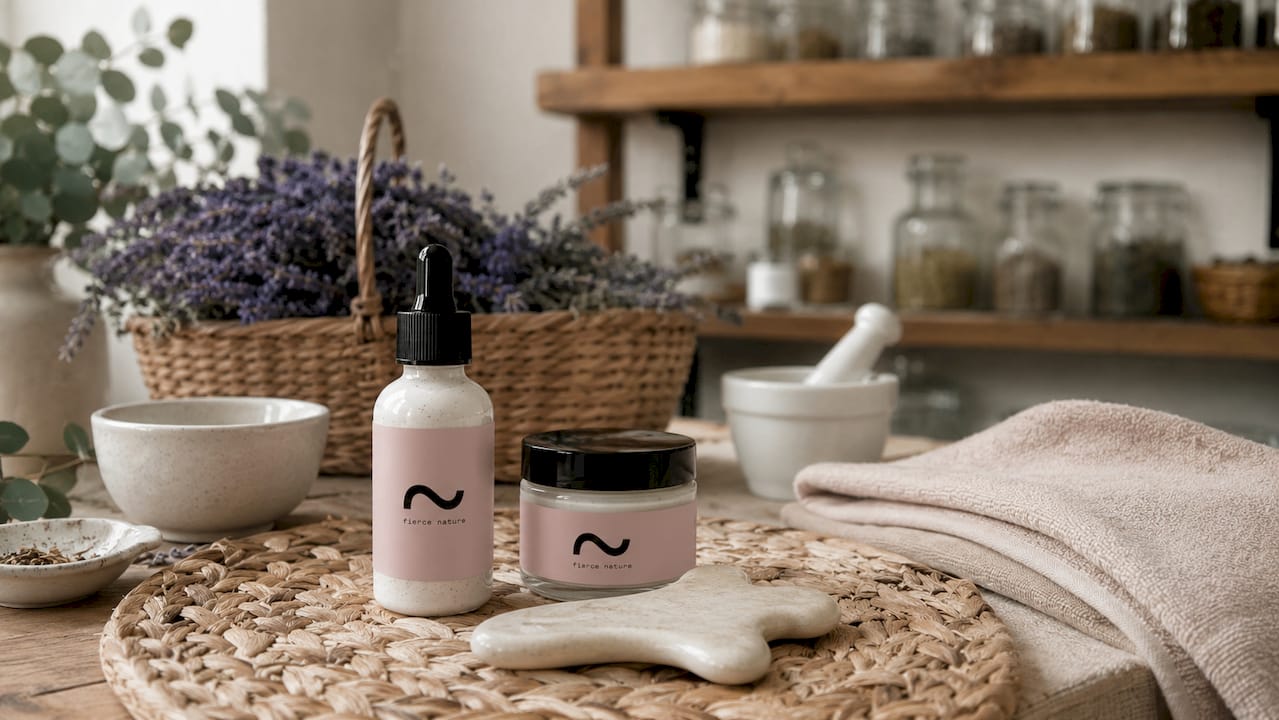
The skin is not a passive barrier. It is a living organ that breathes, regulates temperature, and absorbs compounds directly into the bloodstream. When you layer synthetic ingredients onto it daily, you are not just coating the surface. You are feeding your body a cocktail of substances it was never designed to process. Choosing ingredients that support the skin’s natural functions, rather than overwhelming it with synthetic additives, is the foundation of effective non-toxic beauty.
Organic certification matters here because it provides independent verification. In the UK, certifications from bodies such as the Soil Association and COSMOS Organic confirm that ingredients meet strict standards for purity, sourcing, and processing. A product labelled “natural” without certification can still contain synthetic preservatives. Certification is the difference between a genuine commitment and a marketing claim. Understanding what organic certified means in skincare gives you the tools to read labels with confidence.
Effective natural routines require only 3–5 well-chosen certified formulations rather than complex multi-step processes. This is genuinely good news. Fewer products mean fewer opportunities for irritation, lower cost, and a clearer understanding of what is actually working for your skin.
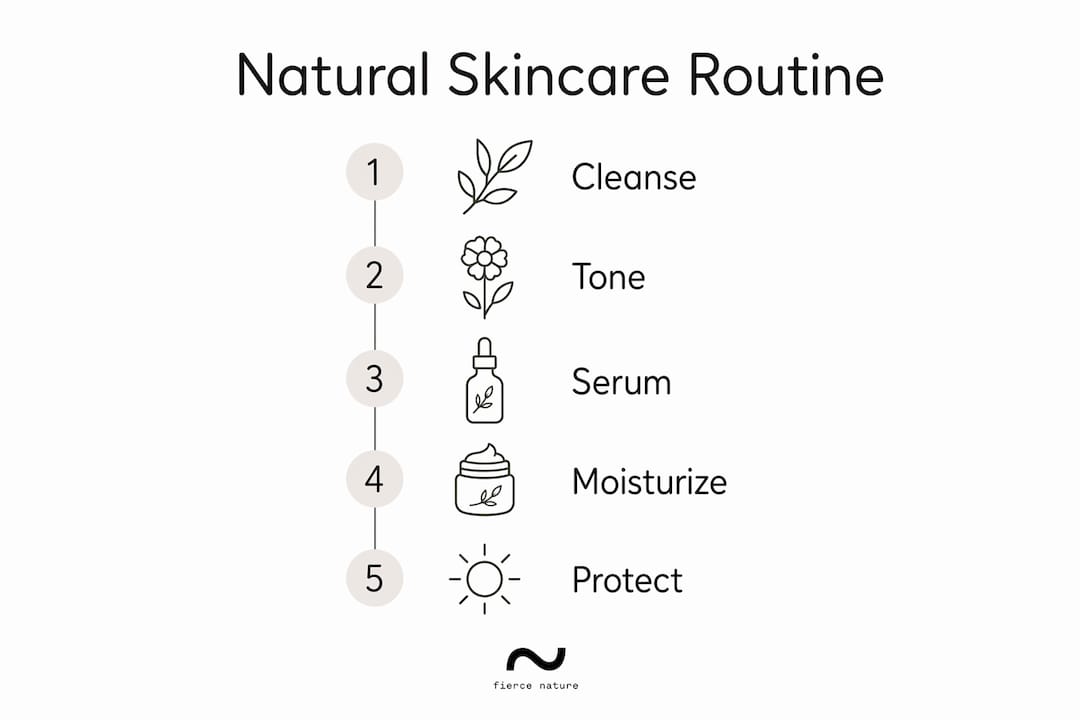
The core products for a clean, organic skincare routine are:
Cleanser: A gentle, oil-based or cream cleanser removes impurities without stripping the skin’s natural oils. Avoid foaming cleansers with sodium lauryl sulphate, which disrupts the skin barrier.
Toner: An optional but useful step. A simple rosewater or witch hazel toner balances skin pH after cleansing. Choose alcohol-free formulations.
Serum or treatment oil: This is where potent, single-ingredient options shine. Certified organic rosehip oil contains a minimum of 80% combined Omega 3, 6, and 9 essential fatty acids. That density of essential fatty acids makes it one of the most nourishing single-ingredient treatments available.
Moisturiser or balm: A rich, whole-food moisturiser seals in hydration and supports the skin barrier. Tallow-based balms, like those made by Fierce Nature, are particularly effective because tallow’s fatty acid profile closely mirrors the skin’s own sebum.
Morning routines focus on protection, using lighter textures that sit comfortably under clothing or light coverage. Evening routines focus on cleansing and recovery, where richer formulations can work overnight without interference. This distinction is not arbitrary. Skin cell renewal peaks at night, so applying your most nourishing products before bed gives them the best possible conditions to work.
Pro Tip: Apply your serum or facial oil to slightly damp skin immediately after cleansing. This simple step significantly improves absorption and means you need less product overall.
Whole-plant ingredients retain complex nutrient profiles that isolated or processed botanical compounds cannot replicate. When you choose a product made with whole rosehip fruit oil rather than a synthetic rosehip fragrance, you are getting the full spectrum of vitamins, antioxidants, and fatty acids the plant contains. That complexity is what makes natural skincare products genuinely restorative.
Natural or organic does not guarantee gentleness for every skin type. Potency varies significantly between botanical ingredients, and compatibility depends on your individual skin chemistry. This is one of the most important things to understand before switching to a clean beauty routine.
Different skin types need different approaches:
Oily or combination skin: Lightweight oils such as jojoba or squalane absorb quickly and do not clog pores. Avoid heavy balms on the T-zone. A simple cleanser, a light serum, and a gel-based moisturiser work well.
Dry or mature skin: Richer formulations with tallow, shea butter, or rosehip oil provide the deep nourishment dry skin needs. Fierce Nature’s tallow-based balms are particularly suited here because tallow penetrates deeply rather than sitting on the surface.
Sensitive skin: Fragrance, even natural fragrance from essential oils, is the most common trigger for reactions. Start with unscented formulations and introduce one product at a time. A guide to natural skincare for sensitive skin can help you navigate this carefully.
Introducing new products gradually over 2–4 weeks helps you identify any reactions caused by botanical ingredients. This is not overcaution. It is the only reliable way to know which product is responsible if something does not agree with your skin. Patch testing on the inner arm for 48 hours before full application is the standard method.
Some botanicals are genuinely potent. Undiluted essential oils, high-concentration vitamin C serums, and certain plant acids can cause reactions in sensitive individuals. Natural does not mean mild. It means the source is plant or animal-derived. Always test new skincare products before committing to full use.
Pro Tip: Keep a simple skincare diary for the first month of any new routine. Note what you applied, when, and how your skin responded. Patterns become obvious quickly, and you will never need to guess what caused a reaction.
The biggest misconception about chemical free skincare is that it is literally free of chemicals. All matter is chemical by nature. The phrase signals the avoidance of synthetic, harsh, or unnecessary substances rather than the literal absence of chemistry. Understanding this distinction shifts your focus from fear to informed choice, which is far more useful.
Here are the most common challenges people face when switching to a non-toxic beauty routine, and how to address each one:
The transition period. Transitioning to chemical-free skincare often includes a period where skin may react before it balances. Conventional products, particularly those with silicones and synthetic emollients, create a surface layer the skin becomes dependent on. When you remove them, the skin needs time to recalibrate its own oil production. This can last two to four weeks and may involve temporary breakouts or dryness. It is not a sign that natural products are not working.
Greenwashing. The term “natural” carries no legal definition in UK cosmetics regulation. A product can be labelled natural while containing synthetic preservatives, artificial colours, and petroleum-derived ingredients. Learning to read an INCI (International Nomenclature of Cosmetic Ingredients) list is the most reliable defence. Ingredients are listed in descending order of concentration, so the first five tell you most of what you need to know. Understanding greenwashed beauty products protects you from paying a premium for products that do not deliver.
Over-complexity. Many people switch to natural skincare and immediately build a ten-step routine, replacing each synthetic product with a natural equivalent. Simplified routines avoid excessive steps and support sensitive skin by reducing the risk of irritation and ingredient conflict. More products do not mean better results. They mean more variables and more opportunities for your skin to react.
Expecting instant results. Conventional products often contain ingredients that create an immediate visual effect, such as silicones that smooth the skin’s surface on contact. Natural formulations work differently. They nourish and repair over time rather than masking. Give any new routine at least six weeks before evaluating results.
Ignoring ingredient quality. Not all natural ingredients are equal. Cold-pressed, unrefined oils retain far more nutrients than refined versions. Small-batch, freshly made products are less likely to contain high levels of preservatives. The sourcing and processing of an ingredient matters as much as the ingredient itself.
Consistency is the single most important factor in any skincare routine. A simple routine you follow every day outperforms a complex one you abandon after a week. The goal is to make your routine easy enough that it requires no decision-making.
Here is how to build and maintain a routine that lasts:
Start with the minimum. A cleanser, a treatment oil, and a moisturiser cover the three core functions: cleanse, treat, and protect. Add products only when you have a specific, identified need.
Apply products in the right order. Thinnest to thickest. Cleanse first, then apply any serum or oil, then seal with a balm or moisturiser. This order maximises absorption and prevents heavier products from blocking lighter ones.
Use damp skin to your advantage. Applying serums and oils on damp skin significantly improves their absorption. Pat your face dry but leave it slightly moist before applying your treatment oil.
Choose small-batch products. Freshly made, small-batch formulations contain fewer preservatives and retain higher ingredient integrity. Fierce Nature makes all products by hand in the UK for exactly this reason.
Protect in the morning, repair at night. Use your lightest products in the morning to create a clean base. Reserve your richest, most nourishing balms for the evening when your skin is in active repair mode.
Pro Tip: If your skin feels tight or uncomfortable after cleansing, your cleanser is too harsh. A good natural cleanser should leave your skin feeling clean but comfortable, never stripped.
The benefits of organic skincare ingredients become most apparent when you give them time and consistency. Skin renewal takes approximately 28 days, so any honest evaluation of a new routine needs at least that long. Patience is not passive. It is part of the practice.
Effective chemical free skincare is built on simplicity, ingredient quality, and consistency rather than complexity or the number of products used.
| Point | Details |
|---|---|
| Define the term correctly | “Chemical free” means avoiding synthetic, harsh, or unnecessary ingredients, not the literal absence of chemistry. |
| Keep routines minimal | A 3–5 product routine outperforms a ten-step one by reducing irritation and making consistency easier. |
| Match products to your skin type | Natural does not mean universally gentle; always patch test and introduce products gradually over 2–4 weeks. |
| Time your routine deliberately | Use lighter products in the morning for protection and richer formulations at night for repair and nourishment. |
| Prioritise ingredient quality | Cold-pressed, unrefined, and small-batch formulations retain more nutrients and require fewer preservatives. |
The most common mistake people make when switching to natural skincare is trying to replicate their old routine product for product. They swap a synthetic serum for a natural serum, a synthetic moisturiser for a natural moisturiser, and end up with just as many products and just as much confusion. The real shift is not in the products. It is in the philosophy.
We started Fierce Nature because we lived the consequences of conventional beauty. Skin rashes, unexplained reactions, and the slow realisation that the products promising to fix our skin were contributing to the problem. What we found when we stripped everything back was that the skin, given the right support, is remarkably capable of looking after itself.
The ingredients that work best are the ones the body already recognises. Tallow, for example, has been used for centuries as a skin emollient because its fatty acid profile is almost identical to human sebum. It does not sit on the surface. It feeds the skin at a cellular level. That bioavailability is something no synthetic ingredient can replicate.
We have also learned that the transition period is real and worth pushing through. The first two to four weeks of switching can feel discouraging. Your skin is recalibrating. It is learning to function without the synthetic scaffolding it has relied on. Stay consistent, keep your routine simple, and trust the process. The skin that emerges on the other side is genuinely different: calmer, more balanced, and more resilient.
Mindfulness about ingredient choices also extends to sustainability. Small-batch, handmade products generate less waste, use fewer synthetic preservatives, and support more transparent supply chains. Choosing natural skincare is not just a decision for your skin. It is a decision for the wider world your skin lives in.
— Fierce Nature
Fierce Nature handcrafts every product in the UK using premium, naturally sourced ingredients with pure organic tallow as the foundation. The Luxe Face Balm is a bestseller for good reason: it delivers deep nourishment without synthetic additives, making it ideal for dry, sensitive, or mature skin. For a versatile everyday option, the Unscented Tallow Bar works on both face and body, fragrance-free and suitable for the most reactive skin types. Every formulation is transparent about its ingredients, made in small batches for freshness, and built on the principle that your skin deserves food, not chemistry. Browse the full organic face and body balms collection to find the right fit for your routine.
“Chemical free skincare” is a consumer term for products that avoid synthetic, harsh, or unnecessary ingredients. All matter is technically chemical, so the phrase signals clean formulation rather than the literal absence of chemistry.
Skin renewal takes approximately 28 days, so allow at least six weeks before evaluating any new routine. The first two to four weeks may include a transition period as your skin adjusts from synthetic product dependence.
Natural does not automatically mean gentle. Some botanical ingredients are highly potent and can cause reactions. Patch testing each new product over 48 hours and introducing one product at a time is the safest approach for sensitive skin.
An effective organic skincare routine requires only 3–5 well-chosen products. A cleanser, a treatment oil, and a moisturiser or balm cover the core functions without overloading the skin.
“Natural” has no legal definition in UK cosmetics regulation and can appear on products containing synthetic ingredients. Certified organic, verified by bodies such as the Soil Association or COSMOS Organic, confirms that ingredients meet independently audited standards for purity and sourcing.
TL;DR:
- Organic skincare ingredients are plant-derived actives that nourish, protect, and restore skin without synthetic chemicals. They deliver essential nutrients like fatty acids and antioxidants that work harmoniously with the skin’s natural biology. Choosing certified organic products supports skin health and environmental sustainability through pure, biodegradable ingredients.
Organic skincare ingredients are plant-derived actives that nourish, protect, and restore skin without the synthetic pesticides, parabens, or artificial fragrances found in conventional cosmetics. The benefits of organic skincare ingredients extend well beyond avoiding irritants. They deliver essential fatty acids, vitamins, and antioxidants that work with your skin’s natural biology rather than against it. At Fierce Nature, we believe the land provides everything your skin truly needs. This article walks you through the top advantages, the science behind specific botanicals, and how to choose products that genuinely deliver on their promises.
Organic skincare formulations reduce the likelihood of skin reactions by removing synthetic pesticides, parabens, and artificial fragrances from the equation. For anyone with sensitive or reactive skin, this is the single most meaningful difference. Conventional products often contain petrochemical stabilisers and synthetic emulsifiers that disrupt the skin barrier over time. Organic alternatives use plant-based emulsifiers that support rather than compromise your skin’s protective layer.
The deeper advantage lies in what organic ingredients actively contribute. Rosehip seed oil, for example, delivers essential fatty acids and vitamin C precursors that improve hydration and texture with consistent use. Green tea extract provides antioxidant protection against UV damage and environmental pollution. These are not passive ingredients. They feed your skin at a cellular level.
Fierce Nature builds every formulation on this principle. Pure organic tallow forms the foundation of our range because its fatty acid profile mirrors the lipids naturally present in human skin. That bioavailability means it penetrates deeply rather than sitting on the surface.
Rosehip seed oil is one of the top organic skincare ingredients for texture, tone, and hydration. It is rich in linoleic acid and oleic acid, two essential fatty acids the skin cannot produce on its own. It also contains natural precursors to vitamin A, which support cell turnover and reduce the appearance of fine lines and uneven pigmentation.
Regular use of rosehip seed oil visibly improves skin texture within four to six weeks for most skin types. The oil absorbs quickly without leaving a greasy residue, making it suitable for oily and combination skin as well as dry skin. Its anti-inflammatory properties also make it a strong choice for post-blemish recovery.
Pro Tip: Store rosehip seed oil in a dark glass bottle away from direct sunlight. Natural lipids oxidise faster than synthetic alternatives, so proper storage protects potency and extends shelf life.
Green tea extract contains epigallocatechin gallate, commonly known as EGCG, one of the most studied antioxidants in skincare science. Scientific studies document its ability to protect against free radical damage and inhibit enzymes linked to collagen breakdown. This makes it particularly valuable for anyone concerned about premature ageing or pollution-related skin stress.
Green tea extract also carries measurable anti-inflammatory properties. Applied topically, it calms redness, reduces puffiness, and supports recovery after sun exposure. For urban skin exposed to daily environmental stressors, it functions as a daily shield.
The organic sourcing of green tea extract matters here. Conventionally grown tea plants are among the most heavily pesticide-treated crops in the world. Choosing certified organic green tea extract means the antioxidant benefit arrives without a side order of chemical residue.
Aloe vera is the benchmark ingredient for soothing skin inflammation and accelerating healing in reactive or damaged skin. Its gel contains polysaccharides that form a protective film over the skin surface, locking in moisture while reducing transepidermal water loss. It also contains acemannan, a compound with documented wound-healing and antimicrobial properties.
For those with conditions such as eczema, rosacea, or post-procedure sensitivity, aloe vera provides immediate relief without the risk of further irritation. It is one of the few botanicals with a strong enough evidence base to appear in both cosmetic and clinical dermatology contexts. Fierce Nature recommends it as a cornerstone ingredient for anyone building a gentle skincare routine around sensitive skin.
Jojoba oil is technically a liquid wax rather than a true oil, and that distinction matters. Its molecular structure closely resembles the skin’s own sebum, which means it absorbs without blocking pores and helps regulate natural oil production. This makes it one of the most versatile carrier oils across all skin types.
Sunflower oil is rich in linoleic acid, a fatty acid that plays a direct role in maintaining the skin’s lipid matrix. A compromised lipid matrix leads to moisture loss, sensitivity, and increased reactivity. Sunflower oil replenishes this matrix, restoring the skin’s ability to hold water and resist environmental triggers.
Together, jojoba and sunflower oils form a strong base for any organic formulation. They carry active botanicals deeper into the skin while contributing their own nourishing properties. Fierce Nature uses both in formulations designed to feed the skin rather than simply coat it.
Organic farming practices protect soil biodiversity by avoiding synthetic pesticides, herbicides, and genetically modified organisms. Healthy soil produces more nutrient-dense plants, which in turn yield more potent botanical extracts. The environmental benefit and the skincare benefit are directly connected.
Organic cosmetic ingredients are also biodegradable. They break down naturally without releasing harmful chemical residues into waterways. Conventional cosmetic ingredients, particularly synthetic preservatives and petrochemical derivatives, persist in water systems and accumulate in aquatic ecosystems. Choosing organic is a vote for cleaner rivers and healthier oceans.
Pro Tip: Look for brands that publish their sourcing practices, not just their ingredient lists. Transparent supply chains are a reliable indicator of genuine environmental commitment.
Here is a direct comparison of the environmental impact between organic and conventional cosmetic ingredient production:
| Factor | Organic Ingredients | Conventional Ingredients |
|---|---|---|
| Pesticide use | None permitted | Synthetic pesticides applied routinely |
| Soil health | Supported through crop rotation and composting | Depleted by chemical inputs over time |
| Biodegradability | Fully biodegradable | Synthetic compounds persist in waterways |
| GMO status | Prohibited | Permitted in many formulations |
| Supply chain transparency | Audited by certification bodies | Variable and often unverified |
Fierce Nature sources ingredients with full traceability because we believe what goes into the land matters as much as what goes onto your skin.
Greenwashing is widespread in the beauty industry. Front-label claims like “natural,” “botanical,” or “plant-based” carry no legal weight and require no third-party verification. The only reliable way to confirm organic authenticity is through official certification.
Look for these markers when selecting products:
COSMOS Organic certification: The European standard for organic and natural cosmetics, audited by bodies such as the Soil Association in the UK.
USDA Organic: The American equivalent, widely recognised globally and requiring at least 95% certified organic ingredients.
Soil Association certification: The UK’s most trusted organic standard, covering both ingredient sourcing and manufacturing practices.
Full ingredient lists: Authentic organic products display INCI names transparently. Avoid products that list vague terms like “fragrance” without specifying the source.
Concentration of actives: A product can be certified organic yet contain only trace amounts of the hero ingredient. Check that the active botanical appears within the first five ingredients on the list.
Switching to organic skincare can trigger a short adjustment period as your skin adapts to natural ingredients and the absence of synthetic fillers. This is normal. Give any new organic product at least four weeks before assessing results.
Organic products also have a shorter shelf life because they lack synthetic preservatives. Proper storage away from light and heat prevents oxidation of natural lipids and preserves potency. This is not a flaw. It is evidence that the formulation is genuinely clean.
The organic vs synthetic skincare debate is not a simple win for either side. Each approach has genuine strengths, and understanding both helps you build a routine that actually works.
Organic ingredients excel in gentle, daily maintenance. They are particularly well suited to sensitive, reactive, or compromised skin because they avoid synthetic additives that disrupt the skin barrier. They also deliver vitamins, antioxidants, and fatty acids that nourish skin over time rather than producing short-term surface effects.
Conventional skincare products can achieve higher concentrations of certain actives because synthetic stabilisers extend shelf life and prevent ingredient degradation. Active concentration and formulation stability are more critical to visible results than whether an ingredient is natural or synthetic. This is an important nuance that the organic skincare industry does not always acknowledge honestly.
| Attribute | Organic Skincare | Synthetic Skincare |
|---|---|---|
| Irritation risk | Lower for most skin types | Higher, particularly with fragrances and preservatives |
| Active concentration | Moderate, limited by stability | Higher, supported by synthetic stabilisers |
| Environmental impact | Low, biodegradable | Higher, persistent chemical residues |
| Shelf life | Shorter, requires careful storage | Longer due to synthetic preservatives |
| Skin barrier support | Strong, lipid-based nourishment | Variable, some ingredients disrupt barrier function |
The most effective approach combines the purity of organic ingredients with sound formulation science. Fierce Nature’s tallow-based formulations demonstrate this. Tallow is entirely natural, yet its bioavailability and fatty acid profile make it one of the most scientifically compelling skin nourishment ingredients available. You can explore how to build your organic routine with ingredients that deliver on both counts.
Organic skincare ingredients deliver genuine skin benefits through plant-derived nutrients, reduced irritant exposure, and formulations that support rather than compromise the skin’s natural barrier.
| Point | Details |
|---|---|
| Avoid synthetic irritants | Certified organic formulas remove parabens, synthetic pesticides, and artificial fragrances that trigger reactions. |
| Plant actives nourish deeply | Rosehip, aloe vera, and green tea extract deliver antioxidants and fatty acids that feed skin at a cellular level. |
| Certifications prevent greenwashing | Look for COSMOS, USDA Organic, or Soil Association marks rather than front-label marketing claims. |
| Formulation quality determines results | Active concentration and stability matter as much as organic status for visible skin improvement. |
| Environmental benefits are real | Organic ingredient sourcing protects soil health, biodiversity, and waterways through biodegradable, pesticide-free farming. |
We started Fierce Nature because we lived the consequences of conventional beauty. Growing up surrounded by mainstream cosmetics, the skin rashes and reactions felt like personal failings. They were not. They were the predictable result of applying synthetic chemicals to skin that was never designed to tolerate them.
What we have learned since is that the organic skincare conversation is often oversimplified. Some brands use “organic” as a marketing shortcut, loading products with certified ingredients at negligible concentrations while the base formula remains full of synthetic fillers. That is not what we do, and it is not what you deserve.
The ingredients that have genuinely transformed skin health in our experience are the ones that mirror what skin already produces. Tallow. Jojoba. Rosehip. Aloe. These are not trends. They are the materials human skin has been nourished by for centuries. The science now confirms what traditional practice always knew.
We also want to be honest about one common misconception: organic does not automatically mean safe for every person. Some botanical actives cause genuine reactions in certain individuals. Patch testing matters. Reading ingredient lists matters. Choosing certified products from transparent brands matters far more than trusting a “natural” label on the front of a bottle.
Our advice is to start simply. One or two well-formulated organic products used consistently will outperform a shelf full of mediocre ones. Give your skin time to adjust, store your products correctly, and pay attention to how your skin responds rather than how a product is marketed.
— Fierce Nature
Fierce Nature handcrafts every product in the UK using premium, naturally sourced ingredients with pure organic tallow at the core. Our organic face and body balms are formulated without synthetic preservatives, petrochemicals, or artificial fragrances. Every ingredient earns its place. If you are ready to see what genuinely clean skincare can do for your skin, explore our toxin-free skincare routine guide and find the right starting point for your skin type. Real results come from real ingredients, and we are here to help you find them.
Organic skincare ingredients reduce irritation risk by avoiding synthetic pesticides, parabens, and artificial fragrances. They also deliver plant-derived antioxidants, essential fatty acids, and vitamins that nourish and protect skin over time.
Check for third-party certifications such as COSMOS Organic, USDA Organic, or Soil Association approval. Front-label terms like “natural” or “botanical” carry no legal requirement and are not a reliable indicator of organic authenticity.
Organic ingredients excel at gentle, daily nourishment and are particularly effective for sensitive skin. Visible results depend on active concentration and formulation quality, not simply on whether ingredients are organic or synthetic.
A short adjustment period is normal when switching to organic skincare, as skin adapts to natural ingredients and the absence of synthetic fillers. Patch testing new products and introducing them gradually reduces the risk of unwanted reactions.
Organic formulations lack synthetic preservatives, which means natural lipids and botanicals can oxidise more quickly. Storing products away from light and heat preserves their potency and extends their usable life.
TL;DR:
- Chemical free skincare avoids synthetic and harsh ingredients, using naturally sourced products that support the skin’s health. Certified organic products ensure genuine purity, reducing exposure to potentially harmful additives. A simple routine of three to five well-chosen, high-quality products provides effective nourishment and better results over time.
Chemical free skincare is defined as the practice of choosing products that avoid synthetic, harsh, or unnecessary ingredients, focusing instead on naturally sourced, skin-supportive formulations that work with your skin’s own biology. The industry term for this approach is “clean beauty,” though “non-toxic beauty” is increasingly used by UK regulators and certification bodies. Your skin absorbs what you put on it, and the cumulative effect of synthetic additives, preservatives, and artificial fragrances adds to what researchers call your body’s toxic load. Fierce Nature was built on this exact understanding: that the promises made by conventional beauty products are largely misleading, and that genuinely nourishing skin means returning to ingredients the body already recognises. A simplified, well-chosen natural skincare routine is not a compromise. It is an upgrade.
Chemical free skincare, in its truest sense, means avoiding synthetic additives that disrupt the skin’s natural functions rather than supporting them. Every substance on earth is technically a chemical, including water and vitamin C, so the phrase is a consumer shorthand. What it really signals is the absence of parabens, synthetic fragrances, petroleum derivatives, and harsh preservatives that serve the product’s shelf life rather than your skin’s health.
The skin is not a passive barrier. It is a living organ that breathes, regulates temperature, and absorbs compounds directly into the bloodstream. When you layer synthetic ingredients onto it daily, you are not just coating the surface. You are feeding your body a cocktail of substances it was never designed to process. Choosing ingredients that support the skin’s natural functions, rather than overwhelming it with synthetic additives, is the foundation of effective non-toxic beauty.
Organic certification matters here because it provides independent verification. In the UK, certifications from bodies such as the Soil Association and COSMOS Organic confirm that ingredients meet strict standards for purity, sourcing, and processing. A product labelled “natural” without certification can still contain synthetic preservatives. Certification is the difference between a genuine commitment and a marketing claim. Understanding what organic certified means in skincare gives you the tools to read labels with confidence.
Effective natural routines require only 3–5 well-chosen certified formulations rather than complex multi-step processes. This is genuinely good news. Fewer products mean fewer opportunities for irritation, lower cost, and a clearer understanding of what is actually working for your skin.
The core products for a clean, organic skincare routine are:
Cleanser: A gentle, oil-based or cream cleanser removes impurities without stripping the skin’s natural oils. Avoid foaming cleansers with sodium lauryl sulphate, which disrupts the skin barrier.
Toner: An optional but useful step. A simple rosewater or witch hazel toner balances skin pH after cleansing. Choose alcohol-free formulations.
Serum or treatment oil: This is where potent, single-ingredient options shine. Certified organic rosehip oil contains a minimum of 80% combined Omega 3, 6, and 9 essential fatty acids. That density of essential fatty acids makes it one of the most nourishing single-ingredient treatments available.
Moisturiser or balm: A rich, whole-food moisturiser seals in hydration and supports the skin barrier. Tallow-based balms, like those made by Fierce Nature, are particularly effective because tallow’s fatty acid profile closely mirrors the skin’s own sebum.
Morning routines focus on protection, using lighter textures that sit comfortably under clothing or light coverage. Evening routines focus on cleansing and recovery, where richer formulations can work overnight without interference. This distinction is not arbitrary. Skin cell renewal peaks at night, so applying your most nourishing products before bed gives them the best possible conditions to work.
Pro Tip: Apply your serum or facial oil to slightly damp skin immediately after cleansing. This simple step significantly improves absorption and means you need less product overall.
Whole-plant ingredients retain complex nutrient profiles that isolated or processed botanical compounds cannot replicate. When you choose a product made with whole rosehip fruit oil rather than a synthetic rosehip fragrance, you are getting the full spectrum of vitamins, antioxidants, and fatty acids the plant contains. That complexity is what makes natural skincare products genuinely restorative.
Natural or organic does not guarantee gentleness for every skin type. Potency varies significantly between botanical ingredients, and compatibility depends on your individual skin chemistry. This is one of the most important things to understand before switching to a clean beauty routine.
Different skin types need different approaches:
Oily or combination skin: Lightweight oils such as jojoba or squalane absorb quickly and do not clog pores. Avoid heavy balms on the T-zone. A simple cleanser, a light serum, and a gel-based moisturiser work well.
Dry or mature skin: Richer formulations with tallow, shea butter, or rosehip oil provide the deep nourishment dry skin needs. Fierce Nature’s tallow-based balms are particularly suited here because tallow penetrates deeply rather than sitting on the surface.
Sensitive skin: Fragrance, even natural fragrance from essential oils, is the most common trigger for reactions. Start with unscented formulations and introduce one product at a time. A guide to natural skincare for sensitive skin can help you navigate this carefully.
Introducing new products gradually over 2–4 weeks helps you identify any reactions caused by botanical ingredients. This is not overcaution. It is the only reliable way to know which product is responsible if something does not agree with your skin. Patch testing on the inner arm for 48 hours before full application is the standard method.
Some botanicals are genuinely potent. Undiluted essential oils, high-concentration vitamin C serums, and certain plant acids can cause reactions in sensitive individuals. Natural does not mean mild. It means the source is plant or animal-derived. Always test new skincare products before committing to full use.
Pro Tip: Keep a simple skincare diary for the first month of any new routine. Note what you applied, when, and how your skin responded. Patterns become obvious quickly, and you will never need to guess what caused a reaction.
The biggest misconception about chemical free skincare is that it is literally free of chemicals. All matter is chemical by nature. The phrase signals the avoidance of synthetic, harsh, or unnecessary substances rather than the literal absence of chemistry. Understanding this distinction shifts your focus from fear to informed choice, which is far more useful.
Here are the most common challenges people face when switching to a non-toxic beauty routine, and how to address each one:
The transition period. Transitioning to chemical-free skincare often includes a period where skin may react before it balances. Conventional products, particularly those with silicones and synthetic emollients, create a surface layer the skin becomes dependent on. When you remove them, the skin needs time to recalibrate its own oil production. This can last two to four weeks and may involve temporary breakouts or dryness. It is not a sign that natural products are not working.
Greenwashing. The term “natural” carries no legal definition in UK cosmetics regulation. A product can be labelled natural while containing synthetic preservatives, artificial colours, and petroleum-derived ingredients. Learning to read an INCI (International Nomenclature of Cosmetic Ingredients) list is the most reliable defence. Ingredients are listed in descending order of concentration, so the first five tell you most of what you need to know. Understanding greenwashed beauty products protects you from paying a premium for products that do not deliver.
Over-complexity. Many people switch to natural skincare and immediately build a ten-step routine, replacing each synthetic product with a natural equivalent. Simplified routines avoid excessive steps and support sensitive skin by reducing the risk of irritation and ingredient conflict. More products do not mean better results. They mean more variables and more opportunities for your skin to react.
Expecting instant results. Conventional products often contain ingredients that create an immediate visual effect, such as silicones that smooth the skin’s surface on contact. Natural formulations work differently. They nourish and repair over time rather than masking. Give any new routine at least six weeks before evaluating results.
Ignoring ingredient quality. Not all natural ingredients are equal. Cold-pressed, unrefined oils retain far more nutrients than refined versions. Small-batch, freshly made products are less likely to contain high levels of preservatives. The sourcing and processing of an ingredient matters as much as the ingredient itself.
Consistency is the single most important factor in any skincare routine. A simple routine you follow every day outperforms a complex one you abandon after a week. The goal is to make your routine easy enough that it requires no decision-making.
Here is how to build and maintain a routine that lasts:
Start with the minimum. A cleanser, a treatment oil, and a moisturiser cover the three core functions: cleanse, treat, and protect. Add products only when you have a specific, identified need.
Apply products in the right order. Thinnest to thickest. Cleanse first, then apply any serum or oil, then seal with a balm or moisturiser. This order maximises absorption and prevents heavier products from blocking lighter ones.
Use damp skin to your advantage. Applying serums and oils on damp skin significantly improves their absorption. Pat your face dry but leave it slightly moist before applying your treatment oil.
Choose small-batch products. Freshly made, small-batch formulations contain fewer preservatives and retain higher ingredient integrity. Fierce Nature makes all products by hand in the UK for exactly this reason.
Protect in the morning, repair at night. Use your lightest products in the morning to create a clean base. Reserve your richest, most nourishing balms for the evening when your skin is in active repair mode.
Pro Tip: If your skin feels tight or uncomfortable after cleansing, your cleanser is too harsh. A good natural cleanser should leave your skin feeling clean but comfortable, never stripped.
The benefits of organic skincare ingredients become most apparent when you give them time and consistency. Skin renewal takes approximately 28 days, so any honest evaluation of a new routine needs at least that long. Patience is not passive. It is part of the practice.
Effective chemical free skincare is built on simplicity, ingredient quality, and consistency rather than complexity or the number of products used.
| Point | Details |
|---|---|
| Define the term correctly | “Chemical free” means avoiding synthetic, harsh, or unnecessary ingredients, not the literal absence of chemistry. |
| Keep routines minimal | A 3–5 product routine outperforms a ten-step one by reducing irritation and making consistency easier. |
| Match products to your skin type | Natural does not mean universally gentle; always patch test and introduce products gradually over 2–4 weeks. |
| Time your routine deliberately | Use lighter products in the morning for protection and richer formulations at night for repair and nourishment. |
| Prioritise ingredient quality | Cold-pressed, unrefined, and small-batch formulations retain more nutrients and require fewer preservatives. |
The most common mistake people make when switching to natural skincare is trying to replicate their old routine product for product. They swap a synthetic serum for a natural serum, a synthetic moisturiser for a natural moisturiser, and end up with just as many products and just as much confusion. The real shift is not in the products. It is in the philosophy.
We started Fierce Nature because we lived the consequences of conventional beauty. Skin rashes, unexplained reactions, and the slow realisation that the products promising to fix our skin were contributing to the problem. What we found when we stripped everything back was that the skin, given the right support, is remarkably capable of looking after itself.
The ingredients that work best are the ones the body already recognises. Tallow, for example, has been used for centuries as a skin emollient because its fatty acid profile is almost identical to human sebum. It does not sit on the surface. It feeds the skin at a cellular level. That bioavailability is something no synthetic ingredient can replicate.
We have also learned that the transition period is real and worth pushing through. The first two to four weeks of switching can feel discouraging. Your skin is recalibrating. It is learning to function without the synthetic scaffolding it has relied on. Stay consistent, keep your routine simple, and trust the process. The skin that emerges on the other side is genuinely different: calmer, more balanced, and more resilient.
Mindfulness about ingredient choices also extends to sustainability. Small-batch, handmade products generate less waste, use fewer synthetic preservatives, and support more transparent supply chains. Choosing natural skincare is not just a decision for your skin. It is a decision for the wider world your skin lives in.
— Fierce Nature
Fierce Nature handcrafts every product in the UK using premium, naturally sourced ingredients with pure organic tallow as the foundation. The Luxe Face Balm is a bestseller for good reason: it delivers deep nourishment without synthetic additives, making it ideal for dry, sensitive, or mature skin. For a versatile everyday option, the Unscented Tallow Bar works on both face and body, fragrance-free and suitable for the most reactive skin types. Every formulation is transparent about its ingredients, made in small batches for freshness, and built on the principle that your skin deserves food, not chemistry. Browse the full organic face and body balms collection to find the right fit for your routine.
“Chemical free skincare” is a consumer term for products that avoid synthetic, harsh, or unnecessary ingredients. All matter is technically chemical, so the phrase signals clean formulation rather than the literal absence of chemistry.
Skin renewal takes approximately 28 days, so allow at least six weeks before evaluating any new routine. The first two to four weeks may include a transition period as your skin adjusts from synthetic product dependence.
Natural does not automatically mean gentle. Some botanical ingredients are highly potent and can cause reactions. Patch testing each new product over 48 hours and introducing one product at a time is the safest approach for sensitive skin.
An effective organic skincare routine requires only 3–5 well-chosen products. A cleanser, a treatment oil, and a moisturiser or balm cover the core functions without overloading the skin.
“Natural” has no legal definition in UK cosmetics regulation and can appear on products containing synthetic ingredients. Certified organic, verified by bodies such as the Soil Association or COSMOS Organic, confirms that ingredients meet independently audited standards for purity and sourcing.
TL;DR:
- Organic skincare ingredients are plant-derived actives that nourish, protect, and restore skin without synthetic chemicals. They deliver essential nutrients like fatty acids and antioxidants that work harmoniously with the skin’s natural biology. Choosing certified organic products supports skin health and environmental sustainability through pure, biodegradable ingredients.
Organic skincare ingredients are plant-derived actives that nourish, protect, and restore skin without the synthetic pesticides, parabens, or artificial fragrances found in conventional cosmetics. The benefits of organic skincare ingredients extend well beyond avoiding irritants. They deliver essential fatty acids, vitamins, and antioxidants that work with your skin’s natural biology rather than against it. At Fierce Nature, we believe the land provides everything your skin truly needs. This article walks you through the top advantages, the science behind specific botanicals, and how to choose products that genuinely deliver on their promises.
Organic skincare formulations reduce the likelihood of skin reactions by removing synthetic pesticides, parabens, and artificial fragrances from the equation. For anyone with sensitive or reactive skin, this is the single most meaningful difference. Conventional products often contain petrochemical stabilisers and synthetic emulsifiers that disrupt the skin barrier over time. Organic alternatives use plant-based emulsifiers that support rather than compromise your skin’s protective layer.
The deeper advantage lies in what organic ingredients actively contribute. Rosehip seed oil, for example, delivers essential fatty acids and vitamin C precursors that improve hydration and texture with consistent use. Green tea extract provides antioxidant protection against UV damage and environmental pollution. These are not passive ingredients. They feed your skin at a cellular level.
Fierce Nature builds every formulation on this principle. Pure organic tallow forms the foundation of our range because its fatty acid profile mirrors the lipids naturally present in human skin. That bioavailability means it penetrates deeply rather than sitting on the surface.
Rosehip seed oil is one of the top organic skincare ingredients for texture, tone, and hydration. It is rich in linoleic acid and oleic acid, two essential fatty acids the skin cannot produce on its own. It also contains natural precursors to vitamin A, which support cell turnover and reduce the appearance of fine lines and uneven pigmentation.
Regular use of rosehip seed oil visibly improves skin texture within four to six weeks for most skin types. The oil absorbs quickly without leaving a greasy residue, making it suitable for oily and combination skin as well as dry skin. Its anti-inflammatory properties also make it a strong choice for post-blemish recovery.
Pro Tip: Store rosehip seed oil in a dark glass bottle away from direct sunlight. Natural lipids oxidise faster than synthetic alternatives, so proper storage protects potency and extends shelf life.
Green tea extract contains epigallocatechin gallate, commonly known as EGCG, one of the most studied antioxidants in skincare science. Scientific studies document its ability to protect against free radical damage and inhibit enzymes linked to collagen breakdown. This makes it particularly valuable for anyone concerned about premature ageing or pollution-related skin stress.
Green tea extract also carries measurable anti-inflammatory properties. Applied topically, it calms redness, reduces puffiness, and supports recovery after sun exposure. For urban skin exposed to daily environmental stressors, it functions as a daily shield.
The organic sourcing of green tea extract matters here. Conventionally grown tea plants are among the most heavily pesticide-treated crops in the world. Choosing certified organic green tea extract means the antioxidant benefit arrives without a side order of chemical residue.
Aloe vera is the benchmark ingredient for soothing skin inflammation and accelerating healing in reactive or damaged skin. Its gel contains polysaccharides that form a protective film over the skin surface, locking in moisture while reducing transepidermal water loss. It also contains acemannan, a compound with documented wound-healing and antimicrobial properties.
For those with conditions such as eczema, rosacea, or post-procedure sensitivity, aloe vera provides immediate relief without the risk of further irritation. It is one of the few botanicals with a strong enough evidence base to appear in both cosmetic and clinical dermatology contexts. Fierce Nature recommends it as a cornerstone ingredient for anyone building a gentle skincare routine around sensitive skin.
Jojoba oil is technically a liquid wax rather than a true oil, and that distinction matters. Its molecular structure closely resembles the skin’s own sebum, which means it absorbs without blocking pores and helps regulate natural oil production. This makes it one of the most versatile carrier oils across all skin types.
Sunflower oil is rich in linoleic acid, a fatty acid that plays a direct role in maintaining the skin’s lipid matrix. A compromised lipid matrix leads to moisture loss, sensitivity, and increased reactivity. Sunflower oil replenishes this matrix, restoring the skin’s ability to hold water and resist environmental triggers.
Together, jojoba and sunflower oils form a strong base for any organic formulation. They carry active botanicals deeper into the skin while contributing their own nourishing properties. Fierce Nature uses both in formulations designed to feed the skin rather than simply coat it.
Organic farming practices protect soil biodiversity by avoiding synthetic pesticides, herbicides, and genetically modified organisms. Healthy soil produces more nutrient-dense plants, which in turn yield more potent botanical extracts. The environmental benefit and the skincare benefit are directly connected.
Organic cosmetic ingredients are also biodegradable. They break down naturally without releasing harmful chemical residues into waterways. Conventional cosmetic ingredients, particularly synthetic preservatives and petrochemical derivatives, persist in water systems and accumulate in aquatic ecosystems. Choosing organic is a vote for cleaner rivers and healthier oceans.
Pro Tip: Look for brands that publish their sourcing practices, not just their ingredient lists. Transparent supply chains are a reliable indicator of genuine environmental commitment.
Here is a direct comparison of the environmental impact between organic and conventional cosmetic ingredient production:
| Factor | Organic Ingredients | Conventional Ingredients |
|---|---|---|
| Pesticide use | None permitted | Synthetic pesticides applied routinely |
| Soil health | Supported through crop rotation and composting | Depleted by chemical inputs over time |
| Biodegradability | Fully biodegradable | Synthetic compounds persist in waterways |
| GMO status | Prohibited | Permitted in many formulations |
| Supply chain transparency | Audited by certification bodies | Variable and often unverified |
Fierce Nature sources ingredients with full traceability because we believe what goes into the land matters as much as what goes onto your skin.
Greenwashing is widespread in the beauty industry. Front-label claims like “natural,” “botanical,” or “plant-based” carry no legal weight and require no third-party verification. The only reliable way to confirm organic authenticity is through official certification.
Look for these markers when selecting products:
COSMOS Organic certification: The European standard for organic and natural cosmetics, audited by bodies such as the Soil Association in the UK.
USDA Organic: The American equivalent, widely recognised globally and requiring at least 95% certified organic ingredients.
Soil Association certification: The UK’s most trusted organic standard, covering both ingredient sourcing and manufacturing practices.
Full ingredient lists: Authentic organic products display INCI names transparently. Avoid products that list vague terms like “fragrance” without specifying the source.
Concentration of actives: A product can be certified organic yet contain only trace amounts of the hero ingredient. Check that the active botanical appears within the first five ingredients on the list.
Switching to organic skincare can trigger a short adjustment period as your skin adapts to natural ingredients and the absence of synthetic fillers. This is normal. Give any new organic product at least four weeks before assessing results.
Organic products also have a shorter shelf life because they lack synthetic preservatives. Proper storage away from light and heat prevents oxidation of natural lipids and preserves potency. This is not a flaw. It is evidence that the formulation is genuinely clean.
The organic vs synthetic skincare debate is not a simple win for either side. Each approach has genuine strengths, and understanding both helps you build a routine that actually works.
Organic ingredients excel in gentle, daily maintenance. They are particularly well suited to sensitive, reactive, or compromised skin because they avoid synthetic additives that disrupt the skin barrier. They also deliver vitamins, antioxidants, and fatty acids that nourish skin over time rather than producing short-term surface effects.
Conventional skincare products can achieve higher concentrations of certain actives because synthetic stabilisers extend shelf life and prevent ingredient degradation. Active concentration and formulation stability are more critical to visible results than whether an ingredient is natural or synthetic. This is an important nuance that the organic skincare industry does not always acknowledge honestly.
| Attribute | Organic Skincare | Synthetic Skincare |
|---|---|---|
| Irritation risk | Lower for most skin types | Higher, particularly with fragrances and preservatives |
| Active concentration | Moderate, limited by stability | Higher, supported by synthetic stabilisers |
| Environmental impact | Low, biodegradable | Higher, persistent chemical residues |
| Shelf life | Shorter, requires careful storage | Longer due to synthetic preservatives |
| Skin barrier support | Strong, lipid-based nourishment | Variable, some ingredients disrupt barrier function |
The most effective approach combines the purity of organic ingredients with sound formulation science. Fierce Nature’s tallow-based formulations demonstrate this. Tallow is entirely natural, yet its bioavailability and fatty acid profile make it one of the most scientifically compelling skin nourishment ingredients available. You can explore how to build your organic routine with ingredients that deliver on both counts.
Organic skincare ingredients deliver genuine skin benefits through plant-derived nutrients, reduced irritant exposure, and formulations that support rather than compromise the skin’s natural barrier.
| Point | Details |
|---|---|
| Avoid synthetic irritants | Certified organic formulas remove parabens, synthetic pesticides, and artificial fragrances that trigger reactions. |
| Plant actives nourish deeply | Rosehip, aloe vera, and green tea extract deliver antioxidants and fatty acids that feed skin at a cellular level. |
| Certifications prevent greenwashing | Look for COSMOS, USDA Organic, or Soil Association marks rather than front-label marketing claims. |
| Formulation quality determines results | Active concentration and stability matter as much as organic status for visible skin improvement. |
| Environmental benefits are real | Organic ingredient sourcing protects soil health, biodiversity, and waterways through biodegradable, pesticide-free farming. |
We started Fierce Nature because we lived the consequences of conventional beauty. Growing up surrounded by mainstream cosmetics, the skin rashes and reactions felt like personal failings. They were not. They were the predictable result of applying synthetic chemicals to skin that was never designed to tolerate them.
What we have learned since is that the organic skincare conversation is often oversimplified. Some brands use “organic” as a marketing shortcut, loading products with certified ingredients at negligible concentrations while the base formula remains full of synthetic fillers. That is not what we do, and it is not what you deserve.
The ingredients that have genuinely transformed skin health in our experience are the ones that mirror what skin already produces. Tallow. Jojoba. Rosehip. Aloe. These are not trends. They are the materials human skin has been nourished by for centuries. The science now confirms what traditional practice always knew.
We also want to be honest about one common misconception: organic does not automatically mean safe for every person. Some botanical actives cause genuine reactions in certain individuals. Patch testing matters. Reading ingredient lists matters. Choosing certified products from transparent brands matters far more than trusting a “natural” label on the front of a bottle.
Our advice is to start simply. One or two well-formulated organic products used consistently will outperform a shelf full of mediocre ones. Give your skin time to adjust, store your products correctly, and pay attention to how your skin responds rather than how a product is marketed.
— Fierce Nature
Fierce Nature handcrafts every product in the UK using premium, naturally sourced ingredients with pure organic tallow at the core. Our organic face and body balms are formulated without synthetic preservatives, petrochemicals, or artificial fragrances. Every ingredient earns its place. If you are ready to see what genuinely clean skincare can do for your skin, explore our toxin-free skincare routine guide and find the right starting point for your skin type. Real results come from real ingredients, and we are here to help you find them.
Organic skincare ingredients reduce irritation risk by avoiding synthetic pesticides, parabens, and artificial fragrances. They also deliver plant-derived antioxidants, essential fatty acids, and vitamins that nourish and protect skin over time.
Check for third-party certifications such as COSMOS Organic, USDA Organic, or Soil Association approval. Front-label terms like “natural” or “botanical” carry no legal requirement and are not a reliable indicator of organic authenticity.
Organic ingredients excel at gentle, daily nourishment and are particularly effective for sensitive skin. Visible results depend on active concentration and formulation quality, not simply on whether ingredients are organic or synthetic.
A short adjustment period is normal when switching to organic skincare, as skin adapts to natural ingredients and the absence of synthetic fillers. Patch testing new products and introducing them gradually reduces the risk of unwanted reactions.
Organic formulations lack synthetic preservatives, which means natural lipids and botanicals can oxidise more quickly. Storing products away from light and heat preserves their potency and extends their usable life.
TL;DR:
- Chemical free skincare avoids synthetic and harsh ingredients, using naturally sourced products that support the skin’s health. Certified organic products ensure genuine purity, reducing exposure to potentially harmful additives. A simple routine of three to five well-chosen, high-quality products provides effective nourishment and better results over time.
Chemical free skincare is defined as the practice of choosing products that avoid synthetic, harsh, or unnecessary ingredients, focusing instead on naturally sourced, skin-supportive formulations that work with your skin’s own biology. The industry term for this approach is “clean beauty,” though “non-toxic beauty” is increasingly used by UK regulators and certification bodies. Your skin absorbs what you put on it, and the cumulative effect of synthetic additives, preservatives, and artificial fragrances adds to what researchers call your body’s toxic load. Fierce Nature was built on this exact understanding: that the promises made by conventional beauty products are largely misleading, and that genuinely nourishing skin means returning to ingredients the body already recognises. A simplified, well-chosen natural skincare routine is not a compromise. It is an upgrade.
Chemical free skincare, in its truest sense, means avoiding synthetic additives that disrupt the skin’s natural functions rather than supporting them. Every substance on earth is technically a chemical, including water and vitamin C, so the phrase is a consumer shorthand. What it really signals is the absence of parabens, synthetic fragrances, petroleum derivatives, and harsh preservatives that serve the product’s shelf life rather than your skin’s health.
The skin is not a passive barrier. It is a living organ that breathes, regulates temperature, and absorbs compounds directly into the bloodstream. When you layer synthetic ingredients onto it daily, you are not just coating the surface. You are feeding your body a cocktail of substances it was never designed to process. Choosing ingredients that support the skin’s natural functions, rather than overwhelming it with synthetic additives, is the foundation of effective non-toxic beauty.
Organic certification matters here because it provides independent verification. In the UK, certifications from bodies such as the Soil Association and COSMOS Organic confirm that ingredients meet strict standards for purity, sourcing, and processing. A product labelled “natural” without certification can still contain synthetic preservatives. Certification is the difference between a genuine commitment and a marketing claim. Understanding what organic certified means in skincare gives you the tools to read labels with confidence.
Effective natural routines require only 3–5 well-chosen certified formulations rather than complex multi-step processes. This is genuinely good news. Fewer products mean fewer opportunities for irritation, lower cost, and a clearer understanding of what is actually working for your skin.
The core products for a clean, organic skincare routine are:
Cleanser: A gentle, oil-based or cream cleanser removes impurities without stripping the skin’s natural oils. Avoid foaming cleansers with sodium lauryl sulphate, which disrupts the skin barrier.
Toner: An optional but useful step. A simple rosewater or witch hazel toner balances skin pH after cleansing. Choose alcohol-free formulations.
Serum or treatment oil: This is where potent, single-ingredient options shine. Certified organic rosehip oil contains a minimum of 80% combined Omega 3, 6, and 9 essential fatty acids. That density of essential fatty acids makes it one of the most nourishing single-ingredient treatments available.
Moisturiser or balm: A rich, whole-food moisturiser seals in hydration and supports the skin barrier. Tallow-based balms, like those made by Fierce Nature, are particularly effective because tallow’s fatty acid profile closely mirrors the skin’s own sebum.
Morning routines focus on protection, using lighter textures that sit comfortably under clothing or light coverage. Evening routines focus on cleansing and recovery, where richer formulations can work overnight without interference. This distinction is not arbitrary. Skin cell renewal peaks at night, so applying your most nourishing products before bed gives them the best possible conditions to work.
Pro Tip: Apply your serum or facial oil to slightly damp skin immediately after cleansing. This simple step significantly improves absorption and means you need less product overall.
Whole-plant ingredients retain complex nutrient profiles that isolated or processed botanical compounds cannot replicate. When you choose a product made with whole rosehip fruit oil rather than a synthetic rosehip fragrance, you are getting the full spectrum of vitamins, antioxidants, and fatty acids the plant contains. That complexity is what makes natural skincare products genuinely restorative.
Natural or organic does not guarantee gentleness for every skin type. Potency varies significantly between botanical ingredients, and compatibility depends on your individual skin chemistry. This is one of the most important things to understand before switching to a clean beauty routine.
Different skin types need different approaches:
Oily or combination skin: Lightweight oils such as jojoba or squalane absorb quickly and do not clog pores. Avoid heavy balms on the T-zone. A simple cleanser, a light serum, and a gel-based moisturiser work well.
Dry or mature skin: Richer formulations with tallow, shea butter, or rosehip oil provide the deep nourishment dry skin needs. Fierce Nature’s tallow-based balms are particularly suited here because tallow penetrates deeply rather than sitting on the surface.
Sensitive skin: Fragrance, even natural fragrance from essential oils, is the most common trigger for reactions. Start with unscented formulations and introduce one product at a time. A guide to natural skincare for sensitive skin can help you navigate this carefully.
Introducing new products gradually over 2–4 weeks helps you identify any reactions caused by botanical ingredients. This is not overcaution. It is the only reliable way to know which product is responsible if something does not agree with your skin. Patch testing on the inner arm for 48 hours before full application is the standard method.
Some botanicals are genuinely potent. Undiluted essential oils, high-concentration vitamin C serums, and certain plant acids can cause reactions in sensitive individuals. Natural does not mean mild. It means the source is plant or animal-derived. Always test new skincare products before committing to full use.
Pro Tip: Keep a simple skincare diary for the first month of any new routine. Note what you applied, when, and how your skin responded. Patterns become obvious quickly, and you will never need to guess what caused a reaction.
The biggest misconception about chemical free skincare is that it is literally free of chemicals. All matter is chemical by nature. The phrase signals the avoidance of synthetic, harsh, or unnecessary substances rather than the literal absence of chemistry. Understanding this distinction shifts your focus from fear to informed choice, which is far more useful.
Here are the most common challenges people face when switching to a non-toxic beauty routine, and how to address each one:
The transition period. Transitioning to chemical-free skincare often includes a period where skin may react before it balances. Conventional products, particularly those with silicones and synthetic emollients, create a surface layer the skin becomes dependent on. When you remove them, the skin needs time to recalibrate its own oil production. This can last two to four weeks and may involve temporary breakouts or dryness. It is not a sign that natural products are not working.
Greenwashing. The term “natural” carries no legal definition in UK cosmetics regulation. A product can be labelled natural while containing synthetic preservatives, artificial colours, and petroleum-derived ingredients. Learning to read an INCI (International Nomenclature of Cosmetic Ingredients) list is the most reliable defence. Ingredients are listed in descending order of concentration, so the first five tell you most of what you need to know. Understanding greenwashed beauty products protects you from paying a premium for products that do not deliver.
Over-complexity. Many people switch to natural skincare and immediately build a ten-step routine, replacing each synthetic product with a natural equivalent. Simplified routines avoid excessive steps and support sensitive skin by reducing the risk of irritation and ingredient conflict. More products do not mean better results. They mean more variables and more opportunities for your skin to react.
Expecting instant results. Conventional products often contain ingredients that create an immediate visual effect, such as silicones that smooth the skin’s surface on contact. Natural formulations work differently. They nourish and repair over time rather than masking. Give any new routine at least six weeks before evaluating results.
Ignoring ingredient quality. Not all natural ingredients are equal. Cold-pressed, unrefined oils retain far more nutrients than refined versions. Small-batch, freshly made products are less likely to contain high levels of preservatives. The sourcing and processing of an ingredient matters as much as the ingredient itself.
Consistency is the single most important factor in any skincare routine. A simple routine you follow every day outperforms a complex one you abandon after a week. The goal is to make your routine easy enough that it requires no decision-making.
Here is how to build and maintain a routine that lasts:
Start with the minimum. A cleanser, a treatment oil, and a moisturiser cover the three core functions: cleanse, treat, and protect. Add products only when you have a specific, identified need.
Apply products in the right order. Thinnest to thickest. Cleanse first, then apply any serum or oil, then seal with a balm or moisturiser. This order maximises absorption and prevents heavier products from blocking lighter ones.
Use damp skin to your advantage. Applying serums and oils on damp skin significantly improves their absorption. Pat your face dry but leave it slightly moist before applying your treatment oil.
Choose small-batch products. Freshly made, small-batch formulations contain fewer preservatives and retain higher ingredient integrity. Fierce Nature makes all products by hand in the UK for exactly this reason.
Protect in the morning, repair at night. Use your lightest products in the morning to create a clean base. Reserve your richest, most nourishing balms for the evening when your skin is in active repair mode.
Pro Tip: If your skin feels tight or uncomfortable after cleansing, your cleanser is too harsh. A good natural cleanser should leave your skin feeling clean but comfortable, never stripped.
The benefits of organic skincare ingredients become most apparent when you give them time and consistency. Skin renewal takes approximately 28 days, so any honest evaluation of a new routine needs at least that long. Patience is not passive. It is part of the practice.
Effective chemical free skincare is built on simplicity, ingredient quality, and consistency rather than complexity or the number of products used.
| Point | Details |
|---|---|
| Define the term correctly | “Chemical free” means avoiding synthetic, harsh, or unnecessary ingredients, not the literal absence of chemistry. |
| Keep routines minimal | A 3–5 product routine outperforms a ten-step one by reducing irritation and making consistency easier. |
| Match products to your skin type | Natural does not mean universally gentle; always patch test and introduce products gradually over 2–4 weeks. |
| Time your routine deliberately | Use lighter products in the morning for protection and richer formulations at night for repair and nourishment. |
| Prioritise ingredient quality | Cold-pressed, unrefined, and small-batch formulations retain more nutrients and require fewer preservatives. |
The most common mistake people make when switching to natural skincare is trying to replicate their old routine product for product. They swap a synthetic serum for a natural serum, a synthetic moisturiser for a natural moisturiser, and end up with just as many products and just as much confusion. The real shift is not in the products. It is in the philosophy.
We started Fierce Nature because we lived the consequences of conventional beauty. Skin rashes, unexplained reactions, and the slow realisation that the products promising to fix our skin were contributing to the problem. What we found when we stripped everything back was that the skin, given the right support, is remarkably capable of looking after itself.
The ingredients that work best are the ones the body already recognises. Tallow, for example, has been used for centuries as a skin emollient because its fatty acid profile is almost identical to human sebum. It does not sit on the surface. It feeds the skin at a cellular level. That bioavailability is something no synthetic ingredient can replicate.
We have also learned that the transition period is real and worth pushing through. The first two to four weeks of switching can feel discouraging. Your skin is recalibrating. It is learning to function without the synthetic scaffolding it has relied on. Stay consistent, keep your routine simple, and trust the process. The skin that emerges on the other side is genuinely different: calmer, more balanced, and more resilient.
Mindfulness about ingredient choices also extends to sustainability. Small-batch, handmade products generate less waste, use fewer synthetic preservatives, and support more transparent supply chains. Choosing natural skincare is not just a decision for your skin. It is a decision for the wider world your skin lives in.
— Fierce Nature
Fierce Nature handcrafts every product in the UK using premium, naturally sourced ingredients with pure organic tallow as the foundation. The Luxe Face Balm is a bestseller for good reason: it delivers deep nourishment without synthetic additives, making it ideal for dry, sensitive, or mature skin. For a versatile everyday option, the Unscented Tallow Bar works on both face and body, fragrance-free and suitable for the most reactive skin types. Every formulation is transparent about its ingredients, made in small batches for freshness, and built on the principle that your skin deserves food, not chemistry. Browse the full organic face and body balms collection to find the right fit for your routine.
“Chemical free skincare” is a consumer term for products that avoid synthetic, harsh, or unnecessary ingredients. All matter is technically chemical, so the phrase signals clean formulation rather than the literal absence of chemistry.
Skin renewal takes approximately 28 days, so allow at least six weeks before evaluating any new routine. The first two to four weeks may include a transition period as your skin adjusts from synthetic product dependence.
Natural does not automatically mean gentle. Some botanical ingredients are highly potent and can cause reactions. Patch testing each new product over 48 hours and introducing one product at a time is the safest approach for sensitive skin.
An effective organic skincare routine requires only 3–5 well-chosen products. A cleanser, a treatment oil, and a moisturiser or balm cover the core functions without overloading the skin.
“Natural” has no legal definition in UK cosmetics regulation and can appear on products containing synthetic ingredients. Certified organic, verified by bodies such as the Soil Association or COSMOS Organic, confirms that ingredients meet independently audited standards for purity and sourcing.
TL;DR:
- Organic skincare ingredients are plant-derived actives that nourish, protect, and restore skin without synthetic chemicals. They deliver essential nutrients like fatty acids and antioxidants that work harmoniously with the skin’s natural biology. Choosing certified organic products supports skin health and environmental sustainability through pure, biodegradable ingredients.
Organic skincare ingredients are plant-derived actives that nourish, protect, and restore skin without the synthetic pesticides, parabens, or artificial fragrances found in conventional cosmetics. The benefits of organic skincare ingredients extend well beyond avoiding irritants. They deliver essential fatty acids, vitamins, and antioxidants that work with your skin’s natural biology rather than against it. At Fierce Nature, we believe the land provides everything your skin truly needs. This article walks you through the top advantages, the science behind specific botanicals, and how to choose products that genuinely deliver on their promises.
Organic skincare formulations reduce the likelihood of skin reactions by removing synthetic pesticides, parabens, and artificial fragrances from the equation. For anyone with sensitive or reactive skin, this is the single most meaningful difference. Conventional products often contain petrochemical stabilisers and synthetic emulsifiers that disrupt the skin barrier over time. Organic alternatives use plant-based emulsifiers that support rather than compromise your skin’s protective layer.
The deeper advantage lies in what organic ingredients actively contribute. Rosehip seed oil, for example, delivers essential fatty acids and vitamin C precursors that improve hydration and texture with consistent use. Green tea extract provides antioxidant protection against UV damage and environmental pollution. These are not passive ingredients. They feed your skin at a cellular level.
Fierce Nature builds every formulation on this principle. Pure organic tallow forms the foundation of our range because its fatty acid profile mirrors the lipids naturally present in human skin. That bioavailability means it penetrates deeply rather than sitting on the surface.
Rosehip seed oil is one of the top organic skincare ingredients for texture, tone, and hydration. It is rich in linoleic acid and oleic acid, two essential fatty acids the skin cannot produce on its own. It also contains natural precursors to vitamin A, which support cell turnover and reduce the appearance of fine lines and uneven pigmentation.
Regular use of rosehip seed oil visibly improves skin texture within four to six weeks for most skin types. The oil absorbs quickly without leaving a greasy residue, making it suitable for oily and combination skin as well as dry skin. Its anti-inflammatory properties also make it a strong choice for post-blemish recovery.
Pro Tip: Store rosehip seed oil in a dark glass bottle away from direct sunlight. Natural lipids oxidise faster than synthetic alternatives, so proper storage protects potency and extends shelf life.
Green tea extract contains epigallocatechin gallate, commonly known as EGCG, one of the most studied antioxidants in skincare science. Scientific studies document its ability to protect against free radical damage and inhibit enzymes linked to collagen breakdown. This makes it particularly valuable for anyone concerned about premature ageing or pollution-related skin stress.
Green tea extract also carries measurable anti-inflammatory properties. Applied topically, it calms redness, reduces puffiness, and supports recovery after sun exposure. For urban skin exposed to daily environmental stressors, it functions as a daily shield.
The organic sourcing of green tea extract matters here. Conventionally grown tea plants are among the most heavily pesticide-treated crops in the world. Choosing certified organic green tea extract means the antioxidant benefit arrives without a side order of chemical residue.
Aloe vera is the benchmark ingredient for soothing skin inflammation and accelerating healing in reactive or damaged skin. Its gel contains polysaccharides that form a protective film over the skin surface, locking in moisture while reducing transepidermal water loss. It also contains acemannan, a compound with documented wound-healing and antimicrobial properties.
For those with conditions such as eczema, rosacea, or post-procedure sensitivity, aloe vera provides immediate relief without the risk of further irritation. It is one of the few botanicals with a strong enough evidence base to appear in both cosmetic and clinical dermatology contexts. Fierce Nature recommends it as a cornerstone ingredient for anyone building a gentle skincare routine around sensitive skin.
Jojoba oil is technically a liquid wax rather than a true oil, and that distinction matters. Its molecular structure closely resembles the skin’s own sebum, which means it absorbs without blocking pores and helps regulate natural oil production. This makes it one of the most versatile carrier oils across all skin types.
Sunflower oil is rich in linoleic acid, a fatty acid that plays a direct role in maintaining the skin’s lipid matrix. A compromised lipid matrix leads to moisture loss, sensitivity, and increased reactivity. Sunflower oil replenishes this matrix, restoring the skin’s ability to hold water and resist environmental triggers.
Together, jojoba and sunflower oils form a strong base for any organic formulation. They carry active botanicals deeper into the skin while contributing their own nourishing properties. Fierce Nature uses both in formulations designed to feed the skin rather than simply coat it.
Organic farming practices protect soil biodiversity by avoiding synthetic pesticides, herbicides, and genetically modified organisms. Healthy soil produces more nutrient-dense plants, which in turn yield more potent botanical extracts. The environmental benefit and the skincare benefit are directly connected.
Organic cosmetic ingredients are also biodegradable. They break down naturally without releasing harmful chemical residues into waterways. Conventional cosmetic ingredients, particularly synthetic preservatives and petrochemical derivatives, persist in water systems and accumulate in aquatic ecosystems. Choosing organic is a vote for cleaner rivers and healthier oceans.
Pro Tip: Look for brands that publish their sourcing practices, not just their ingredient lists. Transparent supply chains are a reliable indicator of genuine environmental commitment.
Here is a direct comparison of the environmental impact between organic and conventional cosmetic ingredient production:
| Factor | Organic Ingredients | Conventional Ingredients |
|---|---|---|
| Pesticide use | None permitted | Synthetic pesticides applied routinely |
| Soil health | Supported through crop rotation and composting | Depleted by chemical inputs over time |
| Biodegradability | Fully biodegradable | Synthetic compounds persist in waterways |
| GMO status | Prohibited | Permitted in many formulations |
| Supply chain transparency | Audited by certification bodies | Variable and often unverified |
Fierce Nature sources ingredients with full traceability because we believe what goes into the land matters as much as what goes onto your skin.
Greenwashing is widespread in the beauty industry. Front-label claims like “natural,” “botanical,” or “plant-based” carry no legal weight and require no third-party verification. The only reliable way to confirm organic authenticity is through official certification.
Look for these markers when selecting products:
COSMOS Organic certification: The European standard for organic and natural cosmetics, audited by bodies such as the Soil Association in the UK.
USDA Organic: The American equivalent, widely recognised globally and requiring at least 95% certified organic ingredients.
Soil Association certification: The UK’s most trusted organic standard, covering both ingredient sourcing and manufacturing practices.
Full ingredient lists: Authentic organic products display INCI names transparently. Avoid products that list vague terms like “fragrance” without specifying the source.
Concentration of actives: A product can be certified organic yet contain only trace amounts of the hero ingredient. Check that the active botanical appears within the first five ingredients on the list.
Switching to organic skincare can trigger a short adjustment period as your skin adapts to natural ingredients and the absence of synthetic fillers. This is normal. Give any new organic product at least four weeks before assessing results.
Organic products also have a shorter shelf life because they lack synthetic preservatives. Proper storage away from light and heat prevents oxidation of natural lipids and preserves potency. This is not a flaw. It is evidence that the formulation is genuinely clean.
The organic vs synthetic skincare debate is not a simple win for either side. Each approach has genuine strengths, and understanding both helps you build a routine that actually works.
Organic ingredients excel in gentle, daily maintenance. They are particularly well suited to sensitive, reactive, or compromised skin because they avoid synthetic additives that disrupt the skin barrier. They also deliver vitamins, antioxidants, and fatty acids that nourish skin over time rather than producing short-term surface effects.
Conventional skincare products can achieve higher concentrations of certain actives because synthetic stabilisers extend shelf life and prevent ingredient degradation. Active concentration and formulation stability are more critical to visible results than whether an ingredient is natural or synthetic. This is an important nuance that the organic skincare industry does not always acknowledge honestly.
| Attribute | Organic Skincare | Synthetic Skincare |
|---|---|---|
| Irritation risk | Lower for most skin types | Higher, particularly with fragrances and preservatives |
| Active concentration | Moderate, limited by stability | Higher, supported by synthetic stabilisers |
| Environmental impact | Low, biodegradable | Higher, persistent chemical residues |
| Shelf life | Shorter, requires careful storage | Longer due to synthetic preservatives |
| Skin barrier support | Strong, lipid-based nourishment | Variable, some ingredients disrupt barrier function |
The most effective approach combines the purity of organic ingredients with sound formulation science. Fierce Nature’s tallow-based formulations demonstrate this. Tallow is entirely natural, yet its bioavailability and fatty acid profile make it one of the most scientifically compelling skin nourishment ingredients available. You can explore how to build your organic routine with ingredients that deliver on both counts.
Organic skincare ingredients deliver genuine skin benefits through plant-derived nutrients, reduced irritant exposure, and formulations that support rather than compromise the skin’s natural barrier.
| Point | Details |
|---|---|
| Avoid synthetic irritants | Certified organic formulas remove parabens, synthetic pesticides, and artificial fragrances that trigger reactions. |
| Plant actives nourish deeply | Rosehip, aloe vera, and green tea extract deliver antioxidants and fatty acids that feed skin at a cellular level. |
| Certifications prevent greenwashing | Look for COSMOS, USDA Organic, or Soil Association marks rather than front-label marketing claims. |
| Formulation quality determines results | Active concentration and stability matter as much as organic status for visible skin improvement. |
| Environmental benefits are real | Organic ingredient sourcing protects soil health, biodiversity, and waterways through biodegradable, pesticide-free farming. |
We started Fierce Nature because we lived the consequences of conventional beauty. Growing up surrounded by mainstream cosmetics, the skin rashes and reactions felt like personal failings. They were not. They were the predictable result of applying synthetic chemicals to skin that was never designed to tolerate them.
What we have learned since is that the organic skincare conversation is often oversimplified. Some brands use “organic” as a marketing shortcut, loading products with certified ingredients at negligible concentrations while the base formula remains full of synthetic fillers. That is not what we do, and it is not what you deserve.
The ingredients that have genuinely transformed skin health in our experience are the ones that mirror what skin already produces. Tallow. Jojoba. Rosehip. Aloe. These are not trends. They are the materials human skin has been nourished by for centuries. The science now confirms what traditional practice always knew.
We also want to be honest about one common misconception: organic does not automatically mean safe for every person. Some botanical actives cause genuine reactions in certain individuals. Patch testing matters. Reading ingredient lists matters. Choosing certified products from transparent brands matters far more than trusting a “natural” label on the front of a bottle.
Our advice is to start simply. One or two well-formulated organic products used consistently will outperform a shelf full of mediocre ones. Give your skin time to adjust, store your products correctly, and pay attention to how your skin responds rather than how a product is marketed.
— Fierce Nature
Fierce Nature handcrafts every product in the UK using premium, naturally sourced ingredients with pure organic tallow at the core. Our organic face and body balms are formulated without synthetic preservatives, petrochemicals, or artificial fragrances. Every ingredient earns its place. If you are ready to see what genuinely clean skincare can do for your skin, explore our toxin-free skincare routine guide and find the right starting point for your skin type. Real results come from real ingredients, and we are here to help you find them.
Organic skincare ingredients reduce irritation risk by avoiding synthetic pesticides, parabens, and artificial fragrances. They also deliver plant-derived antioxidants, essential fatty acids, and vitamins that nourish and protect skin over time.
Check for third-party certifications such as COSMOS Organic, USDA Organic, or Soil Association approval. Front-label terms like “natural” or “botanical” carry no legal requirement and are not a reliable indicator of organic authenticity.
Organic ingredients excel at gentle, daily nourishment and are particularly effective for sensitive skin. Visible results depend on active concentration and formulation quality, not simply on whether ingredients are organic or synthetic.
A short adjustment period is normal when switching to organic skincare, as skin adapts to natural ingredients and the absence of synthetic fillers. Patch testing new products and introducing them gradually reduces the risk of unwanted reactions.
Organic formulations lack synthetic preservatives, which means natural lipids and botanicals can oxidise more quickly. Storing products away from light and heat preserves their potency and extends their usable life.
TL;DR:
- Chemical free skincare avoids synthetic and harsh ingredients, using naturally sourced products that support the skin’s health. Certified organic products ensure genuine purity, reducing exposure to potentially harmful additives. A simple routine of three to five well-chosen, high-quality products provides effective nourishment and better results over time.
Chemical free skincare is defined as the practice of choosing products that avoid synthetic, harsh, or unnecessary ingredients, focusing instead on naturally sourced, skin-supportive formulations that work with your skin’s own biology. The industry term for this approach is “clean beauty,” though “non-toxic beauty” is increasingly used by UK regulators and certification bodies. Your skin absorbs what you put on it, and the cumulative effect of synthetic additives, preservatives, and artificial fragrances adds to what researchers call your body’s toxic load. Fierce Nature was built on this exact understanding: that the promises made by conventional beauty products are largely misleading, and that genuinely nourishing skin means returning to ingredients the body already recognises. A simplified, well-chosen natural skincare routine is not a compromise. It is an upgrade.
Chemical free skincare, in its truest sense, means avoiding synthetic additives that disrupt the skin’s natural functions rather than supporting them. Every substance on earth is technically a chemical, including water and vitamin C, so the phrase is a consumer shorthand. What it really signals is the absence of parabens, synthetic fragrances, petroleum derivatives, and harsh preservatives that serve the product’s shelf life rather than your skin’s health.
The skin is not a passive barrier. It is a living organ that breathes, regulates temperature, and absorbs compounds directly into the bloodstream. When you layer synthetic ingredients onto it daily, you are not just coating the surface. You are feeding your body a cocktail of substances it was never designed to process. Choosing ingredients that support the skin’s natural functions, rather than overwhelming it with synthetic additives, is the foundation of effective non-toxic beauty.
Organic certification matters here because it provides independent verification. In the UK, certifications from bodies such as the Soil Association and COSMOS Organic confirm that ingredients meet strict standards for purity, sourcing, and processing. A product labelled “natural” without certification can still contain synthetic preservatives. Certification is the difference between a genuine commitment and a marketing claim. Understanding what organic certified means in skincare gives you the tools to read labels with confidence.
Effective natural routines require only 3–5 well-chosen certified formulations rather than complex multi-step processes. This is genuinely good news. Fewer products mean fewer opportunities for irritation, lower cost, and a clearer understanding of what is actually working for your skin.
The core products for a clean, organic skincare routine are:
Cleanser: A gentle, oil-based or cream cleanser removes impurities without stripping the skin’s natural oils. Avoid foaming cleansers with sodium lauryl sulphate, which disrupts the skin barrier.
Toner: An optional but useful step. A simple rosewater or witch hazel toner balances skin pH after cleansing. Choose alcohol-free formulations.
Serum or treatment oil: This is where potent, single-ingredient options shine. Certified organic rosehip oil contains a minimum of 80% combined Omega 3, 6, and 9 essential fatty acids. That density of essential fatty acids makes it one of the most nourishing single-ingredient treatments available.
Moisturiser or balm: A rich, whole-food moisturiser seals in hydration and supports the skin barrier. Tallow-based balms, like those made by Fierce Nature, are particularly effective because tallow’s fatty acid profile closely mirrors the skin’s own sebum.
Morning routines focus on protection, using lighter textures that sit comfortably under clothing or light coverage. Evening routines focus on cleansing and recovery, where richer formulations can work overnight without interference. This distinction is not arbitrary. Skin cell renewal peaks at night, so applying your most nourishing products before bed gives them the best possible conditions to work.
Pro Tip: Apply your serum or facial oil to slightly damp skin immediately after cleansing. This simple step significantly improves absorption and means you need less product overall.
Whole-plant ingredients retain complex nutrient profiles that isolated or processed botanical compounds cannot replicate. When you choose a product made with whole rosehip fruit oil rather than a synthetic rosehip fragrance, you are getting the full spectrum of vitamins, antioxidants, and fatty acids the plant contains. That complexity is what makes natural skincare products genuinely restorative.
Natural or organic does not guarantee gentleness for every skin type. Potency varies significantly between botanical ingredients, and compatibility depends on your individual skin chemistry. This is one of the most important things to understand before switching to a clean beauty routine.
Different skin types need different approaches:
Oily or combination skin: Lightweight oils such as jojoba or squalane absorb quickly and do not clog pores. Avoid heavy balms on the T-zone. A simple cleanser, a light serum, and a gel-based moisturiser work well.
Dry or mature skin: Richer formulations with tallow, shea butter, or rosehip oil provide the deep nourishment dry skin needs. Fierce Nature’s tallow-based balms are particularly suited here because tallow penetrates deeply rather than sitting on the surface.
Sensitive skin: Fragrance, even natural fragrance from essential oils, is the most common trigger for reactions. Start with unscented formulations and introduce one product at a time. A guide to natural skincare for sensitive skin can help you navigate this carefully.
Introducing new products gradually over 2–4 weeks helps you identify any reactions caused by botanical ingredients. This is not overcaution. It is the only reliable way to know which product is responsible if something does not agree with your skin. Patch testing on the inner arm for 48 hours before full application is the standard method.
Some botanicals are genuinely potent. Undiluted essential oils, high-concentration vitamin C serums, and certain plant acids can cause reactions in sensitive individuals. Natural does not mean mild. It means the source is plant or animal-derived. Always test new skincare products before committing to full use.
Pro Tip: Keep a simple skincare diary for the first month of any new routine. Note what you applied, when, and how your skin responded. Patterns become obvious quickly, and you will never need to guess what caused a reaction.
The biggest misconception about chemical free skincare is that it is literally free of chemicals. All matter is chemical by nature. The phrase signals the avoidance of synthetic, harsh, or unnecessary substances rather than the literal absence of chemistry. Understanding this distinction shifts your focus from fear to informed choice, which is far more useful.
Here are the most common challenges people face when switching to a non-toxic beauty routine, and how to address each one:
The transition period. Transitioning to chemical-free skincare often includes a period where skin may react before it balances. Conventional products, particularly those with silicones and synthetic emollients, create a surface layer the skin becomes dependent on. When you remove them, the skin needs time to recalibrate its own oil production. This can last two to four weeks and may involve temporary breakouts or dryness. It is not a sign that natural products are not working.
Greenwashing. The term “natural” carries no legal definition in UK cosmetics regulation. A product can be labelled natural while containing synthetic preservatives, artificial colours, and petroleum-derived ingredients. Learning to read an INCI (International Nomenclature of Cosmetic Ingredients) list is the most reliable defence. Ingredients are listed in descending order of concentration, so the first five tell you most of what you need to know. Understanding greenwashed beauty products protects you from paying a premium for products that do not deliver.
Over-complexity. Many people switch to natural skincare and immediately build a ten-step routine, replacing each synthetic product with a natural equivalent. Simplified routines avoid excessive steps and support sensitive skin by reducing the risk of irritation and ingredient conflict. More products do not mean better results. They mean more variables and more opportunities for your skin to react.
Expecting instant results. Conventional products often contain ingredients that create an immediate visual effect, such as silicones that smooth the skin’s surface on contact. Natural formulations work differently. They nourish and repair over time rather than masking. Give any new routine at least six weeks before evaluating results.
Ignoring ingredient quality. Not all natural ingredients are equal. Cold-pressed, unrefined oils retain far more nutrients than refined versions. Small-batch, freshly made products are less likely to contain high levels of preservatives. The sourcing and processing of an ingredient matters as much as the ingredient itself.
Consistency is the single most important factor in any skincare routine. A simple routine you follow every day outperforms a complex one you abandon after a week. The goal is to make your routine easy enough that it requires no decision-making.
Here is how to build and maintain a routine that lasts:
Start with the minimum. A cleanser, a treatment oil, and a moisturiser cover the three core functions: cleanse, treat, and protect. Add products only when you have a specific, identified need.
Apply products in the right order. Thinnest to thickest. Cleanse first, then apply any serum or oil, then seal with a balm or moisturiser. This order maximises absorption and prevents heavier products from blocking lighter ones.
Use damp skin to your advantage. Applying serums and oils on damp skin significantly improves their absorption. Pat your face dry but leave it slightly moist before applying your treatment oil.
Choose small-batch products. Freshly made, small-batch formulations contain fewer preservatives and retain higher ingredient integrity. Fierce Nature makes all products by hand in the UK for exactly this reason.
Protect in the morning, repair at night. Use your lightest products in the morning to create a clean base. Reserve your richest, most nourishing balms for the evening when your skin is in active repair mode.
Pro Tip: If your skin feels tight or uncomfortable after cleansing, your cleanser is too harsh. A good natural cleanser should leave your skin feeling clean but comfortable, never stripped.
The benefits of organic skincare ingredients become most apparent when you give them time and consistency. Skin renewal takes approximately 28 days, so any honest evaluation of a new routine needs at least that long. Patience is not passive. It is part of the practice.
Effective chemical free skincare is built on simplicity, ingredient quality, and consistency rather than complexity or the number of products used.
| Point | Details |
|---|---|
| Define the term correctly | “Chemical free” means avoiding synthetic, harsh, or unnecessary ingredients, not the literal absence of chemistry. |
| Keep routines minimal | A 3–5 product routine outperforms a ten-step one by reducing irritation and making consistency easier. |
| Match products to your skin type | Natural does not mean universally gentle; always patch test and introduce products gradually over 2–4 weeks. |
| Time your routine deliberately | Use lighter products in the morning for protection and richer formulations at night for repair and nourishment. |
| Prioritise ingredient quality | Cold-pressed, unrefined, and small-batch formulations retain more nutrients and require fewer preservatives. |
The most common mistake people make when switching to natural skincare is trying to replicate their old routine product for product. They swap a synthetic serum for a natural serum, a synthetic moisturiser for a natural moisturiser, and end up with just as many products and just as much confusion. The real shift is not in the products. It is in the philosophy.
We started Fierce Nature because we lived the consequences of conventional beauty. Skin rashes, unexplained reactions, and the slow realisation that the products promising to fix our skin were contributing to the problem. What we found when we stripped everything back was that the skin, given the right support, is remarkably capable of looking after itself.
The ingredients that work best are the ones the body already recognises. Tallow, for example, has been used for centuries as a skin emollient because its fatty acid profile is almost identical to human sebum. It does not sit on the surface. It feeds the skin at a cellular level. That bioavailability is something no synthetic ingredient can replicate.
We have also learned that the transition period is real and worth pushing through. The first two to four weeks of switching can feel discouraging. Your skin is recalibrating. It is learning to function without the synthetic scaffolding it has relied on. Stay consistent, keep your routine simple, and trust the process. The skin that emerges on the other side is genuinely different: calmer, more balanced, and more resilient.
Mindfulness about ingredient choices also extends to sustainability. Small-batch, handmade products generate less waste, use fewer synthetic preservatives, and support more transparent supply chains. Choosing natural skincare is not just a decision for your skin. It is a decision for the wider world your skin lives in.
— Fierce Nature
Fierce Nature handcrafts every product in the UK using premium, naturally sourced ingredients with pure organic tallow as the foundation. The Luxe Face Balm is a bestseller for good reason: it delivers deep nourishment without synthetic additives, making it ideal for dry, sensitive, or mature skin. For a versatile everyday option, the Unscented Tallow Bar works on both face and body, fragrance-free and suitable for the most reactive skin types. Every formulation is transparent about its ingredients, made in small batches for freshness, and built on the principle that your skin deserves food, not chemistry. Browse the full organic face and body balms collection to find the right fit for your routine.
“Chemical free skincare” is a consumer term for products that avoid synthetic, harsh, or unnecessary ingredients. All matter is technically chemical, so the phrase signals clean formulation rather than the literal absence of chemistry.
Skin renewal takes approximately 28 days, so allow at least six weeks before evaluating any new routine. The first two to four weeks may include a transition period as your skin adjusts from synthetic product dependence.
Natural does not automatically mean gentle. Some botanical ingredients are highly potent and can cause reactions. Patch testing each new product over 48 hours and introducing one product at a time is the safest approach for sensitive skin.
An effective organic skincare routine requires only 3–5 well-chosen products. A cleanser, a treatment oil, and a moisturiser or balm cover the core functions without overloading the skin.
“Natural” has no legal definition in UK cosmetics regulation and can appear on products containing synthetic ingredients. Certified organic, verified by bodies such as the Soil Association or COSMOS Organic, confirms that ingredients meet independently audited standards for purity and sourcing.
TL;DR:
- Organic skincare ingredients are plant-derived actives that nourish, protect, and restore skin without synthetic chemicals. They deliver essential nutrients like fatty acids and antioxidants that work harmoniously with the skin’s natural biology. Choosing certified organic products supports skin health and environmental sustainability through pure, biodegradable ingredients.
Organic skincare ingredients are plant-derived actives that nourish, protect, and restore skin without the synthetic pesticides, parabens, or artificial fragrances found in conventional cosmetics. The benefits of organic skincare ingredients extend well beyond avoiding irritants. They deliver essential fatty acids, vitamins, and antioxidants that work with your skin’s natural biology rather than against it. At Fierce Nature, we believe the land provides everything your skin truly needs. This article walks you through the top advantages, the science behind specific botanicals, and how to choose products that genuinely deliver on their promises.
Organic skincare formulations reduce the likelihood of skin reactions by removing synthetic pesticides, parabens, and artificial fragrances from the equation. For anyone with sensitive or reactive skin, this is the single most meaningful difference. Conventional products often contain petrochemical stabilisers and synthetic emulsifiers that disrupt the skin barrier over time. Organic alternatives use plant-based emulsifiers that support rather than compromise your skin’s protective layer.
The deeper advantage lies in what organic ingredients actively contribute. Rosehip seed oil, for example, delivers essential fatty acids and vitamin C precursors that improve hydration and texture with consistent use. Green tea extract provides antioxidant protection against UV damage and environmental pollution. These are not passive ingredients. They feed your skin at a cellular level.
Fierce Nature builds every formulation on this principle. Pure organic tallow forms the foundation of our range because its fatty acid profile mirrors the lipids naturally present in human skin. That bioavailability means it penetrates deeply rather than sitting on the surface.
Rosehip seed oil is one of the top organic skincare ingredients for texture, tone, and hydration. It is rich in linoleic acid and oleic acid, two essential fatty acids the skin cannot produce on its own. It also contains natural precursors to vitamin A, which support cell turnover and reduce the appearance of fine lines and uneven pigmentation.
Regular use of rosehip seed oil visibly improves skin texture within four to six weeks for most skin types. The oil absorbs quickly without leaving a greasy residue, making it suitable for oily and combination skin as well as dry skin. Its anti-inflammatory properties also make it a strong choice for post-blemish recovery.
Pro Tip: Store rosehip seed oil in a dark glass bottle away from direct sunlight. Natural lipids oxidise faster than synthetic alternatives, so proper storage protects potency and extends shelf life.
Green tea extract contains epigallocatechin gallate, commonly known as EGCG, one of the most studied antioxidants in skincare science. Scientific studies document its ability to protect against free radical damage and inhibit enzymes linked to collagen breakdown. This makes it particularly valuable for anyone concerned about premature ageing or pollution-related skin stress.
Green tea extract also carries measurable anti-inflammatory properties. Applied topically, it calms redness, reduces puffiness, and supports recovery after sun exposure. For urban skin exposed to daily environmental stressors, it functions as a daily shield.
The organic sourcing of green tea extract matters here. Conventionally grown tea plants are among the most heavily pesticide-treated crops in the world. Choosing certified organic green tea extract means the antioxidant benefit arrives without a side order of chemical residue.
Aloe vera is the benchmark ingredient for soothing skin inflammation and accelerating healing in reactive or damaged skin. Its gel contains polysaccharides that form a protective film over the skin surface, locking in moisture while reducing transepidermal water loss. It also contains acemannan, a compound with documented wound-healing and antimicrobial properties.
For those with conditions such as eczema, rosacea, or post-procedure sensitivity, aloe vera provides immediate relief without the risk of further irritation. It is one of the few botanicals with a strong enough evidence base to appear in both cosmetic and clinical dermatology contexts. Fierce Nature recommends it as a cornerstone ingredient for anyone building a gentle skincare routine around sensitive skin.
Jojoba oil is technically a liquid wax rather than a true oil, and that distinction matters. Its molecular structure closely resembles the skin’s own sebum, which means it absorbs without blocking pores and helps regulate natural oil production. This makes it one of the most versatile carrier oils across all skin types.
Sunflower oil is rich in linoleic acid, a fatty acid that plays a direct role in maintaining the skin’s lipid matrix. A compromised lipid matrix leads to moisture loss, sensitivity, and increased reactivity. Sunflower oil replenishes this matrix, restoring the skin’s ability to hold water and resist environmental triggers.
Together, jojoba and sunflower oils form a strong base for any organic formulation. They carry active botanicals deeper into the skin while contributing their own nourishing properties. Fierce Nature uses both in formulations designed to feed the skin rather than simply coat it.
Organic farming practices protect soil biodiversity by avoiding synthetic pesticides, herbicides, and genetically modified organisms. Healthy soil produces more nutrient-dense plants, which in turn yield more potent botanical extracts. The environmental benefit and the skincare benefit are directly connected.
Organic cosmetic ingredients are also biodegradable. They break down naturally without releasing harmful chemical residues into waterways. Conventional cosmetic ingredients, particularly synthetic preservatives and petrochemical derivatives, persist in water systems and accumulate in aquatic ecosystems. Choosing organic is a vote for cleaner rivers and healthier oceans.
Pro Tip: Look for brands that publish their sourcing practices, not just their ingredient lists. Transparent supply chains are a reliable indicator of genuine environmental commitment.
Here is a direct comparison of the environmental impact between organic and conventional cosmetic ingredient production:
| Factor | Organic Ingredients | Conventional Ingredients |
|---|---|---|
| Pesticide use | None permitted | Synthetic pesticides applied routinely |
| Soil health | Supported through crop rotation and composting | Depleted by chemical inputs over time |
| Biodegradability | Fully biodegradable | Synthetic compounds persist in waterways |
| GMO status | Prohibited | Permitted in many formulations |
| Supply chain transparency | Audited by certification bodies | Variable and often unverified |
Fierce Nature sources ingredients with full traceability because we believe what goes into the land matters as much as what goes onto your skin.
Greenwashing is widespread in the beauty industry. Front-label claims like “natural,” “botanical,” or “plant-based” carry no legal weight and require no third-party verification. The only reliable way to confirm organic authenticity is through official certification.
Look for these markers when selecting products:
COSMOS Organic certification: The European standard for organic and natural cosmetics, audited by bodies such as the Soil Association in the UK.
USDA Organic: The American equivalent, widely recognised globally and requiring at least 95% certified organic ingredients.
Soil Association certification: The UK’s most trusted organic standard, covering both ingredient sourcing and manufacturing practices.
Full ingredient lists: Authentic organic products display INCI names transparently. Avoid products that list vague terms like “fragrance” without specifying the source.
Concentration of actives: A product can be certified organic yet contain only trace amounts of the hero ingredient. Check that the active botanical appears within the first five ingredients on the list.
Switching to organic skincare can trigger a short adjustment period as your skin adapts to natural ingredients and the absence of synthetic fillers. This is normal. Give any new organic product at least four weeks before assessing results.
Organic products also have a shorter shelf life because they lack synthetic preservatives. Proper storage away from light and heat prevents oxidation of natural lipids and preserves potency. This is not a flaw. It is evidence that the formulation is genuinely clean.
The organic vs synthetic skincare debate is not a simple win for either side. Each approach has genuine strengths, and understanding both helps you build a routine that actually works.
Organic ingredients excel in gentle, daily maintenance. They are particularly well suited to sensitive, reactive, or compromised skin because they avoid synthetic additives that disrupt the skin barrier. They also deliver vitamins, antioxidants, and fatty acids that nourish skin over time rather than producing short-term surface effects.
Conventional skincare products can achieve higher concentrations of certain actives because synthetic stabilisers extend shelf life and prevent ingredient degradation. Active concentration and formulation stability are more critical to visible results than whether an ingredient is natural or synthetic. This is an important nuance that the organic skincare industry does not always acknowledge honestly.
| Attribute | Organic Skincare | Synthetic Skincare |
|---|---|---|
| Irritation risk | Lower for most skin types | Higher, particularly with fragrances and preservatives |
| Active concentration | Moderate, limited by stability | Higher, supported by synthetic stabilisers |
| Environmental impact | Low, biodegradable | Higher, persistent chemical residues |
| Shelf life | Shorter, requires careful storage | Longer due to synthetic preservatives |
| Skin barrier support | Strong, lipid-based nourishment | Variable, some ingredients disrupt barrier function |
The most effective approach combines the purity of organic ingredients with sound formulation science. Fierce Nature’s tallow-based formulations demonstrate this. Tallow is entirely natural, yet its bioavailability and fatty acid profile make it one of the most scientifically compelling skin nourishment ingredients available. You can explore how to build your organic routine with ingredients that deliver on both counts.
Organic skincare ingredients deliver genuine skin benefits through plant-derived nutrients, reduced irritant exposure, and formulations that support rather than compromise the skin’s natural barrier.
| Point | Details |
|---|---|
| Avoid synthetic irritants | Certified organic formulas remove parabens, synthetic pesticides, and artificial fragrances that trigger reactions. |
| Plant actives nourish deeply | Rosehip, aloe vera, and green tea extract deliver antioxidants and fatty acids that feed skin at a cellular level. |
| Certifications prevent greenwashing | Look for COSMOS, USDA Organic, or Soil Association marks rather than front-label marketing claims. |
| Formulation quality determines results | Active concentration and stability matter as much as organic status for visible skin improvement. |
| Environmental benefits are real | Organic ingredient sourcing protects soil health, biodiversity, and waterways through biodegradable, pesticide-free farming. |
We started Fierce Nature because we lived the consequences of conventional beauty. Growing up surrounded by mainstream cosmetics, the skin rashes and reactions felt like personal failings. They were not. They were the predictable result of applying synthetic chemicals to skin that was never designed to tolerate them.
What we have learned since is that the organic skincare conversation is often oversimplified. Some brands use “organic” as a marketing shortcut, loading products with certified ingredients at negligible concentrations while the base formula remains full of synthetic fillers. That is not what we do, and it is not what you deserve.
The ingredients that have genuinely transformed skin health in our experience are the ones that mirror what skin already produces. Tallow. Jojoba. Rosehip. Aloe. These are not trends. They are the materials human skin has been nourished by for centuries. The science now confirms what traditional practice always knew.
We also want to be honest about one common misconception: organic does not automatically mean safe for every person. Some botanical actives cause genuine reactions in certain individuals. Patch testing matters. Reading ingredient lists matters. Choosing certified products from transparent brands matters far more than trusting a “natural” label on the front of a bottle.
Our advice is to start simply. One or two well-formulated organic products used consistently will outperform a shelf full of mediocre ones. Give your skin time to adjust, store your products correctly, and pay attention to how your skin responds rather than how a product is marketed.
— Fierce Nature
Fierce Nature handcrafts every product in the UK using premium, naturally sourced ingredients with pure organic tallow at the core. Our organic face and body balms are formulated without synthetic preservatives, petrochemicals, or artificial fragrances. Every ingredient earns its place. If you are ready to see what genuinely clean skincare can do for your skin, explore our toxin-free skincare routine guide and find the right starting point for your skin type. Real results come from real ingredients, and we are here to help you find them.
Organic skincare ingredients reduce irritation risk by avoiding synthetic pesticides, parabens, and artificial fragrances. They also deliver plant-derived antioxidants, essential fatty acids, and vitamins that nourish and protect skin over time.
Check for third-party certifications such as COSMOS Organic, USDA Organic, or Soil Association approval. Front-label terms like “natural” or “botanical” carry no legal requirement and are not a reliable indicator of organic authenticity.
Organic ingredients excel at gentle, daily nourishment and are particularly effective for sensitive skin. Visible results depend on active concentration and formulation quality, not simply on whether ingredients are organic or synthetic.
A short adjustment period is normal when switching to organic skincare, as skin adapts to natural ingredients and the absence of synthetic fillers. Patch testing new products and introducing them gradually reduces the risk of unwanted reactions.
Organic formulations lack synthetic preservatives, which means natural lipids and botanicals can oxidise more quickly. Storing products away from light and heat preserves their potency and extends their usable life.
TL;DR:
- Chemical free skincare avoids synthetic and harsh ingredients, using naturally sourced products that support the skin’s health. Certified organic products ensure genuine purity, reducing exposure to potentially harmful additives. A simple routine of three to five well-chosen, high-quality products provides effective nourishment and better results over time.
Chemical free skincare is defined as the practice of choosing products that avoid synthetic, harsh, or unnecessary ingredients, focusing instead on naturally sourced, skin-supportive formulations that work with your skin’s own biology. The industry term for this approach is “clean beauty,” though “non-toxic beauty” is increasingly used by UK regulators and certification bodies. Your skin absorbs what you put on it, and the cumulative effect of synthetic additives, preservatives, and artificial fragrances adds to what researchers call your body’s toxic load. Fierce Nature was built on this exact understanding: that the promises made by conventional beauty products are largely misleading, and that genuinely nourishing skin means returning to ingredients the body already recognises. A simplified, well-chosen natural skincare routine is not a compromise. It is an upgrade.
Chemical free skincare, in its truest sense, means avoiding synthetic additives that disrupt the skin’s natural functions rather than supporting them. Every substance on earth is technically a chemical, including water and vitamin C, so the phrase is a consumer shorthand. What it really signals is the absence of parabens, synthetic fragrances, petroleum derivatives, and harsh preservatives that serve the product’s shelf life rather than your skin’s health.
The skin is not a passive barrier. It is a living organ that breathes, regulates temperature, and absorbs compounds directly into the bloodstream. When you layer synthetic ingredients onto it daily, you are not just coating the surface. You are feeding your body a cocktail of substances it was never designed to process. Choosing ingredients that support the skin’s natural functions, rather than overwhelming it with synthetic additives, is the foundation of effective non-toxic beauty.
Organic certification matters here because it provides independent verification. In the UK, certifications from bodies such as the Soil Association and COSMOS Organic confirm that ingredients meet strict standards for purity, sourcing, and processing. A product labelled “natural” without certification can still contain synthetic preservatives. Certification is the difference between a genuine commitment and a marketing claim. Understanding what organic certified means in skincare gives you the tools to read labels with confidence.
Effective natural routines require only 3–5 well-chosen certified formulations rather than complex multi-step processes. This is genuinely good news. Fewer products mean fewer opportunities for irritation, lower cost, and a clearer understanding of what is actually working for your skin.
The core products for a clean, organic skincare routine are:
Cleanser: A gentle, oil-based or cream cleanser removes impurities without stripping the skin’s natural oils. Avoid foaming cleansers with sodium lauryl sulphate, which disrupts the skin barrier.
Toner: An optional but useful step. A simple rosewater or witch hazel toner balances skin pH after cleansing. Choose alcohol-free formulations.
Serum or treatment oil: This is where potent, single-ingredient options shine. Certified organic rosehip oil contains a minimum of 80% combined Omega 3, 6, and 9 essential fatty acids. That density of essential fatty acids makes it one of the most nourishing single-ingredient treatments available.
Moisturiser or balm: A rich, whole-food moisturiser seals in hydration and supports the skin barrier. Tallow-based balms, like those made by Fierce Nature, are particularly effective because tallow’s fatty acid profile closely mirrors the skin’s own sebum.
Morning routines focus on protection, using lighter textures that sit comfortably under clothing or light coverage. Evening routines focus on cleansing and recovery, where richer formulations can work overnight without interference. This distinction is not arbitrary. Skin cell renewal peaks at night, so applying your most nourishing products before bed gives them the best possible conditions to work.
Pro Tip: Apply your serum or facial oil to slightly damp skin immediately after cleansing. This simple step significantly improves absorption and means you need less product overall.
Whole-plant ingredients retain complex nutrient profiles that isolated or processed botanical compounds cannot replicate. When you choose a product made with whole rosehip fruit oil rather than a synthetic rosehip fragrance, you are getting the full spectrum of vitamins, antioxidants, and fatty acids the plant contains. That complexity is what makes natural skincare products genuinely restorative.
Natural or organic does not guarantee gentleness for every skin type. Potency varies significantly between botanical ingredients, and compatibility depends on your individual skin chemistry. This is one of the most important things to understand before switching to a clean beauty routine.
Different skin types need different approaches:
Oily or combination skin: Lightweight oils such as jojoba or squalane absorb quickly and do not clog pores. Avoid heavy balms on the T-zone. A simple cleanser, a light serum, and a gel-based moisturiser work well.
Dry or mature skin: Richer formulations with tallow, shea butter, or rosehip oil provide the deep nourishment dry skin needs. Fierce Nature’s tallow-based balms are particularly suited here because tallow penetrates deeply rather than sitting on the surface.
Sensitive skin: Fragrance, even natural fragrance from essential oils, is the most common trigger for reactions. Start with unscented formulations and introduce one product at a time. A guide to natural skincare for sensitive skin can help you navigate this carefully.
Introducing new products gradually over 2–4 weeks helps you identify any reactions caused by botanical ingredients. This is not overcaution. It is the only reliable way to know which product is responsible if something does not agree with your skin. Patch testing on the inner arm for 48 hours before full application is the standard method.
Some botanicals are genuinely potent. Undiluted essential oils, high-concentration vitamin C serums, and certain plant acids can cause reactions in sensitive individuals. Natural does not mean mild. It means the source is plant or animal-derived. Always test new skincare products before committing to full use.
Pro Tip: Keep a simple skincare diary for the first month of any new routine. Note what you applied, when, and how your skin responded. Patterns become obvious quickly, and you will never need to guess what caused a reaction.
The biggest misconception about chemical free skincare is that it is literally free of chemicals. All matter is chemical by nature. The phrase signals the avoidance of synthetic, harsh, or unnecessary substances rather than the literal absence of chemistry. Understanding this distinction shifts your focus from fear to informed choice, which is far more useful.
Here are the most common challenges people face when switching to a non-toxic beauty routine, and how to address each one:
The transition period. Transitioning to chemical-free skincare often includes a period where skin may react before it balances. Conventional products, particularly those with silicones and synthetic emollients, create a surface layer the skin becomes dependent on. When you remove them, the skin needs time to recalibrate its own oil production. This can last two to four weeks and may involve temporary breakouts or dryness. It is not a sign that natural products are not working.
Greenwashing. The term “natural” carries no legal definition in UK cosmetics regulation. A product can be labelled natural while containing synthetic preservatives, artificial colours, and petroleum-derived ingredients. Learning to read an INCI (International Nomenclature of Cosmetic Ingredients) list is the most reliable defence. Ingredients are listed in descending order of concentration, so the first five tell you most of what you need to know. Understanding greenwashed beauty products protects you from paying a premium for products that do not deliver.
Over-complexity. Many people switch to natural skincare and immediately build a ten-step routine, replacing each synthetic product with a natural equivalent. Simplified routines avoid excessive steps and support sensitive skin by reducing the risk of irritation and ingredient conflict. More products do not mean better results. They mean more variables and more opportunities for your skin to react.
Expecting instant results. Conventional products often contain ingredients that create an immediate visual effect, such as silicones that smooth the skin’s surface on contact. Natural formulations work differently. They nourish and repair over time rather than masking. Give any new routine at least six weeks before evaluating results.
Ignoring ingredient quality. Not all natural ingredients are equal. Cold-pressed, unrefined oils retain far more nutrients than refined versions. Small-batch, freshly made products are less likely to contain high levels of preservatives. The sourcing and processing of an ingredient matters as much as the ingredient itself.
Consistency is the single most important factor in any skincare routine. A simple routine you follow every day outperforms a complex one you abandon after a week. The goal is to make your routine easy enough that it requires no decision-making.
Here is how to build and maintain a routine that lasts:
Start with the minimum. A cleanser, a treatment oil, and a moisturiser cover the three core functions: cleanse, treat, and protect. Add products only when you have a specific, identified need.
Apply products in the right order. Thinnest to thickest. Cleanse first, then apply any serum or oil, then seal with a balm or moisturiser. This order maximises absorption and prevents heavier products from blocking lighter ones.
Use damp skin to your advantage. Applying serums and oils on damp skin significantly improves their absorption. Pat your face dry but leave it slightly moist before applying your treatment oil.
Choose small-batch products. Freshly made, small-batch formulations contain fewer preservatives and retain higher ingredient integrity. Fierce Nature makes all products by hand in the UK for exactly this reason.
Protect in the morning, repair at night. Use your lightest products in the morning to create a clean base. Reserve your richest, most nourishing balms for the evening when your skin is in active repair mode.
Pro Tip: If your skin feels tight or uncomfortable after cleansing, your cleanser is too harsh. A good natural cleanser should leave your skin feeling clean but comfortable, never stripped.
The benefits of organic skincare ingredients become most apparent when you give them time and consistency. Skin renewal takes approximately 28 days, so any honest evaluation of a new routine needs at least that long. Patience is not passive. It is part of the practice.
Effective chemical free skincare is built on simplicity, ingredient quality, and consistency rather than complexity or the number of products used.
| Point | Details |
|---|---|
| Define the term correctly | “Chemical free” means avoiding synthetic, harsh, or unnecessary ingredients, not the literal absence of chemistry. |
| Keep routines minimal | A 3–5 product routine outperforms a ten-step one by reducing irritation and making consistency easier. |
| Match products to your skin type | Natural does not mean universally gentle; always patch test and introduce products gradually over 2–4 weeks. |
| Time your routine deliberately | Use lighter products in the morning for protection and richer formulations at night for repair and nourishment. |
| Prioritise ingredient quality | Cold-pressed, unrefined, and small-batch formulations retain more nutrients and require fewer preservatives. |
The most common mistake people make when switching to natural skincare is trying to replicate their old routine product for product. They swap a synthetic serum for a natural serum, a synthetic moisturiser for a natural moisturiser, and end up with just as many products and just as much confusion. The real shift is not in the products. It is in the philosophy.
We started Fierce Nature because we lived the consequences of conventional beauty. Skin rashes, unexplained reactions, and the slow realisation that the products promising to fix our skin were contributing to the problem. What we found when we stripped everything back was that the skin, given the right support, is remarkably capable of looking after itself.
The ingredients that work best are the ones the body already recognises. Tallow, for example, has been used for centuries as a skin emollient because its fatty acid profile is almost identical to human sebum. It does not sit on the surface. It feeds the skin at a cellular level. That bioavailability is something no synthetic ingredient can replicate.
We have also learned that the transition period is real and worth pushing through. The first two to four weeks of switching can feel discouraging. Your skin is recalibrating. It is learning to function without the synthetic scaffolding it has relied on. Stay consistent, keep your routine simple, and trust the process. The skin that emerges on the other side is genuinely different: calmer, more balanced, and more resilient.
Mindfulness about ingredient choices also extends to sustainability. Small-batch, handmade products generate less waste, use fewer synthetic preservatives, and support more transparent supply chains. Choosing natural skincare is not just a decision for your skin. It is a decision for the wider world your skin lives in.
— Fierce Nature
Fierce Nature handcrafts every product in the UK using premium, naturally sourced ingredients with pure organic tallow as the foundation. The Luxe Face Balm is a bestseller for good reason: it delivers deep nourishment without synthetic additives, making it ideal for dry, sensitive, or mature skin. For a versatile everyday option, the Unscented Tallow Bar works on both face and body, fragrance-free and suitable for the most reactive skin types. Every formulation is transparent about its ingredients, made in small batches for freshness, and built on the principle that your skin deserves food, not chemistry. Browse the full organic face and body balms collection to find the right fit for your routine.
“Chemical free skincare” is a consumer term for products that avoid synthetic, harsh, or unnecessary ingredients. All matter is technically chemical, so the phrase signals clean formulation rather than the literal absence of chemistry.
Skin renewal takes approximately 28 days, so allow at least six weeks before evaluating any new routine. The first two to four weeks may include a transition period as your skin adjusts from synthetic product dependence.
Natural does not automatically mean gentle. Some botanical ingredients are highly potent and can cause reactions. Patch testing each new product over 48 hours and introducing one product at a time is the safest approach for sensitive skin.
An effective organic skincare routine requires only 3–5 well-chosen products. A cleanser, a treatment oil, and a moisturiser or balm cover the core functions without overloading the skin.
“Natural” has no legal definition in UK cosmetics regulation and can appear on products containing synthetic ingredients. Certified organic, verified by bodies such as the Soil Association or COSMOS Organic, confirms that ingredients meet independently audited standards for purity and sourcing.
TL;DR:
- Organic skincare ingredients are plant-derived actives that nourish, protect, and restore skin without synthetic chemicals. They deliver essential nutrients like fatty acids and antioxidants that work harmoniously with the skin’s natural biology. Choosing certified organic products supports skin health and environmental sustainability through pure, biodegradable ingredients.
Organic skincare ingredients are plant-derived actives that nourish, protect, and restore skin without the synthetic pesticides, parabens, or artificial fragrances found in conventional cosmetics. The benefits of organic skincare ingredients extend well beyond avoiding irritants. They deliver essential fatty acids, vitamins, and antioxidants that work with your skin’s natural biology rather than against it. At Fierce Nature, we believe the land provides everything your skin truly needs. This article walks you through the top advantages, the science behind specific botanicals, and how to choose products that genuinely deliver on their promises.
Organic skincare formulations reduce the likelihood of skin reactions by removing synthetic pesticides, parabens, and artificial fragrances from the equation. For anyone with sensitive or reactive skin, this is the single most meaningful difference. Conventional products often contain petrochemical stabilisers and synthetic emulsifiers that disrupt the skin barrier over time. Organic alternatives use plant-based emulsifiers that support rather than compromise your skin’s protective layer.
The deeper advantage lies in what organic ingredients actively contribute. Rosehip seed oil, for example, delivers essential fatty acids and vitamin C precursors that improve hydration and texture with consistent use. Green tea extract provides antioxidant protection against UV damage and environmental pollution. These are not passive ingredients. They feed your skin at a cellular level.
Fierce Nature builds every formulation on this principle. Pure organic tallow forms the foundation of our range because its fatty acid profile mirrors the lipids naturally present in human skin. That bioavailability means it penetrates deeply rather than sitting on the surface.
Rosehip seed oil is one of the top organic skincare ingredients for texture, tone, and hydration. It is rich in linoleic acid and oleic acid, two essential fatty acids the skin cannot produce on its own. It also contains natural precursors to vitamin A, which support cell turnover and reduce the appearance of fine lines and uneven pigmentation.
Regular use of rosehip seed oil visibly improves skin texture within four to six weeks for most skin types. The oil absorbs quickly without leaving a greasy residue, making it suitable for oily and combination skin as well as dry skin. Its anti-inflammatory properties also make it a strong choice for post-blemish recovery.
Pro Tip: Store rosehip seed oil in a dark glass bottle away from direct sunlight. Natural lipids oxidise faster than synthetic alternatives, so proper storage protects potency and extends shelf life.
Green tea extract contains epigallocatechin gallate, commonly known as EGCG, one of the most studied antioxidants in skincare science. Scientific studies document its ability to protect against free radical damage and inhibit enzymes linked to collagen breakdown. This makes it particularly valuable for anyone concerned about premature ageing or pollution-related skin stress.
Green tea extract also carries measurable anti-inflammatory properties. Applied topically, it calms redness, reduces puffiness, and supports recovery after sun exposure. For urban skin exposed to daily environmental stressors, it functions as a daily shield.
The organic sourcing of green tea extract matters here. Conventionally grown tea plants are among the most heavily pesticide-treated crops in the world. Choosing certified organic green tea extract means the antioxidant benefit arrives without a side order of chemical residue.
Aloe vera is the benchmark ingredient for soothing skin inflammation and accelerating healing in reactive or damaged skin. Its gel contains polysaccharides that form a protective film over the skin surface, locking in moisture while reducing transepidermal water loss. It also contains acemannan, a compound with documented wound-healing and antimicrobial properties.
For those with conditions such as eczema, rosacea, or post-procedure sensitivity, aloe vera provides immediate relief without the risk of further irritation. It is one of the few botanicals with a strong enough evidence base to appear in both cosmetic and clinical dermatology contexts. Fierce Nature recommends it as a cornerstone ingredient for anyone building a gentle skincare routine around sensitive skin.
Jojoba oil is technically a liquid wax rather than a true oil, and that distinction matters. Its molecular structure closely resembles the skin’s own sebum, which means it absorbs without blocking pores and helps regulate natural oil production. This makes it one of the most versatile carrier oils across all skin types.
Sunflower oil is rich in linoleic acid, a fatty acid that plays a direct role in maintaining the skin’s lipid matrix. A compromised lipid matrix leads to moisture loss, sensitivity, and increased reactivity. Sunflower oil replenishes this matrix, restoring the skin’s ability to hold water and resist environmental triggers.
Together, jojoba and sunflower oils form a strong base for any organic formulation. They carry active botanicals deeper into the skin while contributing their own nourishing properties. Fierce Nature uses both in formulations designed to feed the skin rather than simply coat it.
Organic farming practices protect soil biodiversity by avoiding synthetic pesticides, herbicides, and genetically modified organisms. Healthy soil produces more nutrient-dense plants, which in turn yield more potent botanical extracts. The environmental benefit and the skincare benefit are directly connected.
Organic cosmetic ingredients are also biodegradable. They break down naturally without releasing harmful chemical residues into waterways. Conventional cosmetic ingredients, particularly synthetic preservatives and petrochemical derivatives, persist in water systems and accumulate in aquatic ecosystems. Choosing organic is a vote for cleaner rivers and healthier oceans.
Pro Tip: Look for brands that publish their sourcing practices, not just their ingredient lists. Transparent supply chains are a reliable indicator of genuine environmental commitment.
Here is a direct comparison of the environmental impact between organic and conventional cosmetic ingredient production:
| Factor | Organic Ingredients | Conventional Ingredients |
|---|---|---|
| Pesticide use | None permitted | Synthetic pesticides applied routinely |
| Soil health | Supported through crop rotation and composting | Depleted by chemical inputs over time |
| Biodegradability | Fully biodegradable | Synthetic compounds persist in waterways |
| GMO status | Prohibited | Permitted in many formulations |
| Supply chain transparency | Audited by certification bodies | Variable and often unverified |
Fierce Nature sources ingredients with full traceability because we believe what goes into the land matters as much as what goes onto your skin.
Greenwashing is widespread in the beauty industry. Front-label claims like “natural,” “botanical,” or “plant-based” carry no legal weight and require no third-party verification. The only reliable way to confirm organic authenticity is through official certification.
Look for these markers when selecting products:
COSMOS Organic certification: The European standard for organic and natural cosmetics, audited by bodies such as the Soil Association in the UK.
USDA Organic: The American equivalent, widely recognised globally and requiring at least 95% certified organic ingredients.
Soil Association certification: The UK’s most trusted organic standard, covering both ingredient sourcing and manufacturing practices.
Full ingredient lists: Authentic organic products display INCI names transparently. Avoid products that list vague terms like “fragrance” without specifying the source.
Concentration of actives: A product can be certified organic yet contain only trace amounts of the hero ingredient. Check that the active botanical appears within the first five ingredients on the list.
Switching to organic skincare can trigger a short adjustment period as your skin adapts to natural ingredients and the absence of synthetic fillers. This is normal. Give any new organic product at least four weeks before assessing results.
Organic products also have a shorter shelf life because they lack synthetic preservatives. Proper storage away from light and heat prevents oxidation of natural lipids and preserves potency. This is not a flaw. It is evidence that the formulation is genuinely clean.
The organic vs synthetic skincare debate is not a simple win for either side. Each approach has genuine strengths, and understanding both helps you build a routine that actually works.
Organic ingredients excel in gentle, daily maintenance. They are particularly well suited to sensitive, reactive, or compromised skin because they avoid synthetic additives that disrupt the skin barrier. They also deliver vitamins, antioxidants, and fatty acids that nourish skin over time rather than producing short-term surface effects.
Conventional skincare products can achieve higher concentrations of certain actives because synthetic stabilisers extend shelf life and prevent ingredient degradation. Active concentration and formulation stability are more critical to visible results than whether an ingredient is natural or synthetic. This is an important nuance that the organic skincare industry does not always acknowledge honestly.
| Attribute | Organic Skincare | Synthetic Skincare |
|---|---|---|
| Irritation risk | Lower for most skin types | Higher, particularly with fragrances and preservatives |
| Active concentration | Moderate, limited by stability | Higher, supported by synthetic stabilisers |
| Environmental impact | Low, biodegradable | Higher, persistent chemical residues |
| Shelf life | Shorter, requires careful storage | Longer due to synthetic preservatives |
| Skin barrier support | Strong, lipid-based nourishment | Variable, some ingredients disrupt barrier function |
The most effective approach combines the purity of organic ingredients with sound formulation science. Fierce Nature’s tallow-based formulations demonstrate this. Tallow is entirely natural, yet its bioavailability and fatty acid profile make it one of the most scientifically compelling skin nourishment ingredients available. You can explore how to build your organic routine with ingredients that deliver on both counts.
Organic skincare ingredients deliver genuine skin benefits through plant-derived nutrients, reduced irritant exposure, and formulations that support rather than compromise the skin’s natural barrier.
| Point | Details |
|---|---|
| Avoid synthetic irritants | Certified organic formulas remove parabens, synthetic pesticides, and artificial fragrances that trigger reactions. |
| Plant actives nourish deeply | Rosehip, aloe vera, and green tea extract deliver antioxidants and fatty acids that feed skin at a cellular level. |
| Certifications prevent greenwashing | Look for COSMOS, USDA Organic, or Soil Association marks rather than front-label marketing claims. |
| Formulation quality determines results | Active concentration and stability matter as much as organic status for visible skin improvement. |
| Environmental benefits are real | Organic ingredient sourcing protects soil health, biodiversity, and waterways through biodegradable, pesticide-free farming. |
We started Fierce Nature because we lived the consequences of conventional beauty. Growing up surrounded by mainstream cosmetics, the skin rashes and reactions felt like personal failings. They were not. They were the predictable result of applying synthetic chemicals to skin that was never designed to tolerate them.
What we have learned since is that the organic skincare conversation is often oversimplified. Some brands use “organic” as a marketing shortcut, loading products with certified ingredients at negligible concentrations while the base formula remains full of synthetic fillers. That is not what we do, and it is not what you deserve.
The ingredients that have genuinely transformed skin health in our experience are the ones that mirror what skin already produces. Tallow. Jojoba. Rosehip. Aloe. These are not trends. They are the materials human skin has been nourished by for centuries. The science now confirms what traditional practice always knew.
We also want to be honest about one common misconception: organic does not automatically mean safe for every person. Some botanical actives cause genuine reactions in certain individuals. Patch testing matters. Reading ingredient lists matters. Choosing certified products from transparent brands matters far more than trusting a “natural” label on the front of a bottle.
Our advice is to start simply. One or two well-formulated organic products used consistently will outperform a shelf full of mediocre ones. Give your skin time to adjust, store your products correctly, and pay attention to how your skin responds rather than how a product is marketed.
— Fierce Nature
Fierce Nature handcrafts every product in the UK using premium, naturally sourced ingredients with pure organic tallow at the core. Our organic face and body balms are formulated without synthetic preservatives, petrochemicals, or artificial fragrances. Every ingredient earns its place. If you are ready to see what genuinely clean skincare can do for your skin, explore our toxin-free skincare routine guide and find the right starting point for your skin type. Real results come from real ingredients, and we are here to help you find them.
Organic skincare ingredients reduce irritation risk by avoiding synthetic pesticides, parabens, and artificial fragrances. They also deliver plant-derived antioxidants, essential fatty acids, and vitamins that nourish and protect skin over time.
Check for third-party certifications such as COSMOS Organic, USDA Organic, or Soil Association approval. Front-label terms like “natural” or “botanical” carry no legal requirement and are not a reliable indicator of organic authenticity.
Organic ingredients excel at gentle, daily nourishment and are particularly effective for sensitive skin. Visible results depend on active concentration and formulation quality, not simply on whether ingredients are organic or synthetic.
A short adjustment period is normal when switching to organic skincare, as skin adapts to natural ingredients and the absence of synthetic fillers. Patch testing new products and introducing them gradually reduces the risk of unwanted reactions.
Organic formulations lack synthetic preservatives, which means natural lipids and botanicals can oxidise more quickly. Storing products away from light and heat preserves their potency and extends their usable life.
TL;DR:
- Chemical free skincare avoids synthetic and harsh ingredients, using naturally sourced products that support the skin’s health. Certified organic products ensure genuine purity, reducing exposure to potentially harmful additives. A simple routine of three to five well-chosen, high-quality products provides effective nourishment and better results over time.
Chemical free skincare is defined as the practice of choosing products that avoid synthetic, harsh, or unnecessary ingredients, focusing instead on naturally sourced, skin-supportive formulations that work with your skin’s own biology. The industry term for this approach is “clean beauty,” though “non-toxic beauty” is increasingly used by UK regulators and certification bodies. Your skin absorbs what you put on it, and the cumulative effect of synthetic additives, preservatives, and artificial fragrances adds to what researchers call your body’s toxic load. Fierce Nature was built on this exact understanding: that the promises made by conventional beauty products are largely misleading, and that genuinely nourishing skin means returning to ingredients the body already recognises. A simplified, well-chosen natural skincare routine is not a compromise. It is an upgrade.
Chemical free skincare, in its truest sense, means avoiding synthetic additives that disrupt the skin’s natural functions rather than supporting them. Every substance on earth is technically a chemical, including water and vitamin C, so the phrase is a consumer shorthand. What it really signals is the absence of parabens, synthetic fragrances, petroleum derivatives, and harsh preservatives that serve the product’s shelf life rather than your skin’s health.
The skin is not a passive barrier. It is a living organ that breathes, regulates temperature, and absorbs compounds directly into the bloodstream. When you layer synthetic ingredients onto it daily, you are not just coating the surface. You are feeding your body a cocktail of substances it was never designed to process. Choosing ingredients that support the skin’s natural functions, rather than overwhelming it with synthetic additives, is the foundation of effective non-toxic beauty.
Organic certification matters here because it provides independent verification. In the UK, certifications from bodies such as the Soil Association and COSMOS Organic confirm that ingredients meet strict standards for purity, sourcing, and processing. A product labelled “natural” without certification can still contain synthetic preservatives. Certification is the difference between a genuine commitment and a marketing claim. Understanding what organic certified means in skincare gives you the tools to read labels with confidence.
Effective natural routines require only 3–5 well-chosen certified formulations rather than complex multi-step processes. This is genuinely good news. Fewer products mean fewer opportunities for irritation, lower cost, and a clearer understanding of what is actually working for your skin.
The core products for a clean, organic skincare routine are:
Cleanser: A gentle, oil-based or cream cleanser removes impurities without stripping the skin’s natural oils. Avoid foaming cleansers with sodium lauryl sulphate, which disrupts the skin barrier.
Toner: An optional but useful step. A simple rosewater or witch hazel toner balances skin pH after cleansing. Choose alcohol-free formulations.
Serum or treatment oil: This is where potent, single-ingredient options shine. Certified organic rosehip oil contains a minimum of 80% combined Omega 3, 6, and 9 essential fatty acids. That density of essential fatty acids makes it one of the most nourishing single-ingredient treatments available.
Moisturiser or balm: A rich, whole-food moisturiser seals in hydration and supports the skin barrier. Tallow-based balms, like those made by Fierce Nature, are particularly effective because tallow’s fatty acid profile closely mirrors the skin’s own sebum.
Morning routines focus on protection, using lighter textures that sit comfortably under clothing or light coverage. Evening routines focus on cleansing and recovery, where richer formulations can work overnight without interference. This distinction is not arbitrary. Skin cell renewal peaks at night, so applying your most nourishing products before bed gives them the best possible conditions to work.
Pro Tip: Apply your serum or facial oil to slightly damp skin immediately after cleansing. This simple step significantly improves absorption and means you need less product overall.
Whole-plant ingredients retain complex nutrient profiles that isolated or processed botanical compounds cannot replicate. When you choose a product made with whole rosehip fruit oil rather than a synthetic rosehip fragrance, you are getting the full spectrum of vitamins, antioxidants, and fatty acids the plant contains. That complexity is what makes natural skincare products genuinely restorative.
Natural or organic does not guarantee gentleness for every skin type. Potency varies significantly between botanical ingredients, and compatibility depends on your individual skin chemistry. This is one of the most important things to understand before switching to a clean beauty routine.
Different skin types need different approaches:
Oily or combination skin: Lightweight oils such as jojoba or squalane absorb quickly and do not clog pores. Avoid heavy balms on the T-zone. A simple cleanser, a light serum, and a gel-based moisturiser work well.
Dry or mature skin: Richer formulations with tallow, shea butter, or rosehip oil provide the deep nourishment dry skin needs. Fierce Nature’s tallow-based balms are particularly suited here because tallow penetrates deeply rather than sitting on the surface.
Sensitive skin: Fragrance, even natural fragrance from essential oils, is the most common trigger for reactions. Start with unscented formulations and introduce one product at a time. A guide to natural skincare for sensitive skin can help you navigate this carefully.
Introducing new products gradually over 2–4 weeks helps you identify any reactions caused by botanical ingredients. This is not overcaution. It is the only reliable way to know which product is responsible if something does not agree with your skin. Patch testing on the inner arm for 48 hours before full application is the standard method.
Some botanicals are genuinely potent. Undiluted essential oils, high-concentration vitamin C serums, and certain plant acids can cause reactions in sensitive individuals. Natural does not mean mild. It means the source is plant or animal-derived. Always test new skincare products before committing to full use.
Pro Tip: Keep a simple skincare diary for the first month of any new routine. Note what you applied, when, and how your skin responded. Patterns become obvious quickly, and you will never need to guess what caused a reaction.
The biggest misconception about chemical free skincare is that it is literally free of chemicals. All matter is chemical by nature. The phrase signals the avoidance of synthetic, harsh, or unnecessary substances rather than the literal absence of chemistry. Understanding this distinction shifts your focus from fear to informed choice, which is far more useful.
Here are the most common challenges people face when switching to a non-toxic beauty routine, and how to address each one:
The transition period. Transitioning to chemical-free skincare often includes a period where skin may react before it balances. Conventional products, particularly those with silicones and synthetic emollients, create a surface layer the skin becomes dependent on. When you remove them, the skin needs time to recalibrate its own oil production. This can last two to four weeks and may involve temporary breakouts or dryness. It is not a sign that natural products are not working.
Greenwashing. The term “natural” carries no legal definition in UK cosmetics regulation. A product can be labelled natural while containing synthetic preservatives, artificial colours, and petroleum-derived ingredients. Learning to read an INCI (International Nomenclature of Cosmetic Ingredients) list is the most reliable defence. Ingredients are listed in descending order of concentration, so the first five tell you most of what you need to know. Understanding greenwashed beauty products protects you from paying a premium for products that do not deliver.
Over-complexity. Many people switch to natural skincare and immediately build a ten-step routine, replacing each synthetic product with a natural equivalent. Simplified routines avoid excessive steps and support sensitive skin by reducing the risk of irritation and ingredient conflict. More products do not mean better results. They mean more variables and more opportunities for your skin to react.
Expecting instant results. Conventional products often contain ingredients that create an immediate visual effect, such as silicones that smooth the skin’s surface on contact. Natural formulations work differently. They nourish and repair over time rather than masking. Give any new routine at least six weeks before evaluating results.
Ignoring ingredient quality. Not all natural ingredients are equal. Cold-pressed, unrefined oils retain far more nutrients than refined versions. Small-batch, freshly made products are less likely to contain high levels of preservatives. The sourcing and processing of an ingredient matters as much as the ingredient itself.
Consistency is the single most important factor in any skincare routine. A simple routine you follow every day outperforms a complex one you abandon after a week. The goal is to make your routine easy enough that it requires no decision-making.
Here is how to build and maintain a routine that lasts:
Start with the minimum. A cleanser, a treatment oil, and a moisturiser cover the three core functions: cleanse, treat, and protect. Add products only when you have a specific, identified need.
Apply products in the right order. Thinnest to thickest. Cleanse first, then apply any serum or oil, then seal with a balm or moisturiser. This order maximises absorption and prevents heavier products from blocking lighter ones.
Use damp skin to your advantage. Applying serums and oils on damp skin significantly improves their absorption. Pat your face dry but leave it slightly moist before applying your treatment oil.
Choose small-batch products. Freshly made, small-batch formulations contain fewer preservatives and retain higher ingredient integrity. Fierce Nature makes all products by hand in the UK for exactly this reason.
Protect in the morning, repair at night. Use your lightest products in the morning to create a clean base. Reserve your richest, most nourishing balms for the evening when your skin is in active repair mode.
Pro Tip: If your skin feels tight or uncomfortable after cleansing, your cleanser is too harsh. A good natural cleanser should leave your skin feeling clean but comfortable, never stripped.
The benefits of organic skincare ingredients become most apparent when you give them time and consistency. Skin renewal takes approximately 28 days, so any honest evaluation of a new routine needs at least that long. Patience is not passive. It is part of the practice.
Effective chemical free skincare is built on simplicity, ingredient quality, and consistency rather than complexity or the number of products used.
| Point | Details |
|---|---|
| Define the term correctly | “Chemical free” means avoiding synthetic, harsh, or unnecessary ingredients, not the literal absence of chemistry. |
| Keep routines minimal | A 3–5 product routine outperforms a ten-step one by reducing irritation and making consistency easier. |
| Match products to your skin type | Natural does not mean universally gentle; always patch test and introduce products gradually over 2–4 weeks. |
| Time your routine deliberately | Use lighter products in the morning for protection and richer formulations at night for repair and nourishment. |
| Prioritise ingredient quality | Cold-pressed, unrefined, and small-batch formulations retain more nutrients and require fewer preservatives. |
The most common mistake people make when switching to natural skincare is trying to replicate their old routine product for product. They swap a synthetic serum for a natural serum, a synthetic moisturiser for a natural moisturiser, and end up with just as many products and just as much confusion. The real shift is not in the products. It is in the philosophy.
We started Fierce Nature because we lived the consequences of conventional beauty. Skin rashes, unexplained reactions, and the slow realisation that the products promising to fix our skin were contributing to the problem. What we found when we stripped everything back was that the skin, given the right support, is remarkably capable of looking after itself.
The ingredients that work best are the ones the body already recognises. Tallow, for example, has been used for centuries as a skin emollient because its fatty acid profile is almost identical to human sebum. It does not sit on the surface. It feeds the skin at a cellular level. That bioavailability is something no synthetic ingredient can replicate.
We have also learned that the transition period is real and worth pushing through. The first two to four weeks of switching can feel discouraging. Your skin is recalibrating. It is learning to function without the synthetic scaffolding it has relied on. Stay consistent, keep your routine simple, and trust the process. The skin that emerges on the other side is genuinely different: calmer, more balanced, and more resilient.
Mindfulness about ingredient choices also extends to sustainability. Small-batch, handmade products generate less waste, use fewer synthetic preservatives, and support more transparent supply chains. Choosing natural skincare is not just a decision for your skin. It is a decision for the wider world your skin lives in.
— Fierce Nature
Fierce Nature handcrafts every product in the UK using premium, naturally sourced ingredients with pure organic tallow as the foundation. The Luxe Face Balm is a bestseller for good reason: it delivers deep nourishment without synthetic additives, making it ideal for dry, sensitive, or mature skin. For a versatile everyday option, the Unscented Tallow Bar works on both face and body, fragrance-free and suitable for the most reactive skin types. Every formulation is transparent about its ingredients, made in small batches for freshness, and built on the principle that your skin deserves food, not chemistry. Browse the full organic face and body balms collection to find the right fit for your routine.
“Chemical free skincare” is a consumer term for products that avoid synthetic, harsh, or unnecessary ingredients. All matter is technically chemical, so the phrase signals clean formulation rather than the literal absence of chemistry.
Skin renewal takes approximately 28 days, so allow at least six weeks before evaluating any new routine. The first two to four weeks may include a transition period as your skin adjusts from synthetic product dependence.
Natural does not automatically mean gentle. Some botanical ingredients are highly potent and can cause reactions. Patch testing each new product over 48 hours and introducing one product at a time is the safest approach for sensitive skin.
An effective organic skincare routine requires only 3–5 well-chosen products. A cleanser, a treatment oil, and a moisturiser or balm cover the core functions without overloading the skin.
“Natural” has no legal definition in UK cosmetics regulation and can appear on products containing synthetic ingredients. Certified organic, verified by bodies such as the Soil Association or COSMOS Organic, confirms that ingredients meet independently audited standards for purity and sourcing.
TL;DR:
- Organic skincare ingredients are plant-derived actives that nourish, protect, and restore skin without synthetic chemicals. They deliver essential nutrients like fatty acids and antioxidants that work harmoniously with the skin’s natural biology. Choosing certified organic products supports skin health and environmental sustainability through pure, biodegradable ingredients.
Organic skincare ingredients are plant-derived actives that nourish, protect, and restore skin without the synthetic pesticides, parabens, or artificial fragrances found in conventional cosmetics. The benefits of organic skincare ingredients extend well beyond avoiding irritants. They deliver essential fatty acids, vitamins, and antioxidants that work with your skin’s natural biology rather than against it. At Fierce Nature, we believe the land provides everything your skin truly needs. This article walks you through the top advantages, the science behind specific botanicals, and how to choose products that genuinely deliver on their promises.
Organic skincare formulations reduce the likelihood of skin reactions by removing synthetic pesticides, parabens, and artificial fragrances from the equation. For anyone with sensitive or reactive skin, this is the single most meaningful difference. Conventional products often contain petrochemical stabilisers and synthetic emulsifiers that disrupt the skin barrier over time. Organic alternatives use plant-based emulsifiers that support rather than compromise your skin’s protective layer.
The deeper advantage lies in what organic ingredients actively contribute. Rosehip seed oil, for example, delivers essential fatty acids and vitamin C precursors that improve hydration and texture with consistent use. Green tea extract provides antioxidant protection against UV damage and environmental pollution. These are not passive ingredients. They feed your skin at a cellular level.
Fierce Nature builds every formulation on this principle. Pure organic tallow forms the foundation of our range because its fatty acid profile mirrors the lipids naturally present in human skin. That bioavailability means it penetrates deeply rather than sitting on the surface.
Rosehip seed oil is one of the top organic skincare ingredients for texture, tone, and hydration. It is rich in linoleic acid and oleic acid, two essential fatty acids the skin cannot produce on its own. It also contains natural precursors to vitamin A, which support cell turnover and reduce the appearance of fine lines and uneven pigmentation.
Regular use of rosehip seed oil visibly improves skin texture within four to six weeks for most skin types. The oil absorbs quickly without leaving a greasy residue, making it suitable for oily and combination skin as well as dry skin. Its anti-inflammatory properties also make it a strong choice for post-blemish recovery.
Pro Tip: Store rosehip seed oil in a dark glass bottle away from direct sunlight. Natural lipids oxidise faster than synthetic alternatives, so proper storage protects potency and extends shelf life.
Green tea extract contains epigallocatechin gallate, commonly known as EGCG, one of the most studied antioxidants in skincare science. Scientific studies document its ability to protect against free radical damage and inhibit enzymes linked to collagen breakdown. This makes it particularly valuable for anyone concerned about premature ageing or pollution-related skin stress.
Green tea extract also carries measurable anti-inflammatory properties. Applied topically, it calms redness, reduces puffiness, and supports recovery after sun exposure. For urban skin exposed to daily environmental stressors, it functions as a daily shield.
The organic sourcing of green tea extract matters here. Conventionally grown tea plants are among the most heavily pesticide-treated crops in the world. Choosing certified organic green tea extract means the antioxidant benefit arrives without a side order of chemical residue.
Aloe vera is the benchmark ingredient for soothing skin inflammation and accelerating healing in reactive or damaged skin. Its gel contains polysaccharides that form a protective film over the skin surface, locking in moisture while reducing transepidermal water loss. It also contains acemannan, a compound with documented wound-healing and antimicrobial properties.
For those with conditions such as eczema, rosacea, or post-procedure sensitivity, aloe vera provides immediate relief without the risk of further irritation. It is one of the few botanicals with a strong enough evidence base to appear in both cosmetic and clinical dermatology contexts. Fierce Nature recommends it as a cornerstone ingredient for anyone building a gentle skincare routine around sensitive skin.
Jojoba oil is technically a liquid wax rather than a true oil, and that distinction matters. Its molecular structure closely resembles the skin’s own sebum, which means it absorbs without blocking pores and helps regulate natural oil production. This makes it one of the most versatile carrier oils across all skin types.
Sunflower oil is rich in linoleic acid, a fatty acid that plays a direct role in maintaining the skin’s lipid matrix. A compromised lipid matrix leads to moisture loss, sensitivity, and increased reactivity. Sunflower oil replenishes this matrix, restoring the skin’s ability to hold water and resist environmental triggers.
Together, jojoba and sunflower oils form a strong base for any organic formulation. They carry active botanicals deeper into the skin while contributing their own nourishing properties. Fierce Nature uses both in formulations designed to feed the skin rather than simply coat it.
Organic farming practices protect soil biodiversity by avoiding synthetic pesticides, herbicides, and genetically modified organisms. Healthy soil produces more nutrient-dense plants, which in turn yield more potent botanical extracts. The environmental benefit and the skincare benefit are directly connected.
Organic cosmetic ingredients are also biodegradable. They break down naturally without releasing harmful chemical residues into waterways. Conventional cosmetic ingredients, particularly synthetic preservatives and petrochemical derivatives, persist in water systems and accumulate in aquatic ecosystems. Choosing organic is a vote for cleaner rivers and healthier oceans.
Pro Tip: Look for brands that publish their sourcing practices, not just their ingredient lists. Transparent supply chains are a reliable indicator of genuine environmental commitment.
Here is a direct comparison of the environmental impact between organic and conventional cosmetic ingredient production:
| Factor | Organic Ingredients | Conventional Ingredients |
|---|---|---|
| Pesticide use | None permitted | Synthetic pesticides applied routinely |
| Soil health | Supported through crop rotation and composting | Depleted by chemical inputs over time |
| Biodegradability | Fully biodegradable | Synthetic compounds persist in waterways |
| GMO status | Prohibited | Permitted in many formulations |
| Supply chain transparency | Audited by certification bodies | Variable and often unverified |
Fierce Nature sources ingredients with full traceability because we believe what goes into the land matters as much as what goes onto your skin.
Greenwashing is widespread in the beauty industry. Front-label claims like “natural,” “botanical,” or “plant-based” carry no legal weight and require no third-party verification. The only reliable way to confirm organic authenticity is through official certification.
Look for these markers when selecting products:
COSMOS Organic certification: The European standard for organic and natural cosmetics, audited by bodies such as the Soil Association in the UK.
USDA Organic: The American equivalent, widely recognised globally and requiring at least 95% certified organic ingredients.
Soil Association certification: The UK’s most trusted organic standard, covering both ingredient sourcing and manufacturing practices.
Full ingredient lists: Authentic organic products display INCI names transparently. Avoid products that list vague terms like “fragrance” without specifying the source.
Concentration of actives: A product can be certified organic yet contain only trace amounts of the hero ingredient. Check that the active botanical appears within the first five ingredients on the list.
Switching to organic skincare can trigger a short adjustment period as your skin adapts to natural ingredients and the absence of synthetic fillers. This is normal. Give any new organic product at least four weeks before assessing results.
Organic products also have a shorter shelf life because they lack synthetic preservatives. Proper storage away from light and heat prevents oxidation of natural lipids and preserves potency. This is not a flaw. It is evidence that the formulation is genuinely clean.
The organic vs synthetic skincare debate is not a simple win for either side. Each approach has genuine strengths, and understanding both helps you build a routine that actually works.
Organic ingredients excel in gentle, daily maintenance. They are particularly well suited to sensitive, reactive, or compromised skin because they avoid synthetic additives that disrupt the skin barrier. They also deliver vitamins, antioxidants, and fatty acids that nourish skin over time rather than producing short-term surface effects.
Conventional skincare products can achieve higher concentrations of certain actives because synthetic stabilisers extend shelf life and prevent ingredient degradation. Active concentration and formulation stability are more critical to visible results than whether an ingredient is natural or synthetic. This is an important nuance that the organic skincare industry does not always acknowledge honestly.
| Attribute | Organic Skincare | Synthetic Skincare |
|---|---|---|
| Irritation risk | Lower for most skin types | Higher, particularly with fragrances and preservatives |
| Active concentration | Moderate, limited by stability | Higher, supported by synthetic stabilisers |
| Environmental impact | Low, biodegradable | Higher, persistent chemical residues |
| Shelf life | Shorter, requires careful storage | Longer due to synthetic preservatives |
| Skin barrier support | Strong, lipid-based nourishment | Variable, some ingredients disrupt barrier function |
The most effective approach combines the purity of organic ingredients with sound formulation science. Fierce Nature’s tallow-based formulations demonstrate this. Tallow is entirely natural, yet its bioavailability and fatty acid profile make it one of the most scientifically compelling skin nourishment ingredients available. You can explore how to build your organic routine with ingredients that deliver on both counts.
Organic skincare ingredients deliver genuine skin benefits through plant-derived nutrients, reduced irritant exposure, and formulations that support rather than compromise the skin’s natural barrier.
| Point | Details |
|---|---|
| Avoid synthetic irritants | Certified organic formulas remove parabens, synthetic pesticides, and artificial fragrances that trigger reactions. |
| Plant actives nourish deeply | Rosehip, aloe vera, and green tea extract deliver antioxidants and fatty acids that feed skin at a cellular level. |
| Certifications prevent greenwashing | Look for COSMOS, USDA Organic, or Soil Association marks rather than front-label marketing claims. |
| Formulation quality determines results | Active concentration and stability matter as much as organic status for visible skin improvement. |
| Environmental benefits are real | Organic ingredient sourcing protects soil health, biodiversity, and waterways through biodegradable, pesticide-free farming. |
We started Fierce Nature because we lived the consequences of conventional beauty. Growing up surrounded by mainstream cosmetics, the skin rashes and reactions felt like personal failings. They were not. They were the predictable result of applying synthetic chemicals to skin that was never designed to tolerate them.
What we have learned since is that the organic skincare conversation is often oversimplified. Some brands use “organic” as a marketing shortcut, loading products with certified ingredients at negligible concentrations while the base formula remains full of synthetic fillers. That is not what we do, and it is not what you deserve.
The ingredients that have genuinely transformed skin health in our experience are the ones that mirror what skin already produces. Tallow. Jojoba. Rosehip. Aloe. These are not trends. They are the materials human skin has been nourished by for centuries. The science now confirms what traditional practice always knew.
We also want to be honest about one common misconception: organic does not automatically mean safe for every person. Some botanical actives cause genuine reactions in certain individuals. Patch testing matters. Reading ingredient lists matters. Choosing certified products from transparent brands matters far more than trusting a “natural” label on the front of a bottle.
Our advice is to start simply. One or two well-formulated organic products used consistently will outperform a shelf full of mediocre ones. Give your skin time to adjust, store your products correctly, and pay attention to how your skin responds rather than how a product is marketed.
— Fierce Nature
Fierce Nature handcrafts every product in the UK using premium, naturally sourced ingredients with pure organic tallow at the core. Our organic face and body balms are formulated without synthetic preservatives, petrochemicals, or artificial fragrances. Every ingredient earns its place. If you are ready to see what genuinely clean skincare can do for your skin, explore our toxin-free skincare routine guide and find the right starting point for your skin type. Real results come from real ingredients, and we are here to help you find them.
Organic skincare ingredients reduce irritation risk by avoiding synthetic pesticides, parabens, and artificial fragrances. They also deliver plant-derived antioxidants, essential fatty acids, and vitamins that nourish and protect skin over time.
Check for third-party certifications such as COSMOS Organic, USDA Organic, or Soil Association approval. Front-label terms like “natural” or “botanical” carry no legal requirement and are not a reliable indicator of organic authenticity.
Organic ingredients excel at gentle, daily nourishment and are particularly effective for sensitive skin. Visible results depend on active concentration and formulation quality, not simply on whether ingredients are organic or synthetic.
A short adjustment period is normal when switching to organic skincare, as skin adapts to natural ingredients and the absence of synthetic fillers. Patch testing new products and introducing them gradually reduces the risk of unwanted reactions.
Organic formulations lack synthetic preservatives, which means natural lipids and botanicals can oxidise more quickly. Storing products away from light and heat preserves their potency and extends their usable life.
TL;DR:
- Chemical free skincare avoids synthetic and harsh ingredients, using naturally sourced products that support the skin’s health. Certified organic products ensure genuine purity, reducing exposure to potentially harmful additives. A simple routine of three to five well-chosen, high-quality products provides effective nourishment and better results over time.
Chemical free skincare is defined as the practice of choosing products that avoid synthetic, harsh, or unnecessary ingredients, focusing instead on naturally sourced, skin-supportive formulations that work with your skin’s own biology. The industry term for this approach is “clean beauty,” though “non-toxic beauty” is increasingly used by UK regulators and certification bodies. Your skin absorbs what you put on it, and the cumulative effect of synthetic additives, preservatives, and artificial fragrances adds to what researchers call your body’s toxic load. Fierce Nature was built on this exact understanding: that the promises made by conventional beauty products are largely misleading, and that genuinely nourishing skin means returning to ingredients the body already recognises. A simplified, well-chosen natural skincare routine is not a compromise. It is an upgrade.
Chemical free skincare, in its truest sense, means avoiding synthetic additives that disrupt the skin’s natural functions rather than supporting them. Every substance on earth is technically a chemical, including water and vitamin C, so the phrase is a consumer shorthand. What it really signals is the absence of parabens, synthetic fragrances, petroleum derivatives, and harsh preservatives that serve the product’s shelf life rather than your skin’s health.
The skin is not a passive barrier. It is a living organ that breathes, regulates temperature, and absorbs compounds directly into the bloodstream. When you layer synthetic ingredients onto it daily, you are not just coating the surface. You are feeding your body a cocktail of substances it was never designed to process. Choosing ingredients that support the skin’s natural functions, rather than overwhelming it with synthetic additives, is the foundation of effective non-toxic beauty.
Organic certification matters here because it provides independent verification. In the UK, certifications from bodies such as the Soil Association and COSMOS Organic confirm that ingredients meet strict standards for purity, sourcing, and processing. A product labelled “natural” without certification can still contain synthetic preservatives. Certification is the difference between a genuine commitment and a marketing claim. Understanding what organic certified means in skincare gives you the tools to read labels with confidence.
Effective natural routines require only 3–5 well-chosen certified formulations rather than complex multi-step processes. This is genuinely good news. Fewer products mean fewer opportunities for irritation, lower cost, and a clearer understanding of what is actually working for your skin.
The core products for a clean, organic skincare routine are:
Cleanser: A gentle, oil-based or cream cleanser removes impurities without stripping the skin’s natural oils. Avoid foaming cleansers with sodium lauryl sulphate, which disrupts the skin barrier.
Toner: An optional but useful step. A simple rosewater or witch hazel toner balances skin pH after cleansing. Choose alcohol-free formulations.
Serum or treatment oil: This is where potent, single-ingredient options shine. Certified organic rosehip oil contains a minimum of 80% combined Omega 3, 6, and 9 essential fatty acids. That density of essential fatty acids makes it one of the most nourishing single-ingredient treatments available.
Moisturiser or balm: A rich, whole-food moisturiser seals in hydration and supports the skin barrier. Tallow-based balms, like those made by Fierce Nature, are particularly effective because tallow’s fatty acid profile closely mirrors the skin’s own sebum.
Morning routines focus on protection, using lighter textures that sit comfortably under clothing or light coverage. Evening routines focus on cleansing and recovery, where richer formulations can work overnight without interference. This distinction is not arbitrary. Skin cell renewal peaks at night, so applying your most nourishing products before bed gives them the best possible conditions to work.
Pro Tip: Apply your serum or facial oil to slightly damp skin immediately after cleansing. This simple step significantly improves absorption and means you need less product overall.
Whole-plant ingredients retain complex nutrient profiles that isolated or processed botanical compounds cannot replicate. When you choose a product made with whole rosehip fruit oil rather than a synthetic rosehip fragrance, you are getting the full spectrum of vitamins, antioxidants, and fatty acids the plant contains. That complexity is what makes natural skincare products genuinely restorative.
Natural or organic does not guarantee gentleness for every skin type. Potency varies significantly between botanical ingredients, and compatibility depends on your individual skin chemistry. This is one of the most important things to understand before switching to a clean beauty routine.
Different skin types need different approaches:
Oily or combination skin: Lightweight oils such as jojoba or squalane absorb quickly and do not clog pores. Avoid heavy balms on the T-zone. A simple cleanser, a light serum, and a gel-based moisturiser work well.
Dry or mature skin: Richer formulations with tallow, shea butter, or rosehip oil provide the deep nourishment dry skin needs. Fierce Nature’s tallow-based balms are particularly suited here because tallow penetrates deeply rather than sitting on the surface.
Sensitive skin: Fragrance, even natural fragrance from essential oils, is the most common trigger for reactions. Start with unscented formulations and introduce one product at a time. A guide to natural skincare for sensitive skin can help you navigate this carefully.
Introducing new products gradually over 2–4 weeks helps you identify any reactions caused by botanical ingredients. This is not overcaution. It is the only reliable way to know which product is responsible if something does not agree with your skin. Patch testing on the inner arm for 48 hours before full application is the standard method.
Some botanicals are genuinely potent. Undiluted essential oils, high-concentration vitamin C serums, and certain plant acids can cause reactions in sensitive individuals. Natural does not mean mild. It means the source is plant or animal-derived. Always test new skincare products before committing to full use.
Pro Tip: Keep a simple skincare diary for the first month of any new routine. Note what you applied, when, and how your skin responded. Patterns become obvious quickly, and you will never need to guess what caused a reaction.
The biggest misconception about chemical free skincare is that it is literally free of chemicals. All matter is chemical by nature. The phrase signals the avoidance of synthetic, harsh, or unnecessary substances rather than the literal absence of chemistry. Understanding this distinction shifts your focus from fear to informed choice, which is far more useful.
Here are the most common challenges people face when switching to a non-toxic beauty routine, and how to address each one:
The transition period. Transitioning to chemical-free skincare often includes a period where skin may react before it balances. Conventional products, particularly those with silicones and synthetic emollients, create a surface layer the skin becomes dependent on. When you remove them, the skin needs time to recalibrate its own oil production. This can last two to four weeks and may involve temporary breakouts or dryness. It is not a sign that natural products are not working.
Greenwashing. The term “natural” carries no legal definition in UK cosmetics regulation. A product can be labelled natural while containing synthetic preservatives, artificial colours, and petroleum-derived ingredients. Learning to read an INCI (International Nomenclature of Cosmetic Ingredients) list is the most reliable defence. Ingredients are listed in descending order of concentration, so the first five tell you most of what you need to know. Understanding greenwashed beauty products protects you from paying a premium for products that do not deliver.
Over-complexity. Many people switch to natural skincare and immediately build a ten-step routine, replacing each synthetic product with a natural equivalent. Simplified routines avoid excessive steps and support sensitive skin by reducing the risk of irritation and ingredient conflict. More products do not mean better results. They mean more variables and more opportunities for your skin to react.
Expecting instant results. Conventional products often contain ingredients that create an immediate visual effect, such as silicones that smooth the skin’s surface on contact. Natural formulations work differently. They nourish and repair over time rather than masking. Give any new routine at least six weeks before evaluating results.
Ignoring ingredient quality. Not all natural ingredients are equal. Cold-pressed, unrefined oils retain far more nutrients than refined versions. Small-batch, freshly made products are less likely to contain high levels of preservatives. The sourcing and processing of an ingredient matters as much as the ingredient itself.
Consistency is the single most important factor in any skincare routine. A simple routine you follow every day outperforms a complex one you abandon after a week. The goal is to make your routine easy enough that it requires no decision-making.
Here is how to build and maintain a routine that lasts:
Start with the minimum. A cleanser, a treatment oil, and a moisturiser cover the three core functions: cleanse, treat, and protect. Add products only when you have a specific, identified need.
Apply products in the right order. Thinnest to thickest. Cleanse first, then apply any serum or oil, then seal with a balm or moisturiser. This order maximises absorption and prevents heavier products from blocking lighter ones.
Use damp skin to your advantage. Applying serums and oils on damp skin significantly improves their absorption. Pat your face dry but leave it slightly moist before applying your treatment oil.
Choose small-batch products. Freshly made, small-batch formulations contain fewer preservatives and retain higher ingredient integrity. Fierce Nature makes all products by hand in the UK for exactly this reason.
Protect in the morning, repair at night. Use your lightest products in the morning to create a clean base. Reserve your richest, most nourishing balms for the evening when your skin is in active repair mode.
Pro Tip: If your skin feels tight or uncomfortable after cleansing, your cleanser is too harsh. A good natural cleanser should leave your skin feeling clean but comfortable, never stripped.
The benefits of organic skincare ingredients become most apparent when you give them time and consistency. Skin renewal takes approximately 28 days, so any honest evaluation of a new routine needs at least that long. Patience is not passive. It is part of the practice.
Effective chemical free skincare is built on simplicity, ingredient quality, and consistency rather than complexity or the number of products used.
| Point | Details |
|---|---|
| Define the term correctly | “Chemical free” means avoiding synthetic, harsh, or unnecessary ingredients, not the literal absence of chemistry. |
| Keep routines minimal | A 3–5 product routine outperforms a ten-step one by reducing irritation and making consistency easier. |
| Match products to your skin type | Natural does not mean universally gentle; always patch test and introduce products gradually over 2–4 weeks. |
| Time your routine deliberately | Use lighter products in the morning for protection and richer formulations at night for repair and nourishment. |
| Prioritise ingredient quality | Cold-pressed, unrefined, and small-batch formulations retain more nutrients and require fewer preservatives. |
The most common mistake people make when switching to natural skincare is trying to replicate their old routine product for product. They swap a synthetic serum for a natural serum, a synthetic moisturiser for a natural moisturiser, and end up with just as many products and just as much confusion. The real shift is not in the products. It is in the philosophy.
We started Fierce Nature because we lived the consequences of conventional beauty. Skin rashes, unexplained reactions, and the slow realisation that the products promising to fix our skin were contributing to the problem. What we found when we stripped everything back was that the skin, given the right support, is remarkably capable of looking after itself.
The ingredients that work best are the ones the body already recognises. Tallow, for example, has been used for centuries as a skin emollient because its fatty acid profile is almost identical to human sebum. It does not sit on the surface. It feeds the skin at a cellular level. That bioavailability is something no synthetic ingredient can replicate.
We have also learned that the transition period is real and worth pushing through. The first two to four weeks of switching can feel discouraging. Your skin is recalibrating. It is learning to function without the synthetic scaffolding it has relied on. Stay consistent, keep your routine simple, and trust the process. The skin that emerges on the other side is genuinely different: calmer, more balanced, and more resilient.
Mindfulness about ingredient choices also extends to sustainability. Small-batch, handmade products generate less waste, use fewer synthetic preservatives, and support more transparent supply chains. Choosing natural skincare is not just a decision for your skin. It is a decision for the wider world your skin lives in.
— Fierce Nature
Fierce Nature handcrafts every product in the UK using premium, naturally sourced ingredients with pure organic tallow as the foundation. The Luxe Face Balm is a bestseller for good reason: it delivers deep nourishment without synthetic additives, making it ideal for dry, sensitive, or mature skin. For a versatile everyday option, the Unscented Tallow Bar works on both face and body, fragrance-free and suitable for the most reactive skin types. Every formulation is transparent about its ingredients, made in small batches for freshness, and built on the principle that your skin deserves food, not chemistry. Browse the full organic face and body balms collection to find the right fit for your routine.
“Chemical free skincare” is a consumer term for products that avoid synthetic, harsh, or unnecessary ingredients. All matter is technically chemical, so the phrase signals clean formulation rather than the literal absence of chemistry.
Skin renewal takes approximately 28 days, so allow at least six weeks before evaluating any new routine. The first two to four weeks may include a transition period as your skin adjusts from synthetic product dependence.
Natural does not automatically mean gentle. Some botanical ingredients are highly potent and can cause reactions. Patch testing each new product over 48 hours and introducing one product at a time is the safest approach for sensitive skin.
An effective organic skincare routine requires only 3–5 well-chosen products. A cleanser, a treatment oil, and a moisturiser or balm cover the core functions without overloading the skin.
“Natural” has no legal definition in UK cosmetics regulation and can appear on products containing synthetic ingredients. Certified organic, verified by bodies such as the Soil Association or COSMOS Organic, confirms that ingredients meet independently audited standards for purity and sourcing.
TL;DR:
- Organic skincare ingredients are plant-derived actives that nourish, protect, and restore skin without synthetic chemicals. They deliver essential nutrients like fatty acids and antioxidants that work harmoniously with the skin’s natural biology. Choosing certified organic products supports skin health and environmental sustainability through pure, biodegradable ingredients.
Organic skincare ingredients are plant-derived actives that nourish, protect, and restore skin without the synthetic pesticides, parabens, or artificial fragrances found in conventional cosmetics. The benefits of organic skincare ingredients extend well beyond avoiding irritants. They deliver essential fatty acids, vitamins, and antioxidants that work with your skin’s natural biology rather than against it. At Fierce Nature, we believe the land provides everything your skin truly needs. This article walks you through the top advantages, the science behind specific botanicals, and how to choose products that genuinely deliver on their promises.
Organic skincare formulations reduce the likelihood of skin reactions by removing synthetic pesticides, parabens, and artificial fragrances from the equation. For anyone with sensitive or reactive skin, this is the single most meaningful difference. Conventional products often contain petrochemical stabilisers and synthetic emulsifiers that disrupt the skin barrier over time. Organic alternatives use plant-based emulsifiers that support rather than compromise your skin’s protective layer.
The deeper advantage lies in what organic ingredients actively contribute. Rosehip seed oil, for example, delivers essential fatty acids and vitamin C precursors that improve hydration and texture with consistent use. Green tea extract provides antioxidant protection against UV damage and environmental pollution. These are not passive ingredients. They feed your skin at a cellular level.
Fierce Nature builds every formulation on this principle. Pure organic tallow forms the foundation of our range because its fatty acid profile mirrors the lipids naturally present in human skin. That bioavailability means it penetrates deeply rather than sitting on the surface.
Rosehip seed oil is one of the top organic skincare ingredients for texture, tone, and hydration. It is rich in linoleic acid and oleic acid, two essential fatty acids the skin cannot produce on its own. It also contains natural precursors to vitamin A, which support cell turnover and reduce the appearance of fine lines and uneven pigmentation.
Regular use of rosehip seed oil visibly improves skin texture within four to six weeks for most skin types. The oil absorbs quickly without leaving a greasy residue, making it suitable for oily and combination skin as well as dry skin. Its anti-inflammatory properties also make it a strong choice for post-blemish recovery.
Pro Tip: Store rosehip seed oil in a dark glass bottle away from direct sunlight. Natural lipids oxidise faster than synthetic alternatives, so proper storage protects potency and extends shelf life.
Green tea extract contains epigallocatechin gallate, commonly known as EGCG, one of the most studied antioxidants in skincare science. Scientific studies document its ability to protect against free radical damage and inhibit enzymes linked to collagen breakdown. This makes it particularly valuable for anyone concerned about premature ageing or pollution-related skin stress.
Green tea extract also carries measurable anti-inflammatory properties. Applied topically, it calms redness, reduces puffiness, and supports recovery after sun exposure. For urban skin exposed to daily environmental stressors, it functions as a daily shield.
The organic sourcing of green tea extract matters here. Conventionally grown tea plants are among the most heavily pesticide-treated crops in the world. Choosing certified organic green tea extract means the antioxidant benefit arrives without a side order of chemical residue.
Aloe vera is the benchmark ingredient for soothing skin inflammation and accelerating healing in reactive or damaged skin. Its gel contains polysaccharides that form a protective film over the skin surface, locking in moisture while reducing transepidermal water loss. It also contains acemannan, a compound with documented wound-healing and antimicrobial properties.
For those with conditions such as eczema, rosacea, or post-procedure sensitivity, aloe vera provides immediate relief without the risk of further irritation. It is one of the few botanicals with a strong enough evidence base to appear in both cosmetic and clinical dermatology contexts. Fierce Nature recommends it as a cornerstone ingredient for anyone building a gentle skincare routine around sensitive skin.
Jojoba oil is technically a liquid wax rather than a true oil, and that distinction matters. Its molecular structure closely resembles the skin’s own sebum, which means it absorbs without blocking pores and helps regulate natural oil production. This makes it one of the most versatile carrier oils across all skin types.
Sunflower oil is rich in linoleic acid, a fatty acid that plays a direct role in maintaining the skin’s lipid matrix. A compromised lipid matrix leads to moisture loss, sensitivity, and increased reactivity. Sunflower oil replenishes this matrix, restoring the skin’s ability to hold water and resist environmental triggers.
Together, jojoba and sunflower oils form a strong base for any organic formulation. They carry active botanicals deeper into the skin while contributing their own nourishing properties. Fierce Nature uses both in formulations designed to feed the skin rather than simply coat it.
Organic farming practices protect soil biodiversity by avoiding synthetic pesticides, herbicides, and genetically modified organisms. Healthy soil produces more nutrient-dense plants, which in turn yield more potent botanical extracts. The environmental benefit and the skincare benefit are directly connected.
Organic cosmetic ingredients are also biodegradable. They break down naturally without releasing harmful chemical residues into waterways. Conventional cosmetic ingredients, particularly synthetic preservatives and petrochemical derivatives, persist in water systems and accumulate in aquatic ecosystems. Choosing organic is a vote for cleaner rivers and healthier oceans.
Pro Tip: Look for brands that publish their sourcing practices, not just their ingredient lists. Transparent supply chains are a reliable indicator of genuine environmental commitment.
Here is a direct comparison of the environmental impact between organic and conventional cosmetic ingredient production:
| Factor | Organic Ingredients | Conventional Ingredients |
|---|---|---|
| Pesticide use | None permitted | Synthetic pesticides applied routinely |
| Soil health | Supported through crop rotation and composting | Depleted by chemical inputs over time |
| Biodegradability | Fully biodegradable | Synthetic compounds persist in waterways |
| GMO status | Prohibited | Permitted in many formulations |
| Supply chain transparency | Audited by certification bodies | Variable and often unverified |
Fierce Nature sources ingredients with full traceability because we believe what goes into the land matters as much as what goes onto your skin.
Greenwashing is widespread in the beauty industry. Front-label claims like “natural,” “botanical,” or “plant-based” carry no legal weight and require no third-party verification. The only reliable way to confirm organic authenticity is through official certification.
Look for these markers when selecting products:
COSMOS Organic certification: The European standard for organic and natural cosmetics, audited by bodies such as the Soil Association in the UK.
USDA Organic: The American equivalent, widely recognised globally and requiring at least 95% certified organic ingredients.
Soil Association certification: The UK’s most trusted organic standard, covering both ingredient sourcing and manufacturing practices.
Full ingredient lists: Authentic organic products display INCI names transparently. Avoid products that list vague terms like “fragrance” without specifying the source.
Concentration of actives: A product can be certified organic yet contain only trace amounts of the hero ingredient. Check that the active botanical appears within the first five ingredients on the list.
Switching to organic skincare can trigger a short adjustment period as your skin adapts to natural ingredients and the absence of synthetic fillers. This is normal. Give any new organic product at least four weeks before assessing results.
Organic products also have a shorter shelf life because they lack synthetic preservatives. Proper storage away from light and heat prevents oxidation of natural lipids and preserves potency. This is not a flaw. It is evidence that the formulation is genuinely clean.
The organic vs synthetic skincare debate is not a simple win for either side. Each approach has genuine strengths, and understanding both helps you build a routine that actually works.
Organic ingredients excel in gentle, daily maintenance. They are particularly well suited to sensitive, reactive, or compromised skin because they avoid synthetic additives that disrupt the skin barrier. They also deliver vitamins, antioxidants, and fatty acids that nourish skin over time rather than producing short-term surface effects.
Conventional skincare products can achieve higher concentrations of certain actives because synthetic stabilisers extend shelf life and prevent ingredient degradation. Active concentration and formulation stability are more critical to visible results than whether an ingredient is natural or synthetic. This is an important nuance that the organic skincare industry does not always acknowledge honestly.
| Attribute | Organic Skincare | Synthetic Skincare |
|---|---|---|
| Irritation risk | Lower for most skin types | Higher, particularly with fragrances and preservatives |
| Active concentration | Moderate, limited by stability | Higher, supported by synthetic stabilisers |
| Environmental impact | Low, biodegradable | Higher, persistent chemical residues |
| Shelf life | Shorter, requires careful storage | Longer due to synthetic preservatives |
| Skin barrier support | Strong, lipid-based nourishment | Variable, some ingredients disrupt barrier function |
The most effective approach combines the purity of organic ingredients with sound formulation science. Fierce Nature’s tallow-based formulations demonstrate this. Tallow is entirely natural, yet its bioavailability and fatty acid profile make it one of the most scientifically compelling skin nourishment ingredients available. You can explore how to build your organic routine with ingredients that deliver on both counts.
Organic skincare ingredients deliver genuine skin benefits through plant-derived nutrients, reduced irritant exposure, and formulations that support rather than compromise the skin’s natural barrier.
| Point | Details |
|---|---|
| Avoid synthetic irritants | Certified organic formulas remove parabens, synthetic pesticides, and artificial fragrances that trigger reactions. |
| Plant actives nourish deeply | Rosehip, aloe vera, and green tea extract deliver antioxidants and fatty acids that feed skin at a cellular level. |
| Certifications prevent greenwashing | Look for COSMOS, USDA Organic, or Soil Association marks rather than front-label marketing claims. |
| Formulation quality determines results | Active concentration and stability matter as much as organic status for visible skin improvement. |
| Environmental benefits are real | Organic ingredient sourcing protects soil health, biodiversity, and waterways through biodegradable, pesticide-free farming. |
We started Fierce Nature because we lived the consequences of conventional beauty. Growing up surrounded by mainstream cosmetics, the skin rashes and reactions felt like personal failings. They were not. They were the predictable result of applying synthetic chemicals to skin that was never designed to tolerate them.
What we have learned since is that the organic skincare conversation is often oversimplified. Some brands use “organic” as a marketing shortcut, loading products with certified ingredients at negligible concentrations while the base formula remains full of synthetic fillers. That is not what we do, and it is not what you deserve.
The ingredients that have genuinely transformed skin health in our experience are the ones that mirror what skin already produces. Tallow. Jojoba. Rosehip. Aloe. These are not trends. They are the materials human skin has been nourished by for centuries. The science now confirms what traditional practice always knew.
We also want to be honest about one common misconception: organic does not automatically mean safe for every person. Some botanical actives cause genuine reactions in certain individuals. Patch testing matters. Reading ingredient lists matters. Choosing certified products from transparent brands matters far more than trusting a “natural” label on the front of a bottle.
Our advice is to start simply. One or two well-formulated organic products used consistently will outperform a shelf full of mediocre ones. Give your skin time to adjust, store your products correctly, and pay attention to how your skin responds rather than how a product is marketed.
— Fierce Nature
Fierce Nature handcrafts every product in the UK using premium, naturally sourced ingredients with pure organic tallow at the core. Our organic face and body balms are formulated without synthetic preservatives, petrochemicals, or artificial fragrances. Every ingredient earns its place. If you are ready to see what genuinely clean skincare can do for your skin, explore our toxin-free skincare routine guide and find the right starting point for your skin type. Real results come from real ingredients, and we are here to help you find them.
Organic skincare ingredients reduce irritation risk by avoiding synthetic pesticides, parabens, and artificial fragrances. They also deliver plant-derived antioxidants, essential fatty acids, and vitamins that nourish and protect skin over time.
Check for third-party certifications such as COSMOS Organic, USDA Organic, or Soil Association approval. Front-label terms like “natural” or “botanical” carry no legal requirement and are not a reliable indicator of organic authenticity.
Organic ingredients excel at gentle, daily nourishment and are particularly effective for sensitive skin. Visible results depend on active concentration and formulation quality, not simply on whether ingredients are organic or synthetic.
A short adjustment period is normal when switching to organic skincare, as skin adapts to natural ingredients and the absence of synthetic fillers. Patch testing new products and introducing them gradually reduces the risk of unwanted reactions.
Organic formulations lack synthetic preservatives, which means natural lipids and botanicals can oxidise more quickly. Storing products away from light and heat preserves their potency and extends their usable life.
TL;DR:
- Chemical free skincare avoids synthetic and harsh ingredients, using naturally sourced products that support the skin’s health. Certified organic products ensure genuine purity, reducing exposure to potentially harmful additives. A simple routine of three to five well-chosen, high-quality products provides effective nourishment and better results over time.
Chemical free skincare is defined as the practice of choosing products that avoid synthetic, harsh, or unnecessary ingredients, focusing instead on naturally sourced, skin-supportive formulations that work with your skin’s own biology. The industry term for this approach is “clean beauty,” though “non-toxic beauty” is increasingly used by UK regulators and certification bodies. Your skin absorbs what you put on it, and the cumulative effect of synthetic additives, preservatives, and artificial fragrances adds to what researchers call your body’s toxic load. Fierce Nature was built on this exact understanding: that the promises made by conventional beauty products are largely misleading, and that genuinely nourishing skin means returning to ingredients the body already recognises. A simplified, well-chosen natural skincare routine is not a compromise. It is an upgrade.
Chemical free skincare, in its truest sense, means avoiding synthetic additives that disrupt the skin’s natural functions rather than supporting them. Every substance on earth is technically a chemical, including water and vitamin C, so the phrase is a consumer shorthand. What it really signals is the absence of parabens, synthetic fragrances, petroleum derivatives, and harsh preservatives that serve the product’s shelf life rather than your skin’s health.
The skin is not a passive barrier. It is a living organ that breathes, regulates temperature, and absorbs compounds directly into the bloodstream. When you layer synthetic ingredients onto it daily, you are not just coating the surface. You are feeding your body a cocktail of substances it was never designed to process. Choosing ingredients that support the skin’s natural functions, rather than overwhelming it with synthetic additives, is the foundation of effective non-toxic beauty.
Organic certification matters here because it provides independent verification. In the UK, certifications from bodies such as the Soil Association and COSMOS Organic confirm that ingredients meet strict standards for purity, sourcing, and processing. A product labelled “natural” without certification can still contain synthetic preservatives. Certification is the difference between a genuine commitment and a marketing claim. Understanding what organic certified means in skincare gives you the tools to read labels with confidence.
Effective natural routines require only 3–5 well-chosen certified formulations rather than complex multi-step processes. This is genuinely good news. Fewer products mean fewer opportunities for irritation, lower cost, and a clearer understanding of what is actually working for your skin.
The core products for a clean, organic skincare routine are:
Cleanser: A gentle, oil-based or cream cleanser removes impurities without stripping the skin’s natural oils. Avoid foaming cleansers with sodium lauryl sulphate, which disrupts the skin barrier.
Toner: An optional but useful step. A simple rosewater or witch hazel toner balances skin pH after cleansing. Choose alcohol-free formulations.
Serum or treatment oil: This is where potent, single-ingredient options shine. Certified organic rosehip oil contains a minimum of 80% combined Omega 3, 6, and 9 essential fatty acids. That density of essential fatty acids makes it one of the most nourishing single-ingredient treatments available.
Moisturiser or balm: A rich, whole-food moisturiser seals in hydration and supports the skin barrier. Tallow-based balms, like those made by Fierce Nature, are particularly effective because tallow’s fatty acid profile closely mirrors the skin’s own sebum.
Morning routines focus on protection, using lighter textures that sit comfortably under clothing or light coverage. Evening routines focus on cleansing and recovery, where richer formulations can work overnight without interference. This distinction is not arbitrary. Skin cell renewal peaks at night, so applying your most nourishing products before bed gives them the best possible conditions to work.
Pro Tip: Apply your serum or facial oil to slightly damp skin immediately after cleansing. This simple step significantly improves absorption and means you need less product overall.
Whole-plant ingredients retain complex nutrient profiles that isolated or processed botanical compounds cannot replicate. When you choose a product made with whole rosehip fruit oil rather than a synthetic rosehip fragrance, you are getting the full spectrum of vitamins, antioxidants, and fatty acids the plant contains. That complexity is what makes natural skincare products genuinely restorative.
Natural or organic does not guarantee gentleness for every skin type. Potency varies significantly between botanical ingredients, and compatibility depends on your individual skin chemistry. This is one of the most important things to understand before switching to a clean beauty routine.
Different skin types need different approaches:
Oily or combination skin: Lightweight oils such as jojoba or squalane absorb quickly and do not clog pores. Avoid heavy balms on the T-zone. A simple cleanser, a light serum, and a gel-based moisturiser work well.
Dry or mature skin: Richer formulations with tallow, shea butter, or rosehip oil provide the deep nourishment dry skin needs. Fierce Nature’s tallow-based balms are particularly suited here because tallow penetrates deeply rather than sitting on the surface.
Sensitive skin: Fragrance, even natural fragrance from essential oils, is the most common trigger for reactions. Start with unscented formulations and introduce one product at a time. A guide to natural skincare for sensitive skin can help you navigate this carefully.
Introducing new products gradually over 2–4 weeks helps you identify any reactions caused by botanical ingredients. This is not overcaution. It is the only reliable way to know which product is responsible if something does not agree with your skin. Patch testing on the inner arm for 48 hours before full application is the standard method.
Some botanicals are genuinely potent. Undiluted essential oils, high-concentration vitamin C serums, and certain plant acids can cause reactions in sensitive individuals. Natural does not mean mild. It means the source is plant or animal-derived. Always test new skincare products before committing to full use.
Pro Tip: Keep a simple skincare diary for the first month of any new routine. Note what you applied, when, and how your skin responded. Patterns become obvious quickly, and you will never need to guess what caused a reaction.
The biggest misconception about chemical free skincare is that it is literally free of chemicals. All matter is chemical by nature. The phrase signals the avoidance of synthetic, harsh, or unnecessary substances rather than the literal absence of chemistry. Understanding this distinction shifts your focus from fear to informed choice, which is far more useful.
Here are the most common challenges people face when switching to a non-toxic beauty routine, and how to address each one:
The transition period. Transitioning to chemical-free skincare often includes a period where skin may react before it balances. Conventional products, particularly those with silicones and synthetic emollients, create a surface layer the skin becomes dependent on. When you remove them, the skin needs time to recalibrate its own oil production. This can last two to four weeks and may involve temporary breakouts or dryness. It is not a sign that natural products are not working.
Greenwashing. The term “natural” carries no legal definition in UK cosmetics regulation. A product can be labelled natural while containing synthetic preservatives, artificial colours, and petroleum-derived ingredients. Learning to read an INCI (International Nomenclature of Cosmetic Ingredients) list is the most reliable defence. Ingredients are listed in descending order of concentration, so the first five tell you most of what you need to know. Understanding greenwashed beauty products protects you from paying a premium for products that do not deliver.
Over-complexity. Many people switch to natural skincare and immediately build a ten-step routine, replacing each synthetic product with a natural equivalent. Simplified routines avoid excessive steps and support sensitive skin by reducing the risk of irritation and ingredient conflict. More products do not mean better results. They mean more variables and more opportunities for your skin to react.
Expecting instant results. Conventional products often contain ingredients that create an immediate visual effect, such as silicones that smooth the skin’s surface on contact. Natural formulations work differently. They nourish and repair over time rather than masking. Give any new routine at least six weeks before evaluating results.
Ignoring ingredient quality. Not all natural ingredients are equal. Cold-pressed, unrefined oils retain far more nutrients than refined versions. Small-batch, freshly made products are less likely to contain high levels of preservatives. The sourcing and processing of an ingredient matters as much as the ingredient itself.
Consistency is the single most important factor in any skincare routine. A simple routine you follow every day outperforms a complex one you abandon after a week. The goal is to make your routine easy enough that it requires no decision-making.
Here is how to build and maintain a routine that lasts:
Start with the minimum. A cleanser, a treatment oil, and a moisturiser cover the three core functions: cleanse, treat, and protect. Add products only when you have a specific, identified need.
Apply products in the right order. Thinnest to thickest. Cleanse first, then apply any serum or oil, then seal with a balm or moisturiser. This order maximises absorption and prevents heavier products from blocking lighter ones.
Use damp skin to your advantage. Applying serums and oils on damp skin significantly improves their absorption. Pat your face dry but leave it slightly moist before applying your treatment oil.
Choose small-batch products. Freshly made, small-batch formulations contain fewer preservatives and retain higher ingredient integrity. Fierce Nature makes all products by hand in the UK for exactly this reason.
Protect in the morning, repair at night. Use your lightest products in the morning to create a clean base. Reserve your richest, most nourishing balms for the evening when your skin is in active repair mode.
Pro Tip: If your skin feels tight or uncomfortable after cleansing, your cleanser is too harsh. A good natural cleanser should leave your skin feeling clean but comfortable, never stripped.
The benefits of organic skincare ingredients become most apparent when you give them time and consistency. Skin renewal takes approximately 28 days, so any honest evaluation of a new routine needs at least that long. Patience is not passive. It is part of the practice.
Effective chemical free skincare is built on simplicity, ingredient quality, and consistency rather than complexity or the number of products used.
| Point | Details |
|---|---|
| Define the term correctly | “Chemical free” means avoiding synthetic, harsh, or unnecessary ingredients, not the literal absence of chemistry. |
| Keep routines minimal | A 3–5 product routine outperforms a ten-step one by reducing irritation and making consistency easier. |
| Match products to your skin type | Natural does not mean universally gentle; always patch test and introduce products gradually over 2–4 weeks. |
| Time your routine deliberately | Use lighter products in the morning for protection and richer formulations at night for repair and nourishment. |
| Prioritise ingredient quality | Cold-pressed, unrefined, and small-batch formulations retain more nutrients and require fewer preservatives. |
The most common mistake people make when switching to natural skincare is trying to replicate their old routine product for product. They swap a synthetic serum for a natural serum, a synthetic moisturiser for a natural moisturiser, and end up with just as many products and just as much confusion. The real shift is not in the products. It is in the philosophy.
We started Fierce Nature because we lived the consequences of conventional beauty. Skin rashes, unexplained reactions, and the slow realisation that the products promising to fix our skin were contributing to the problem. What we found when we stripped everything back was that the skin, given the right support, is remarkably capable of looking after itself.
The ingredients that work best are the ones the body already recognises. Tallow, for example, has been used for centuries as a skin emollient because its fatty acid profile is almost identical to human sebum. It does not sit on the surface. It feeds the skin at a cellular level. That bioavailability is something no synthetic ingredient can replicate.
We have also learned that the transition period is real and worth pushing through. The first two to four weeks of switching can feel discouraging. Your skin is recalibrating. It is learning to function without the synthetic scaffolding it has relied on. Stay consistent, keep your routine simple, and trust the process. The skin that emerges on the other side is genuinely different: calmer, more balanced, and more resilient.
Mindfulness about ingredient choices also extends to sustainability. Small-batch, handmade products generate less waste, use fewer synthetic preservatives, and support more transparent supply chains. Choosing natural skincare is not just a decision for your skin. It is a decision for the wider world your skin lives in.
— Fierce Nature
Fierce Nature handcrafts every product in the UK using premium, naturally sourced ingredients with pure organic tallow as the foundation. The Luxe Face Balm is a bestseller for good reason: it delivers deep nourishment without synthetic additives, making it ideal for dry, sensitive, or mature skin. For a versatile everyday option, the Unscented Tallow Bar works on both face and body, fragrance-free and suitable for the most reactive skin types. Every formulation is transparent about its ingredients, made in small batches for freshness, and built on the principle that your skin deserves food, not chemistry. Browse the full organic face and body balms collection to find the right fit for your routine.
“Chemical free skincare” is a consumer term for products that avoid synthetic, harsh, or unnecessary ingredients. All matter is technically chemical, so the phrase signals clean formulation rather than the literal absence of chemistry.
Skin renewal takes approximately 28 days, so allow at least six weeks before evaluating any new routine. The first two to four weeks may include a transition period as your skin adjusts from synthetic product dependence.
Natural does not automatically mean gentle. Some botanical ingredients are highly potent and can cause reactions. Patch testing each new product over 48 hours and introducing one product at a time is the safest approach for sensitive skin.
An effective organic skincare routine requires only 3–5 well-chosen products. A cleanser, a treatment oil, and a moisturiser or balm cover the core functions without overloading the skin.
“Natural” has no legal definition in UK cosmetics regulation and can appear on products containing synthetic ingredients. Certified organic, verified by bodies such as the Soil Association or COSMOS Organic, confirms that ingredients meet independently audited standards for purity and sourcing.

TL;DR:
- Lanolin is a natural wax that forms a breathable barrier to reduce water loss and moisturize the skin.
- It works with tallow by sealing in nourishing fats, creating a protective film that sustains hydration and repair.
Lanolin is a natural wax secreted by the sebaceous glands of sheep, and its chemistry sits remarkably close to human sebum. That biological similarity is precisely why it has earned its place in traditional balms for centuries. Its role in natural skincare is not decorative; it is deeply functional.
Together, these properties explain why lanolin has remained a cornerstone of traditional balm ingredients across generations.
Tallow and lanolin are chemically distinct, and that distinction is exactly what makes them so effective as a pair. Tallow is rich in triglycerides and fatty acids that mirror the lipid profile of healthy skin cells, delivering genuine nourishment at a cellular level. Lanolin, composed primarily of wax esters and sterol esters, excels at occlusion and moisture retention rather than deep feeding.
Pro Tip: Use lanolin sparingly in your balm formulations. A small amount goes a long way, and keeping the ratio modest avoids any tackiness while still delivering its full barrier benefit.
Lanolin is well tolerated by most people, but it is worth knowing where the risks lie before you start using it daily. Contact dermatitis is the most commonly reported reaction, and it tends to affect those with wool allergies or compromised skin barriers. Patch testing before first use is a simple, sensible step.
Pro Tip: If you have extremely dry or eczema-prone skin, opt for a medical-grade or highly purified lanolin product and introduce it gradually rather than applying it to large areas straight away.
Lanolin’s story in skincare stretches back to antiquity. Romans, Greeks, and Egyptians all recognised its protective and restorative qualities, using it to shield skin from harsh conditions. In Britain, that tradition carried forward naturally, shaped by a climate that demands real protection from wind, rain, and cold.
The continuity from ancient use to modern dermatological recognition speaks to something genuine. Lanolin has not survived this long because of clever marketing.
Natural UK brands working with tallow and lanolin offer something that mass-market skincare rarely can: full transparency over what goes into the tin and where it came from.
Lanolin is recovered during the wool-scouring process, the industrial washing of raw fleece before it is spun. The raw lanolin extracted at this stage is called wool grease or crude lanolin, and it contains impurities including pesticide residues, free fatty acids, and oxidised compounds that can irritate skin.
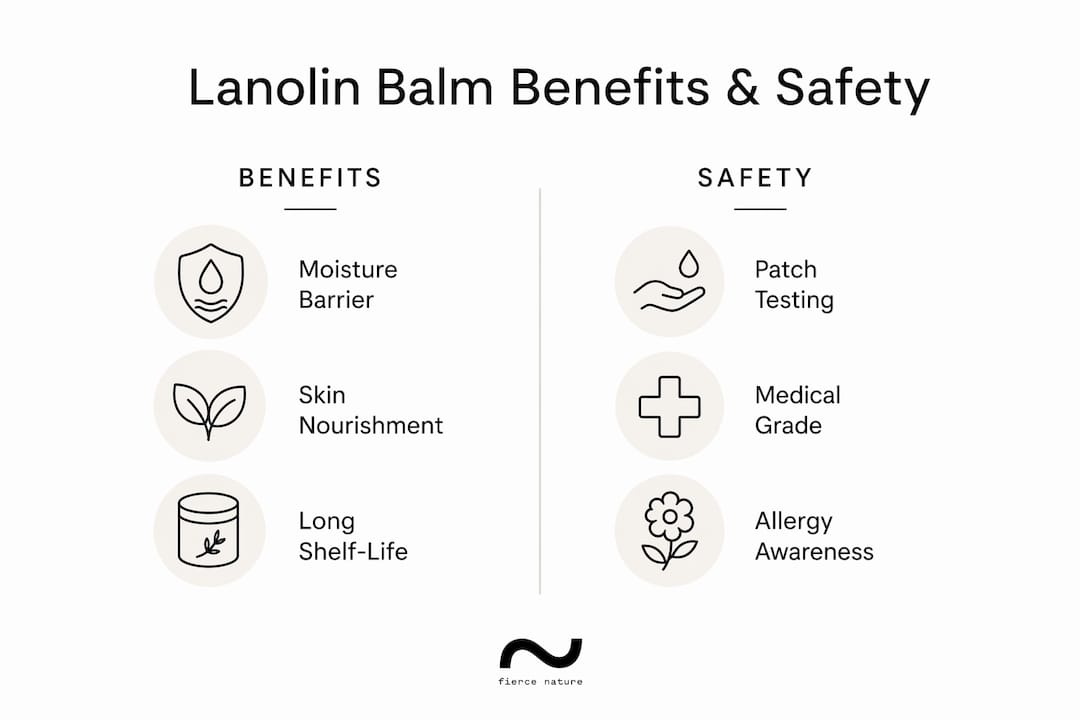
Purification transforms crude lanolin into the ingredient you want in a balm. The process involves degumming, bleaching, and deodorising, with medical-grade purification going further to remove free alcohols and reduce pesticide traces to negligible levels. The grade of lanolin that results from this process directly determines how safe and effective it will be on skin. For sensitive skin applications, medical-grade is the only grade worth using.
Lanolin is a generous collaborator in a balm formula. Its semi-solid, waxy texture blends smoothly with tallow, beeswax, and plant-based oils, and it does not destabilise anhydrous formulations. With tallow, it creates the nourish-and-seal pairing described earlier. With beeswax, it adds slip and reduces the stiffness that beeswax alone can produce.

Essential oils disperse evenly through lanolin, though high concentrations of certain oils (particularly citrus or cinnamon) can increase sensitisation risk in an already occlusive formula. Herbal infusions in a carrier oil blend well with lanolin, and the occlusive layer lanolin provides actually helps the active compounds in those herbs stay in contact with the skin for longer. The key formulation principle is balance: lanolin works best as a supporting player, enhancing the performance of every other ingredient around it.
Lanolin is naturally resistant to oxidation, which gives lanolin-containing balms a meaningful shelf-life advantage over those relying solely on plant oils. Anhydrous lanolin, in particular, is stable at room temperature and does not require refrigeration under normal conditions.
That said, heat and direct sunlight will degrade any balm over time. Store lanolin balms in a cool, dark place, ideally below 25°C, and keep the lid tightly closed to prevent contamination. When combined with tallow, the balm’s stability remains strong, as tallow is also naturally resistant to rancidity compared with most seed oils. A well-formulated tallow and lanolin balm, stored correctly, typically remains effective for 12–18 months.
Fierce Nature handcrafts every product in the UK using organic tallow and naturally sourced ingredients, with no synthetic fillers or hidden chemicals. If you have been reading about the nourishing and protective power of lanolin and tallow, these products are where that knowledge becomes something you can actually use.
The Non-toxic Baby Skin Essentials range is formulated for the most sensitive skin, making it a natural choice for anyone who wants the gentlest possible introduction to tallow-based care. The Multi-Use Tallow Bar (Unscented) delivers pure, deep nourishment without fragrance, while the Selfie Stick Natural offers a portable, multipurpose balm for lips, cuticles, and dry patches. For a richer facial experience, the Luxe Balm combines tallow with premium ingredients for advanced barrier protection. The Biohacking bundle brings several of these together for those ready to commit to a fully natural routine. Browse the full organic body balms collection to find the right fit for your skin.
Most people tolerate lanolin well, but those with wool allergies or broken skin should patch test first. Medical-grade, highly purified lanolin carries the lowest risk of irritation.
Lanolin acts as an occlusive moisturiser, reducing transepidermal water loss by 20–30% and forming a protective barrier that keeps skin hydrated and shielded from environmental stress.
Tallow provides nourishing fatty acids that feed skin cells, while lanolin creates a moisture-retaining occlusive film. Together, they nourish and seal, making the combination more effective than either ingredient alone.
A well-formulated tallow and lanolin balm, stored in a cool, dark place below 25°C, typically remains effective for 12–18 months.
Fierce Nature formulates its handcrafted UK balms with naturally sourced ingredients including tallow, and its product range is built around the same nourish-and-protect principles that make lanolin and tallow such an effective pairing.
Lanolin’s role in traditional balms is to act as a highly effective occlusive layer that reduces moisture loss significantly, working in direct synergy with tallow’s nourishing fatty acids to protect and repair the skin.
| Point | Details |
|---|---|
| Lanolin reduces moisture loss | It cuts transepidermal water loss by 20–30%, keeping skin hydrated in harsh conditions. |
| Wax esters absorb water | Lanolin can absorb up to 200% of its own weight in water, making it exceptionally effective for moisture retention. |
| Tallow and lanolin complement each other | Tallow nourishes skin cells; lanolin seals in that nourishment with a protective barrier. |
| Medical-grade purity matters | Purified lanolin reduces pesticide residues and free alcohols, lowering the risk of irritation significantly. |
| Fierce Nature applies this tradition | Fierce Nature handcrafts tallow-based balms in the UK, combining traditional ingredients with transparent, natural sourcing. |
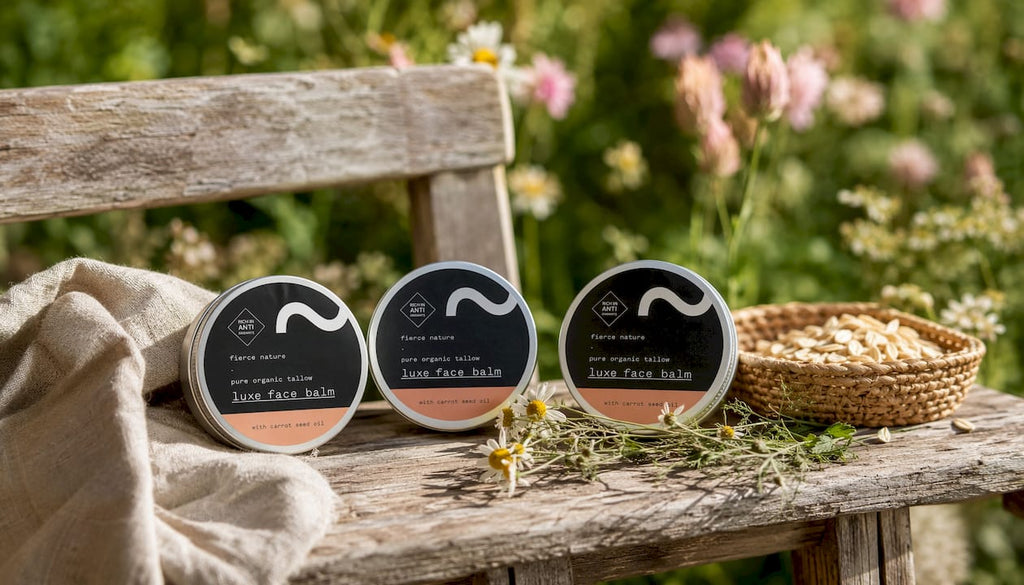
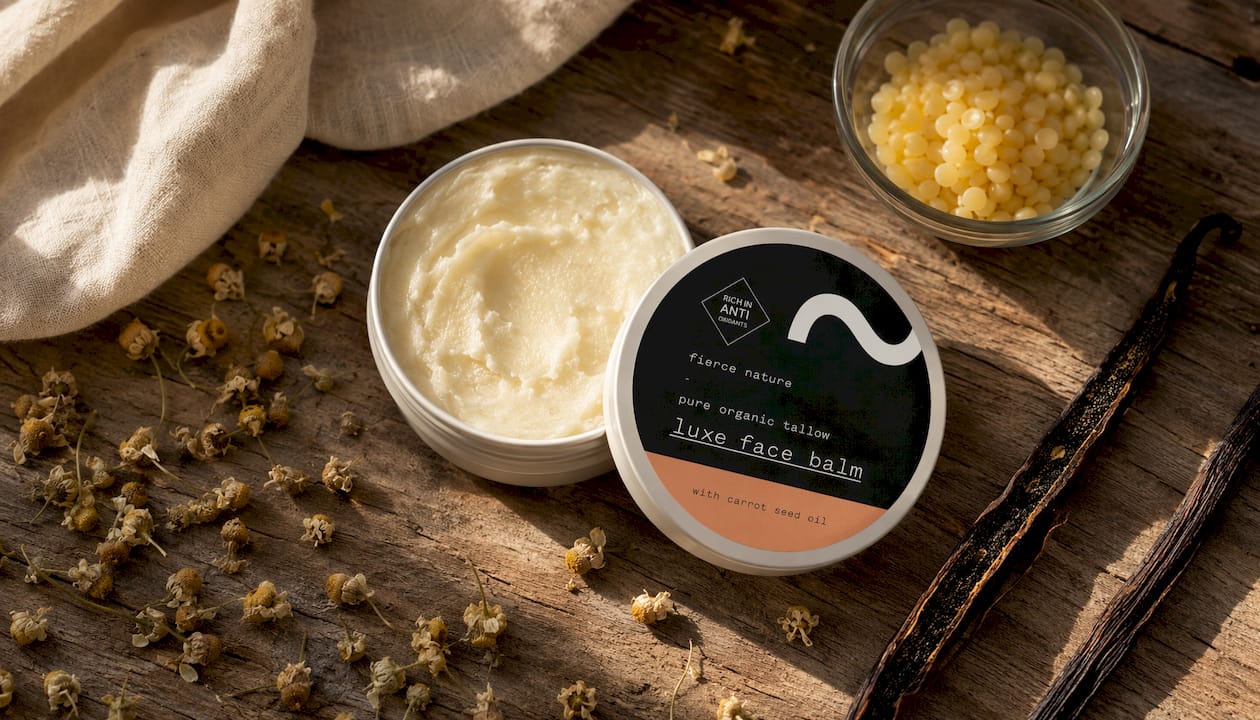
Whipped body balms come in several distinct formulations, each built around a different butter or oil base that shapes how the product feels, absorbs, and nourishes your skin. Unlike traditional solid balms or water-based lotions, whipped balms contain no water. That absence means they deliver occlusive, longer-lasting moisture that sits on the skin’s surface and locks hydration in rather than evaporating quickly. The whipping process aerates the base ingredients into a cloud-soft texture that spreads easily and absorbs faster than a dense, unwhipped butter would.
The most common types you’ll encounter in the UK market are:
Well-regarded UK examples include the Thistle and Rose Whipped Body Balm, a handmade option popular with those seeking artisan, natural formulations, and The Body Shop Mango Body Butter, which has long been a high-street staple for lighter, everyday hydration. Fierce Nature’s tallow-based whipped balms sit in a category of their own, drawing on an ingredient with centuries of use as a skin emollient.
The quality of a whipped body balm comes down almost entirely to its ingredients. Plant butters form the structural base, carrier oils adjust texture and absorption rate, and natural additives bring targeted skin benefits or sensory appeal.
Carrier oils thin the butter base, improve spreadability, and bring their own skin benefits.
Vanilla bean extract adds warmth and a subtle antioxidant quality. Botanicals such as calendula or chamomile bring calming properties. Essential oils like lavender, sweet orange, or frankincense contribute both fragrance and skin-supporting compounds. The best formulations use these purposefully rather than decoratively.
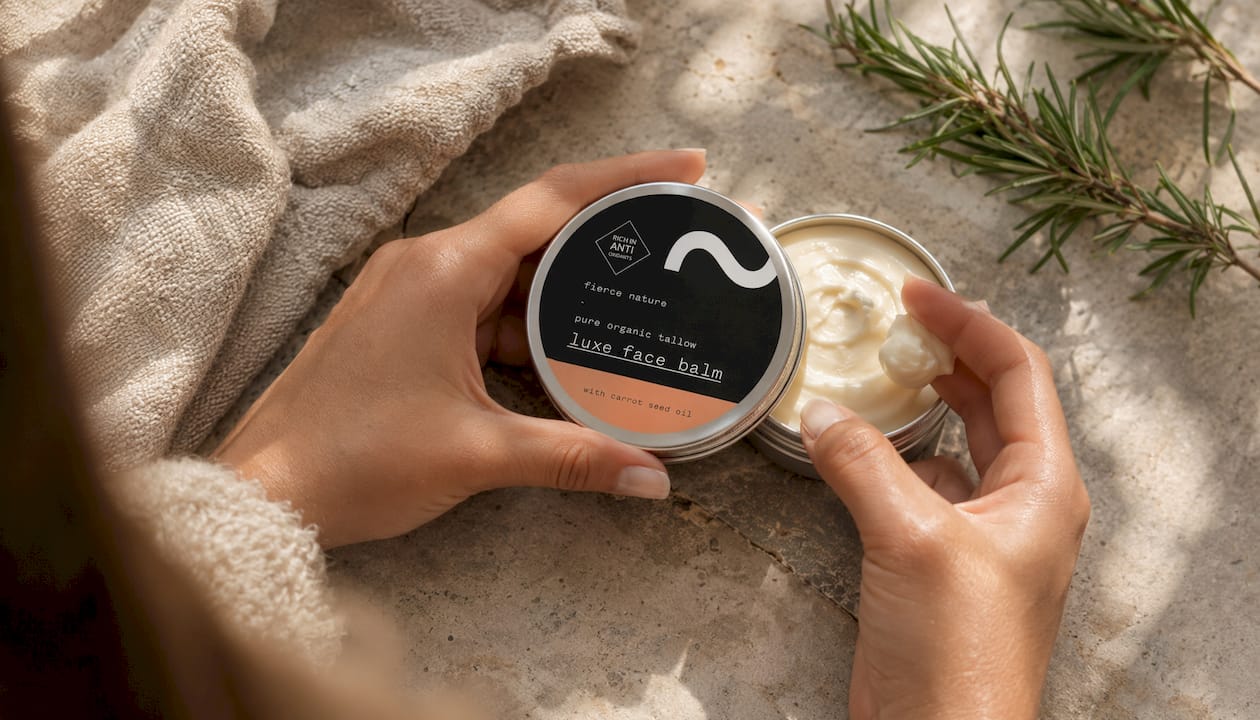
Pro Tip: When reading a product label, ingredients are listed in descending order by concentration. If a beneficial butter or oil appears near the bottom of a long list, it is present in only a trace amount and unlikely to deliver meaningful skin benefit.
Whipped body balms work with your skin rather than sitting on top of it. Because they contain no water, they do not rely on preservatives to prevent bacterial growth, and they deliver concentrated nourishment with every application.
For very dry skin, the occlusive nature of a butter-based balm creates a protective layer that slows transepidermal water loss. This makes whipped balms far more effective than standard lotions for cracked heels, dry elbows, or hands that are frequently washed. Their composition of natural oils and butters offers deep nourishment and protection that lotions, which are largely water, simply cannot match for these areas.
Sensitive and eczema-prone skin responds well to unscented, minimal-ingredient formulations built on shea or tallow. Both are rich in fatty acids that support the skin barrier without triggering reactivity. Fragrance is one of the most common contact allergens in skincare, so choosing a fragrance-free whipped balm removes a significant risk factor.
For ageing skin, avocado and mango butters bring vitamins A and C that support collagen and cell renewal. Cocoa butter’s antioxidants help counter oxidative stress. Applied regularly to the neck, décolletage, or hands, a whipped balm can visibly improve skin texture over time.
Combination and oily skin types often avoid body butters entirely, assuming they will feel greasy. Kokum butter and jojoba-based whipped balms challenge that assumption. Their lightweight, non-comedogenic profiles absorb cleanly, leaving skin nourished without congestion.
Key benefits at a glance:
Making a homemade whipped body butter is genuinely straightforward. The process requires no specialist equipment, and the result is a product you can tailor precisely to your skin’s needs.
Equipment:
Base ingredients (makes approximately 250g):
Store your homemade whipped balm in a cool, dry place away from direct sunlight. In warm weather, refrigeration prevents melting and extends shelf life. Most homemade balms made without water or preservatives remain stable for 3–6 months when stored correctly. Always use clean, dry hands or a spatula to scoop from the jar to avoid introducing moisture or bacteria.
Pro Tip: If your whipped balm feels too greasy on application, you have likely applied too much. A pea-sized amount is enough for most body areas. Warm it between your palms first, then press gently into the skin rather than rubbing vigorously.
The difference between a whipped balm and a solid butter is not just cosmetic. Whipping introduces air into the mixture, fundamentally changing its viscosity and the way it interacts with your skin.
A dense, unwhipped butter requires significant friction to spread, which means you end up applying a thicker, less even layer. Whipped balms spread in a thin, uniform film with minimal effort. Thinner, more uniform layers absorb more efficiently because the skin does not have to work through excess product sitting on the surface.
Skincare experts distinguish between ‘greasiness’ and poor absorption. When a balm feels greasy, it usually means too much product was applied, not that the formula itself is heavy. Whipping body balms improves absorption by enabling thinner, more uniform application, which addresses the ‘oily’ or greasy sensation many people associate with traditional butters. The aerated texture delivers a cloud-soft finish with a softer, faster-absorbing result compared to dense, unwhipped alternatives.
The no-water formulation also plays a role here. Because there is no aqueous phase to evaporate, the nourishing compounds in the butter and oil base remain in contact with the skin for longer, giving them more time to penetrate.
Pro Tip: Apply your whipped balm to slightly damp skin immediately after a shower. The residual moisture helps the balm spread more thinly and absorb even more readily, leaving skin feeling nourished rather than coated.
To understand more about whipped balm absorption, the texture difference goes deeper than feel alone.
Choosing well comes down to knowing your skin type, understanding the ingredient list, and being honest about your sensory preferences. A beautifully formulated balm that you find too heavy or too fragrant will sit unused on a shelf.
For those with reactive skin, the unscented nourish balm from Fierce Nature is formulated specifically with this in mind, using a tallow base with no added fragrance.
The UK market has a growing number of natural and handmade whipped body balm options, ranging from artisan small-batch producers to established high-street names.
Thistle and Rose Whipped Body Balm — a handmade, small-batch UK product with a loyal following among those who prioritise artisan, natural formulations. Typically available through independent online retailers and craft markets.
The Body Shop Mango Body Butter — one of the most recognisable whipped body butters on the UK high street. Built on mango seed butter, it delivers a lighter texture suited to everyday use on normal to dry skin. Widely available in The Body Shop stores and online.
Fierce Nature Nourish Balm (Unscented) — handmade in the UK using organic tallow as the base, this fragrance-free option is particularly well suited to sensitive, eczema-prone, or reactive skin. Tallow’s fatty acid profile closely mirrors the skin’s own lipids, which supports deep absorption and barrier repair. Available directly from Fierce Nature.
Fierce Nature Nourish Balm (Sweet Orange) — the same tallow-based formula with the addition of sweet orange essential oil for an uplifting, citrus scent. A good choice for those who want the nourishing depth of tallow with a light, natural fragrance. Find it as the organic sweet orange balm on the Fierce Nature website.
Fierce Nature Luxe Balm — a richer, premium formulation designed primarily for the face but equally effective on dry patches, the neck, and décolletage. The Luxe face balm is a concentrated option for those who want targeted, intensive nourishment.
For those interested in exploring a wider range of natural whipped butters, there are international artisan options worth considering alongside UK-made products.
Pro Tip: When trying a new whipped balm for the first time, patch test on the inner arm for 24 hours before applying to larger areas. This is especially worth doing if you have known sensitivities or are trying a new ingredient.
Most commercial body balms rely on synthetic emollients, artificial fragrance, and preservative systems that keep products shelf-stable for years but add to the toxic load your skin absorbs daily. Fierce Nature takes a different route entirely. Every balm is handmade in the UK using organic tallow as the foundation, combined with naturally sourced butters and oils and nothing that your skin does not recognise.
Tallow is not a trend ingredient. It has been used for centuries as a skin emollient, and its bioavailability means it penetrates deeply rather than sitting on the surface. For anyone who has tried balm after balm without finding lasting relief for dry, reactive, or sensitive skin, the tallow difference tends to be felt quickly.
The Nourish Balm range covers both unscented and scented options, and the Luxe Balm offers a richer, more concentrated formula for face and targeted areas. If you are ready to move away from ingredient lists you cannot pronounce, the natural body balm is the clearest starting point. Browse the full range at Fierce Nature and find the formulation that works with your skin.
Whipped body balms outperform water-based lotions for lasting hydration because their water-free formulation locks moisture in rather than evaporating from the skin’s surface.
| Point | Details |
|---|---|
| Texture and absorption | Whipping aerates butters and oils, creating a lighter texture that absorbs faster and more evenly than dense, unwhipped alternatives. |
| Ingredient choice matters | The butter base (shea, cocoa, mango, tallow) determines hydration depth, skin feel, and suitability for different skin types. |
| No-water formula | Water-free balms provide occlusive moisture retention and longer-lasting protection compared to lotions or creams. |
| Homemade is achievable | A basic whipped body butter requires only a butter base, a carrier oil, and an electric mixer, with a shelf life of 3–6 months when stored correctly. |
| Fierce Nature | Fierce Nature’s tallow-based whipped balms are handmade in the UK with organic, naturally sourced ingredients, offering a non-toxic option for sensitive and dry skin. |
The main types are shea butter, cocoa butter, mango butter, avocado butter, kokum butter, and tallow-based whipped balms, each suited to different skin types and hydration needs. Blended formulations and scented or unscented variations expand the range further.
Whipped body balms are generally more effective than lotions for dry, sensitive, or eczema-prone skin because they contain no water and provide occlusive, longer-lasting moisture. Lotions suit lighter, everyday hydration on normal skin types.
Chill the melted butter and oil mixture until semi-solid before whipping, then beat on medium-high speed for 3–5 minutes. The colder the mixture when you start whipping, the lighter and fluffier the final texture will be.
Avoid synthetic fragrance compounds, nut-derived oils if you have nut allergies, and long ingredient lists with unfamiliar chemical names. Unscented, minimal-ingredient formulations built on shea or tallow, such as the Fierce Nature Nourish Balm (Unscented), are the safest starting point for reactive skin.
Most water-free homemade whipped balms remain stable for 3–6 months when stored in a cool, dry place in a sterilised, airtight jar. Refrigeration extends shelf life in warmer months and prevents the balm from melting.
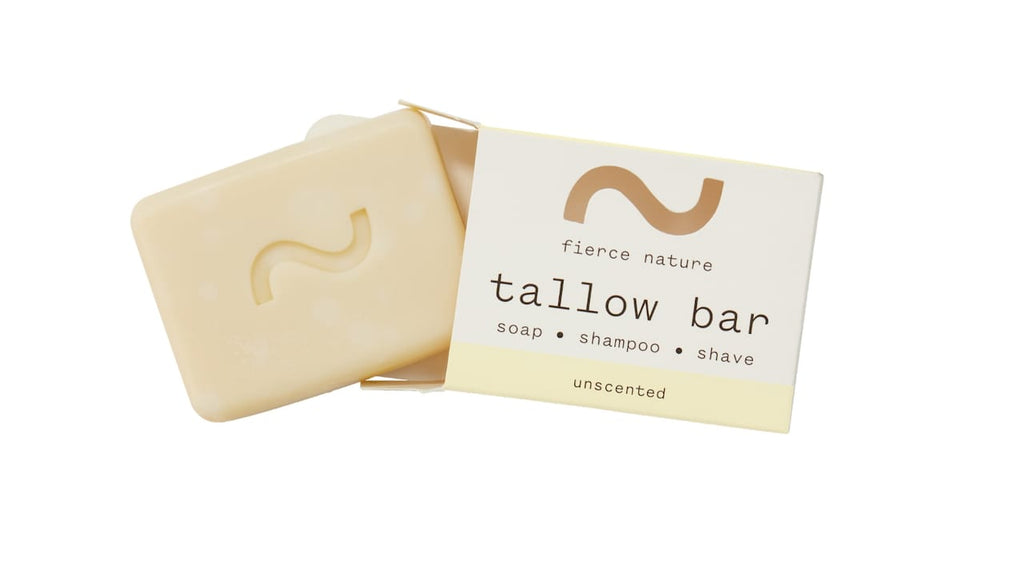
Animal fats nourish skin because their fatty acid composition closely mirrors human sebum, the skin’s own natural oil. That biological similarity means your skin recognises and absorbs these fats readily, rather than treating them as foreign substances to resist.
The key reasons tallow works so well for skin:
Sebum-compatible lipids: Beef tallow contains oleic, palmitic, and stearic acids, the same fatty acids your skin produces naturally, supporting barrier function and moisture retention.
Occlusive protection: Palmitic and stearic acids form a light occlusive layer that reduces transepidermal water loss without a heavy, greasy feel.
Fat-soluble vitamins: Tallow carries fat-soluble vitamins, which are hypothesised to provide antioxidant support and aid skin nourishment.
Two distinct forms: Saponified tallow (in soaps) cleanses without stripping skin lipids aggressively; unsaponified tallow (in balms) acts as an emollient, retaining moisture and nourishing the skin surface.
Skin type caution: Dermatologists advise that those with acne-prone, oily, or combination skin should use tallow cautiously, as its thickness can clog pores.
Oleic acid is the standout performer. It helps lock moisture into the skin, keeping your barrier supple and reducing the tightness that comes with dehydration. Palmitic and stearic acids complement this by sitting on the skin’s surface and slowing water evaporation, a process dermatologists call reducing transepidermal water loss.
Vitamins A, D, E, and K add another layer of benefit. Vitamin A supports cell turnover; vitamin E is a well-regarded antioxidant; vitamins D and K contribute to barrier health. Clinical proof of their effectiveness when delivered topically via tallow is still limited, and dermatologist Dr. Rajani Katta notes that tallow’s popularity has outpaced its scientific validation. That said, the biochemical rationale is genuinely sound.
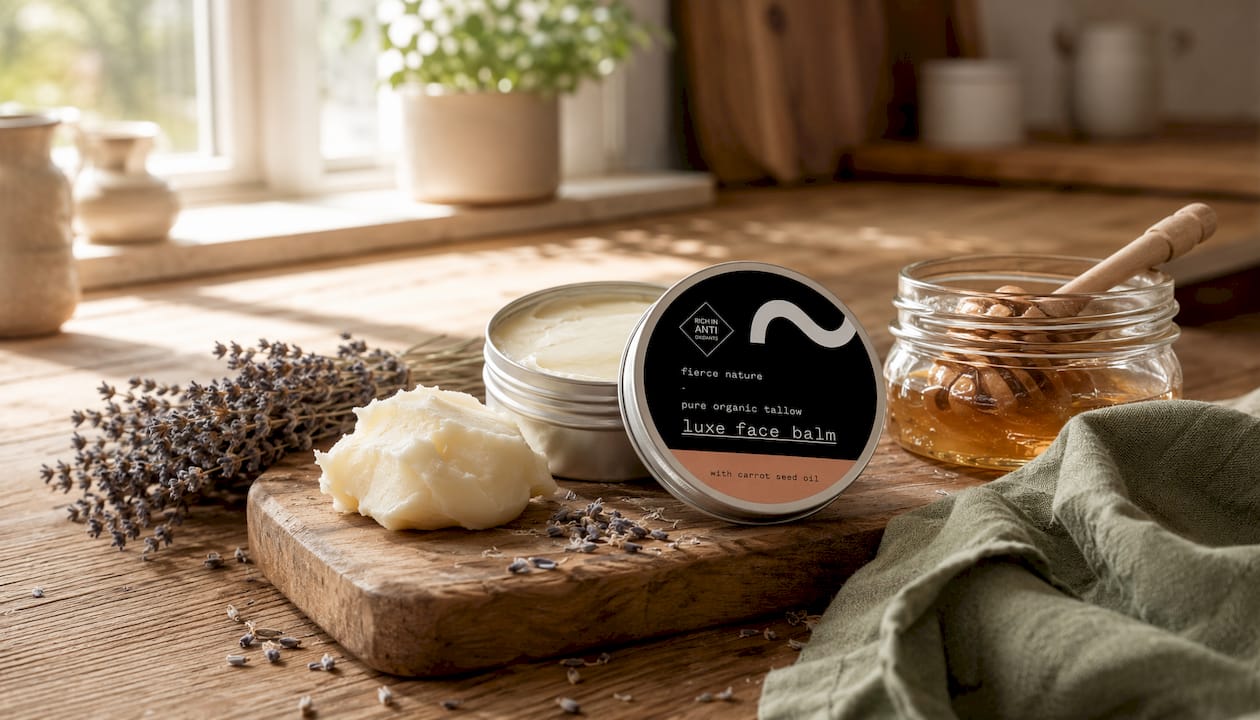
Pro Tip: Grass-fed tallow contains different fatty acid profiles that may offer greater skin benefits than grain-fed versions, so sourcing matters. Always look for products made from grass-fed, organically raised animals for the best skin benefits.
Tallow has been used in soaps and skin emollients for centuries, long before synthetic moisturisers existed. That historical use in skincare reflects a practical wisdom that modern biochemistry is now beginning to explain. When compared with many plant-based oils, tallow’s saturated fat content gives it greater shelf stability and a fatty acid profile that sits closer to skin’s own sebum than most botanical alternatives.
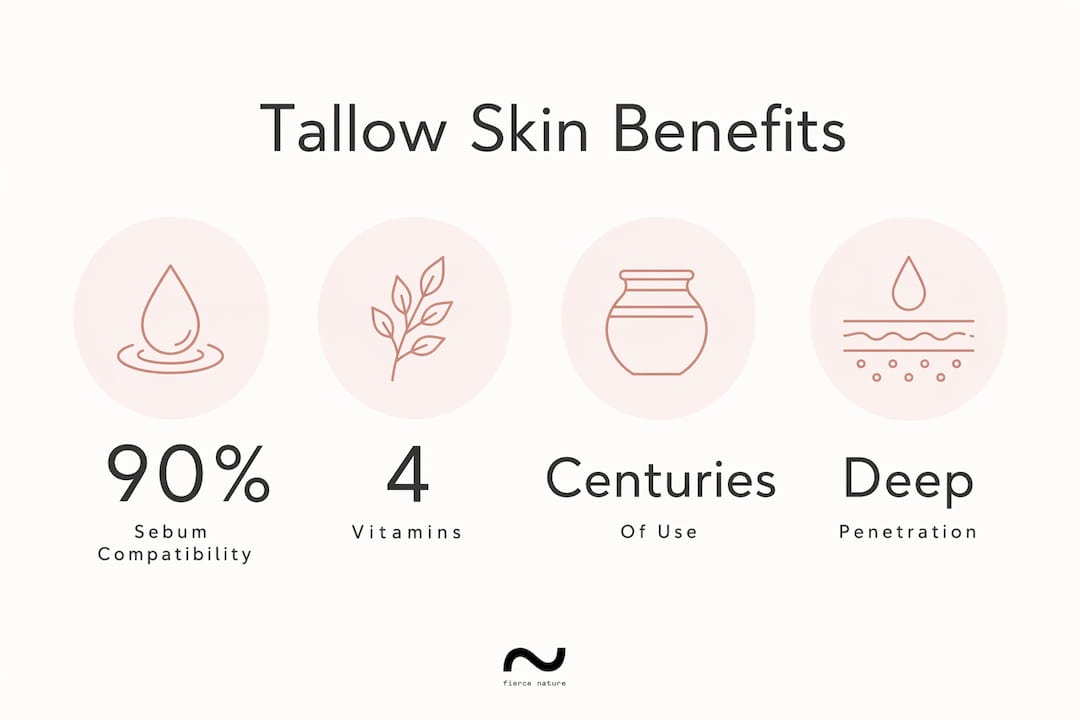
Quality and sourcing shape the outcome significantly. Artisanal tallow products often lack the standardised testing found in dermatologist-recommended moisturisers, so choosing a brand that prioritises purity and traceability matters. Effective use of unsaponified tallow balms also depends on clean formulation and microbial safety, not just natural origin.
Fierce Nature handcrafts every product in the UK using pure organic tallow as the foundation, sourced with care and formulated without synthetic additives. If you are drawn to animal fat skincare for its biocompatibility and natural nourishing properties, our Luxe Balm delivers deep, restorative moisture for the face. For daily body nourishment, the Nourish Balm (Unscented) suits sensitive skin beautifully. Those wanting a touch of colour alongside nourishment will love the Nourish Balm with Rose Tint. Browse the full range and find the right fit for your skin.
Animal fats nourish skin because their fatty acid profile mirrors human sebum, supporting the moisture barrier, reducing water loss, and delivering fat-soluble vitamins A, D, E, and K.
| Point | Details |
|---|---|
| Sebum compatibility | Tallow’s oleic, palmitic, and stearic acids match the skin’s own lipids, aiding absorption. |
| Moisture retention | Palmitic and stearic acids reduce transepidermal water loss with a light occlusive effect. |
| Vitamin content | Fat-soluble vitamins A, D, E, and K in tallow are hypothesised to support antioxidant and barrier health. |
| Skin type caution | Acne-prone and oily skin types should use tallow carefully due to its comedogenic potential. |
| Fierce Nature | Fierce Nature’s organic tallow balms are handcrafted in the UK for deep, clean skin nourishment. |
Not universally. Dermatologists advise that acne-prone, oily, or combination skin types should avoid tallow or use it with caution, as its thickness can clog pores and trigger breakouts.
Saponified tallow is used in soaps and cleanses without stripping the skin’s natural lipids. Unsaponified tallow remains in balm form, acting as an emollient that retains moisture and nourishes the skin surface.
Grass-fed tallow contains higher levels of conjugated linoleic acid and omega-3 fatty acids than grain-fed versions, which may offer greater skin benefits, making source quality a meaningful consideration.
Tallow’s fatty acid profile sits closer to human sebum than most plant oils, and its saturated fat content gives it better shelf stability. Clinical head-to-head comparisons remain limited, so neither is universally superior.
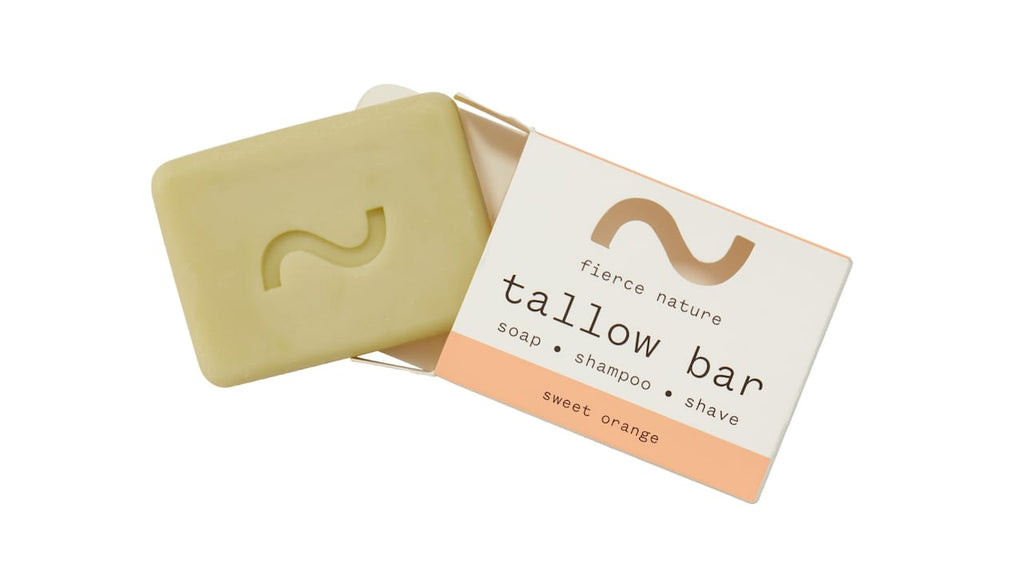
TL;DR:
- Ethically sourced tallow is made from grass-fed, grass-finished cattle raised without hormones or antibiotics, ensuring a pure and nutrient-rich fat for skincare. It contains higher levels of beneficial fatty acids like stearic acid and CLA, which support skin barrier repair and reduce inflammation. The source and production process are crucial, with suet-rendered fat from quality farms delivering the best results and supporting sustainable, low-waste practices.
Ethically sourced tallow is animal fat rendered from cattle raised under strict welfare standards, including grass-fed, grass-finished diets free from synthetic hormones and routine antibiotics. This is the standard the natural skincare world calls “ethical sourcing,” and it matters far more than most labels let on. The difference between ethically sourced fat and conventional tallow is not cosmetic. It changes the fatty acid profile, the purity, and ultimately what your skin receives. At Fierce Nature, this distinction sits at the heart of every product we make.
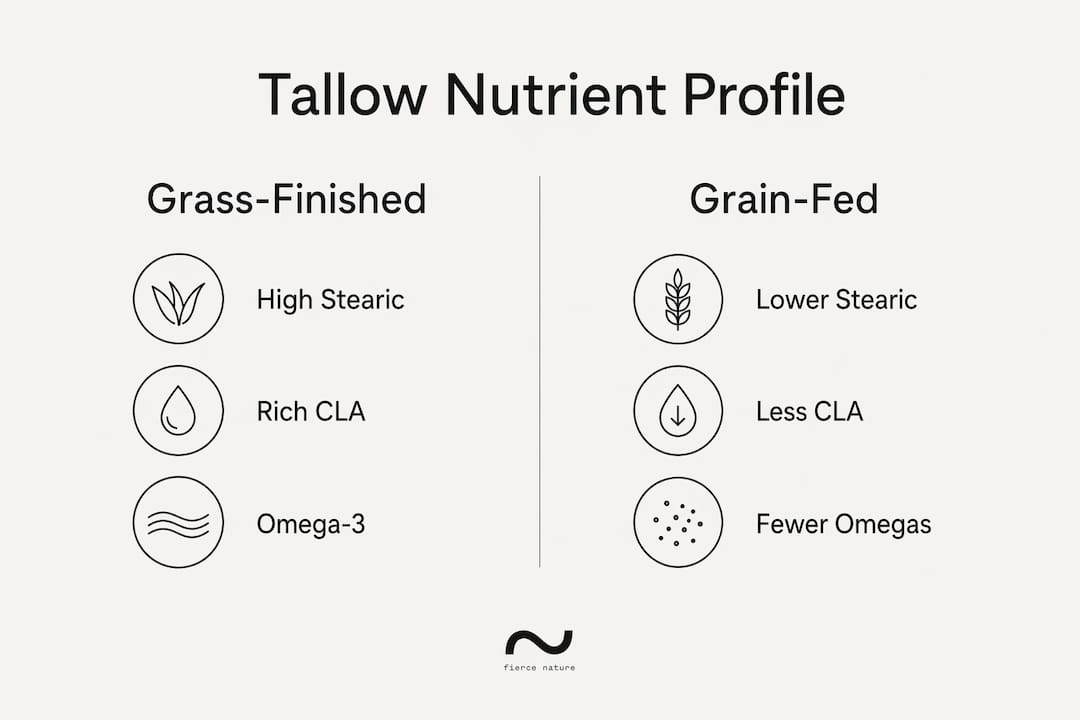
Ethically sourced tallow is defined by three non-negotiable criteria: the cattle must be grass-fed and grass-finished, raised without synthetic hormones, and kept free from routine antibiotic use. “Grass-fed” alone is not enough. Grass-finished means the animal ate only pasture its entire life, not just during early growth before being moved to grain in a feedlot. That distinction changes everything about the fat’s composition.
Grass-finished tallow contains up to 36% more stearic acid than grain-fed tallow. Stearic acid is one of the key fatty acids that supports the skin barrier and gives tallow its firm, nourishing texture. More stearic acid means deeper nourishment and a more stable product on your skin.
The absence of synthetic hormones and antibiotics matters equally. Conventional grain-fed tallow can carry hormone residues and has a lower omega-3 content, both of which affect how the fat interacts with sensitive skin. Ethically sourced fat starts clean, and that purity carries through to the finished skincare product.
The production process is as important as the sourcing criteria. Tallow is made by slowly rendering, or melting, beef fat at a low temperature to separate the pure fat from any connective tissue or moisture. The quality of the starting material determines the quality of the final product.
The best tallow comes from suet, the hard fat found around the kidneys and loins. Suet-rendered tallow produces a harder, more stable, and more neutral-smelling product than fat trimmed from other parts of the animal. This matters enormously in skincare, where scent and stability affect both the user experience and shelf life.
Fat trimmings from other cuts contain more connective tissue and moisture. They yield a softer, less stable tallow with a stronger animal scent. For skincare formulations, suet is not a preference. It is a quality requirement.
Tallow rendering involves slowly melting and filtering the fat twice to remove impurities while preserving its natural character. No additives are used. The result is a clean, shelf-stable fat that retains its full nutrient profile. This traditional technique is what makes tallow suitable for direct skin application.
Key production standards for genuinely ethical tallow include:
Grass-fed and grass-finished cattle with access to open pasture throughout their lives
No synthetic hormones administered at any stage of the animal’s life
No routine antibiotics, used only when medically necessary
Suet as the primary fat source, not general trimmings
Double-filtered rendering with no additives or preservatives
Traceable origin, meaning the producer can name the farm or region
Pro Tip: Ask any tallow skincare brand whether their fat comes from suet specifically or from general trimmings. If they cannot answer, the product almost certainly uses lower-grade fat.
The source of tallow determines its fatty acid composition, and that composition determines how your skin responds. Tallow from grass-fed, grass-finished cattle has a fatty acid profile closely resembling human skin lipids, primarily stearic acid, oleic acid, and palmitic acid. This similarity is why tallow integrates into the skin barrier rather than sitting on top of it like a film.
Oleic acid supports moisture retention and softens the skin. Palmitic acid reinforces the skin barrier. Stearic acid repairs and firms. Together, these three fatty acids work with your skin’s own lipid structure, not against it. That is what makes tallow a genuine skin food rather than a surface moisturiser.
Grass-fed, grass-finished tallow contains higher levels of conjugated linoleic acid (CLA) and omega-3 fatty acids, both of which have well-documented anti-inflammatory properties. For people with sensitive, reactive, or redness-prone skin, this is the difference between a formula that calms and one that does nothing. CLA supports the skin’s natural repair process and helps reduce the visible signs of inflammation.
You can also read more about tallow’s biocompatibility with human skin cells to understand the biological rationale in greater depth.
| Nutrient or property | Grass-fed, grass-finished tallow | Grain-fed, conventional tallow |
|---|---|---|
| Stearic acid content | High (up to 36% more) | Lower |
| CLA and omega-3 levels | Elevated | Minimal |
| Hormone residues | None | Possible |
| Skin barrier integration | Strong | Weaker |
| Scent (suet-rendered) | Neutral | Stronger animal scent |
| Anti-inflammatory potential | High | Low |
The gap between these two profiles is not marginal. It is the difference between a product that actively nourishes your skin and one that simply coats it. For those with grass-fed tallow in skincare as a priority, the sourcing question is non-negotiable.
Choosing ethically sourced tallow is not only a skincare decision. It is a values decision. Pasture-raising cattle without synthetic hormones or routine antibiotics supports animal welfare and reduces the environmental burden associated with intensive farming. Animals raised on open pasture live in conditions aligned with their natural behaviour, which is a meaningful distinction from feedlot production.
The nose-to-tail philosophy sits at the core of ethical tallow sourcing. Tallow is a by-product of the meat industry. Using it in skincare reduces waste by ensuring that every part of the animal contributes value. This is the opposite of the extractive, single-use thinking that drives so much of conventional cosmetics production.
The environmental benefits of tallow-based skincare extend further. Pasture-raised farming supports soil health through natural grazing cycles. It avoids the synthetic fertilisers and pesticides associated with monoculture feed crops. And it produces a skincare ingredient that is fully biodegradable, unlike the petrochemical derivatives found in most conventional moisturisers.
Key ethical sourcing principles to look for in a brand:
Transparent farm-to-product traceability
Commitment to pasture-raised, grass-finished cattle only
No synthetic inputs at any stage of production
Nose-to-tail sourcing philosophy
Clear communication about rendering methods and fat origin
Pro Tip: A brand that genuinely sources ethically will be able to tell you the country of origin, the farming standard, and whether the fat is suet-derived. Vague answers like “high-quality beef fat” are a red flag.
Consumers who care about clean beauty are increasingly aware that ingredient ethics and environmental impact are connected. Choosing a tallow product from a brand with full sourcing transparency is one of the most direct ways to align your skincare with your values. You can also explore how natural ingredients like whipped body butters compare when reading ingredient labels for sourcing claims.
Reading a label correctly is a skill. Most tallow products do not volunteer the information you need, so you have to know what to ask and what to look for.
Brands that cannot specify their tallow’s origin or the animal raising practices used almost certainly do not meet ethical standards. Genuine ethical sourcing is something producers are proud to communicate. Silence or vagueness is a reliable signal of a lower standard.
Use this checklist when evaluating any tallow skincare product:
Check for “grass-finished” specifically. “Grass-fed” without “grass-finished” means the animal may have been grain-finished before slaughter.
Look for “hormone-free” on the label. This should be stated explicitly, not implied.
Confirm “antibiotic-free” or “raised without routine antibiotics.” Routine antibiotic use is common in intensive farming and affects the fat’s purity.
Ask whether the tallow is suet-rendered. Suet produces a cleaner, more stable product. If the brand does not know, the answer is probably no.
Request sourcing transparency. A reputable brand will tell you the country of origin and ideally the farming standard or certification.
Avoid products that list only “beef tallow” with no further detail. This generic label tells you nothing about the animal’s diet, welfare, or the rendering process.
The term “ethically sourced” is not regulated in the UK cosmetics industry, which means any brand can use it without meeting a defined standard. Your best protection is asking direct questions and choosing brands that answer them clearly. Fierce Nature publishes its sourcing standards openly because we believe you deserve to know exactly what you are putting on your skin.
Ethically sourced tallow is defined by grass-fed, grass-finished cattle, suet-derived rendering, and the complete absence of synthetic hormones and antibiotics, producing a skin-compatible fat that conventional tallow cannot match.
| Point | Details |
|---|---|
| Grass-finished is the key standard | Grass-fed alone is insufficient; grass-finished means pasture diet for the animal’s entire life. |
| Suet produces superior tallow | Suet-rendered tallow is harder, more stable, and more neutral-smelling than general fat trimmings. |
| Fatty acid profile drives skin results | Higher stearic acid and CLA in ethical tallow support barrier repair and reduce inflammation. |
| Nose-to-tail sourcing reduces waste | Using tallow as a by-product of meat farming aligns with sustainable, low-waste production values. |
| Label transparency is your best tool | Brands that cannot name their fat’s origin or farming standard rarely meet genuine ethical criteria. |
When we first started formulating with tallow at Fierce Nature, the sourcing question felt straightforward. It was not. We quickly discovered that “grass-fed” on a supplier’s invoice meant very little without knowing whether the cattle were grain-finished before slaughter. We reformulated. We asked harder questions. We found farms that could answer them.
What surprised us most was how much the quality of the fat changed the finished product. Suet-rendered, grass-finished tallow has a noticeably different texture and scent profile compared to general beef fat. It melts more cleanly into the skin. It does not leave a heavy residue. The difference is immediate and tactile, not just theoretical.
The consumer education gap in this space is significant. Most people shopping for natural skincare do not know that “tallow” on a label could mean anything from premium suet from a pasture-raised animal to rendered trimmings from a feedlot. That gap is not accidental. It benefits brands that want to use the word “natural” without meeting the standard.
We believe the future of ethical beauty depends on producers being willing to name their sources, explain their methods, and hold themselves to standards that go beyond what regulation currently requires. Transparency is not a marketing strategy for us. It is the baseline. If a skincare ingredient cannot be traced to a specific farming practice, it has no place in a product we would put on our own skin, or yours.
— Fierce Nature
At Fierce Nature, every product is built on pure, suet-rendered tallow from grass-fed, grass-finished cattle raised without synthetic hormones or routine antibiotics. We handcraft our products in the UK using ingredients we can trace and standards we can name. Our multi-use tallow bar is a direct expression of that commitment, delivering deep nourishment with nothing hidden in the formula. For the most sensitive skin of all, our non-toxic baby skin essentials apply the same sourcing rigour to products designed for newborns. When the ingredient is this pure, the skin simply responds.
Ethically sourced tallow is animal fat rendered from cattle that are grass-fed, grass-finished, and raised without synthetic hormones or routine antibiotics. These standards ensure a cleaner fat with a superior fatty acid profile for skincare use.
No. Tallow from grass-finished, suet-rendered cattle contains significantly more stearic acid and CLA than grain-fed alternatives. Grass-finished tallow can contain up to 36% more stearic acid, which directly affects skin nourishment and barrier support.
Suet is the hard fat surrounding the kidneys and loins. Suet-rendered tallow is harder, more stable, and more neutral-smelling than tallow made from general fat trimmings, making it the preferred source for skincare formulations.
Look for the terms “grass-finished,” “hormone-free,” “antibiotic-free,” and “suet-rendered” on the label. Brands that cannot specify their fat’s origin or farming standard almost certainly do not meet genuine ethical sourcing criteria.
Yes. The elevated CLA and omega-3 content in grass-fed, grass-finished tallow has well-documented anti-inflammatory properties, making it particularly well-suited to sensitive, reactive, or redness-prone skin.