Cart
0
You may also like



TL;DR:
- The term “non-toxic skincare” is not legally defined and relies on marketing claims without standardized testing. Avoiding ingredients like phthalates, parabens, microplastics, and undisclosed fragrances reduces exposure to potential health risks. Simplifying routines and choosing transparent brands help decrease chemical load and support healthier skin and environment.
Non-toxic skincare describes products formulated without ingredients that pose meaningful harm to people or the environment under normal, intended use. The term sounds reassuring, but what does non-toxic skincare mean in legal terms? The honest answer is: very little, at least for now. No government body has defined or standardised the phrase. The FTC requires brands to substantiate any non-toxic claim with reliable scientific evidence, yet no official testing standard exists against which those claims are measured. That gap between marketing language and regulatory reality is exactly what this guide unpacks, so you can make genuinely informed choices rather than trusting a label at face value.
The phrase “non-toxic” carries no legal definition in the skincare industry. The FTC Green Guides (16 CFR 260.10) require scientific evidence for any non-toxic claim, but no pre-approval process exists. A brand can print “non-toxic” on its packaging today without any regulator signing off first. Enforcement only happens after the fact, if a complaint is raised.
This matters because it places the burden of proof entirely on the consumer. Terms like “hypoallergenic” and “clinical-grade” face the same problem. They sound authoritative, but none carry a standardised definition in UK or US cosmetics law. A product labelled hypoallergenic simply means the brand believes it is less likely to cause allergic reactions. There is no test it must pass.
The science adds another layer of complexity. Toxicologists work by a principle that dose makes the poison: every ingredient, including water, can be harmful at a high enough concentration. That means absolute non-toxicity is unattainable. A well-substantiated claim would say “formulated without ingredients linked to harm at typical exposure levels,” not simply “non-toxic.”
“No ingredient is inherently non-toxic or toxic outside of its exposure context. Safety is always a question of dose, frequency, and individual biology.”
The practical takeaway is this: when a brand uses “non-toxic” without publishing its ingredient rationale, that claim is marketing language, not a verified safety standard. Knowing that changes how you read a label.
What the regulatory picture looks like in practice:
No government body pre-approves “non-toxic” skincare labels in the UK or US.
The FTC can act against unsubstantiated claims, but only after they appear on shelves.
The EU Cosmetics Regulation bans or restricts over 1,300 substances, offering stronger ingredient-level protection than the US, though still no “non-toxic” category.
Terms like “clean,” “green,” and “natural” face the same absence of legal definition.
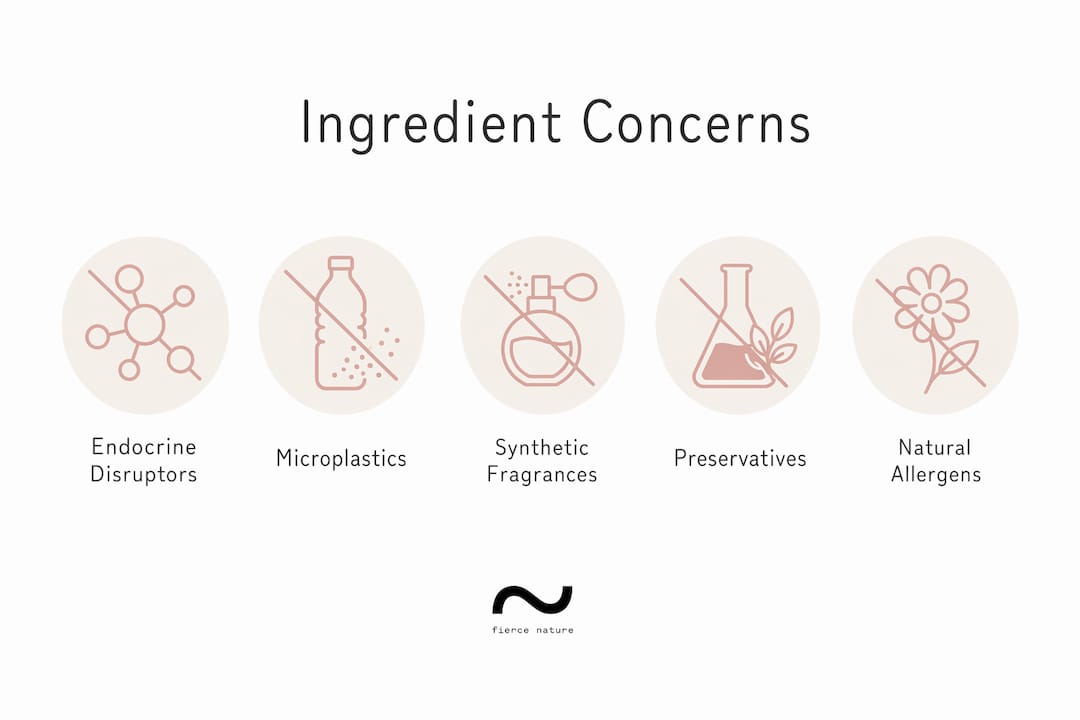
The ingredients most frequently cited in safe skincare conversations fall into a few clear categories: endocrine disruptors, microplastics, synthetic fragrances, and certain preservatives. Understanding why each group raises concern helps you read an ingredient list with confidence rather than anxiety.
Phthalates are plasticising chemicals used in some fragrances and nail products. Parabens, including methylparaben and propylparaben, are preservatives found across a wide range of conventional skincare. Both groups are classified as potential endocrine disruptors, meaning they can interfere with hormone signalling in the body. Some parabens are already restricted or banned in the EU for this reason.
Endocrine disruption is a concern because hormones regulate everything from metabolism to reproductive health. Even low-level, repeated exposure through daily skincare use can contribute to cumulative load. That cumulative effect is what makes these ingredients worth avoiding, not a single application.
Microplastics appear in some exfoliating products, glitter cosmetics, and certain emulsifiers. Research links plastic-derived chemicals in personal care products to dermatitis, inflammation, premature skin ageing, and systemic toxicity including endocrine disruption and reproductive harm. These particles do not biodegrade and accumulate in both the body and the environment.
The UK banned rinse-off microbeads in 2018, but leave-on products and non-bead plastic-derived ingredients remain less tightly controlled. Checking for polyethylene, polypropylene, or nylon in an ingredient list is a practical starting point.
“Fragrance” or “parfum” on a label can represent a blend of hundreds of undisclosed chemicals. Some are known allergens; others are linked to respiratory irritation. This single ingredient entry is one of the most common causes of contact dermatitis in skincare users.
Pro Tip: If a product lists “fragrance” or “parfum” without further detail, contact the brand and ask for a full fragrance disclosure. Transparent brands will provide it. Those that cannot or will not are worth approaching with caution.
“Natural” does not automatically mean safer. Synthetic ingredients often provide more consistent safety profiles than natural extracts, which can vary in concentration, carry allergens, and degrade unpredictably. Poison ivy is natural. So is arsenic. The origin of an ingredient tells you very little about its safety. What matters is the evidence base behind it.
| Ingredient category | Common examples | Primary concern |
|---|---|---|
| Endocrine disruptors | Phthalates, parabens | Hormone interference at cumulative exposure |
| Microplastics | Polyethylene, polypropylene | Skin inflammation, systemic toxicity, environmental harm |
| Synthetic fragrances | “Parfum,” “fragrance” blends | Allergenicity, contact dermatitis, undisclosed chemicals |
| Certain preservatives | Methylparaben, propylparaben | Potential endocrine disruption, EU restrictions apply |
| Natural irritants | Essential oils, plant extracts | Concentration-dependent irritation, allergenicity |
The evidence for reducing chemical exposure through skincare changes is genuinely encouraging. A study of approximately 100 female subjects found that switching to fewer products formulated without common endocrine disruptors produced measurable decreases in urinary biomarkers of phthalates, parabens, and bisphenol A within just five days. Five days is a remarkably short window. It shows that the body clears these compounds quickly when exposure stops.
That finding has real implications for how you approach your routine. You do not need to overhaul everything at once. Reducing the total number of products you use each day is itself a meaningful step. Fewer products means fewer ingredients, fewer potential interactions, and a lower cumulative chemical load on your skin and body.
Simplifying your routine also reduces risk from cumulative exposures more reliably than chasing a perfect ingredient list across a ten-step routine. A four-product routine with well-chosen, transparent formulations outperforms a twelve-product routine where two or three products contain questionable ingredients.
What the evidence supports:
Biomarker reductions from endocrine disruptors occur within days of reducing product use.
Cumulative exposure, not single-product exposure, drives the greatest risk.
Individual sensitivity varies; what irritates one person may be well-tolerated by another.
Simplification is a practical, evidence-backed strategy regardless of budget.
Realistic expectations matter here. Switching to non-toxic skincare is not a cure for existing health conditions, and the research does not claim otherwise. What it does show is that your daily product choices have a measurable effect on your internal chemical environment. That is worth knowing.
Choosing genuinely safe skincare requires a different skill set from reading a marketing claim. It starts with knowing your own skin and ends with asking harder questions of the brands you buy from.
Know your non-negotiables. Identify the ingredients that consistently cause your skin to react. Common culprits include synthetic fragrances, certain preservatives, and alcohol-based astringents. Build your personal “avoid” list before you shop, not after.
Question vague claims. When a brand says “non-toxic,” “clean,” or “natural” without publishing its full ingredient list and rationale, treat that as a warning sign. Genuine transparency means showing you what is in the product and why each ingredient is there.
Check for greenwashing signals. Vague language, unverified certifications, and ingredient lists buried in small print are all red flags. Brands that misuse non-toxic claims often rely on consumer unfamiliarity with ingredient science to avoid scrutiny.
Simplify before you switch. Before replacing every product, cut your routine down to the essentials: a gentle cleanser, a nourishing moisturiser, and sun protection. Assess how your skin responds. This baseline tells you far more than any label.
Prioritise ingredient transparency over certifications. Certifications vary widely in rigour. A brand that publishes its full ingredient list, explains its sourcing, and responds to questions about formulation choices is more trustworthy than one with a badge from an unrecognised body.
Look at the full UK cosmetics ingredient picture. The EU Cosmetics Regulation, which the UK largely mirrors post-Brexit, restricts or bans over 1,300 substances. Products sold legally in the UK already meet a baseline standard. Your job is to go further by choosing brands that exceed that baseline voluntarily.
Pro Tip: Use the INCI (International Nomenclature of Cosmetic Ingredients) name of any ingredient you are unsure about and search it in a credible toxicology database. The Latin-sounding name is not a sign of danger; it is simply the standardised scientific name used globally.
Understanding clean beauty in the UK helps you see how “non-toxic,” “clean,” and “natural” overlap and differ. They are not interchangeable, and knowing the distinction protects you from being misled by any one of them.
Non-toxic skincare is a marketing term, not a regulated category, and the most effective approach is combining ingredient literacy with a simplified, transparent routine.
| Point | Details |
|---|---|
| No legal definition exists | “Non-toxic” is unregulated; the FTC requires substantiation but no standard test applies. |
| Dose determines toxicity | Every ingredient can be harmful at high enough exposure; context always matters. |
| Key ingredients to avoid | Phthalates, parabens, microplastics, and undisclosed fragrances carry the strongest evidence of concern. |
| Simplification reduces exposure | Cutting product numbers lowers biomarker levels of endocrine disruptors within days. |
| Transparency beats labels | Choose brands that publish full ingredient lists and explain their formulation choices. |
Growing up in South Africa, I spent years applying mainstream cosmetics without questioning what was in them. The rashes and reactions I experienced as a teenager made no sense to me at the time. It took years of learning about gut health and toxic load to understand that my skin was simply telling me the truth that the packaging was not.
The non-toxic skincare space has grown enormously, and with that growth has come a wave of brands using the term as a marketing shortcut rather than a genuine commitment. That frustrates me, because the underlying principle is sound. Reducing your exposure to endocrine disruptors, microplastics, and synthetic fragrances is a reasonable and evidence-backed goal. The problem is that a label cannot do that work for you.
What I have found actually works is this: fewer products, better ingredients, and a brand willing to show you exactly what is in the bottle and why. Tallow, the foundation of every Fierce Nature product, has been used as a skin emollient for centuries. Its bioavailability means it works with your skin, not against it. That is not a marketing claim. It is a function of its fatty acid profile, which closely mirrors the lipids found naturally in healthy skin.
My honest view is that the “non-toxic” label is a starting point, not a destination. Use it to open a conversation with a brand, not to close one. Ask questions. Read the ingredient list. If a brand cannot answer you clearly, your skin deserves better.
— Fierce Nature
At Fierce Nature, every product is handmade in the UK using naturally sourced, transparent ingredients. Pure organic tallow forms the foundation of the range because its bioavailability makes it a deeply nourishing skin food, not a filler or a compromise. The non-toxic baby skin essentials range reflects the same standard we hold for every product: nothing hidden, nothing unnecessary. For those building a considered routine from scratch, the Luxe Balm and tallow bar offer a genuinely minimal approach to radiant, well-nourished skin. Fewer ingredients. Full transparency. Real results.
“Non-toxic” has no legal definition in UK or US skincare regulation. The FTC requires brands to substantiate the claim with reliable scientific evidence, but no standardised test or pre-approval process exists.
No. Natural ingredients can cause irritation and allergic reactions, and their concentration varies between batches. Synthetic ingredients often have more consistent, well-studied safety profiles than plant-derived alternatives.
Phthalates, parabens (particularly methylparaben and propylparaben), undisclosed synthetic fragrances, and microplastic-derived ingredients carry the strongest evidence of concern and are a practical starting point.
Research shows measurable reductions in urinary biomarkers of phthalates, parabens, and bisphenol A within five days of switching to fewer products formulated without these compounds.
Look for vague claims without ingredient-level evidence, certifications from unrecognised bodies, and brands that do not publish their full ingredient lists. Genuine transparency means showing you what is in the product and why.