Cart
0
You may also like





TL;DR:
- Brexit has created a separate, independent regulatory framework for UK skincare products that differs from EU rules. The UK now enforces its own safety assessments, product notifications, and Responsible Person requirements without mutual recognition, leading to distinct ingredient restrictions and labelling standards. This regulatory divergence ultimately enhances safety and transparency for UK consumers but requires brands to maintain dual compliance systems.
UK skincare regulations differ from EU rules because Brexit created a fully independent regulatory framework for Great Britain, requiring separate safety assessments, product notifications, and Responsible Person designations that have no mutual recognition with EU systems. The UK Cosmetics Regulation now operates entirely apart from EU Regulation (EC) No 1223/2009, with the Office for Product Safety and Standards (OPSS) enforcing its own rules on ingredient restrictions, labelling, and pre-market compliance. Understanding why UK skincare regulations differ matters deeply if you care about what goes onto your skin and whether the products you buy are genuinely safe.
The core reason skincare regulation differences exist between the UK and EU is legislative independence. When the UK left the EU, it retained the existing EU cosmetics framework as a starting point, then began amending it through its own statutory instruments. The two systems now diverge with every new update, and there is no automatic alignment between them.
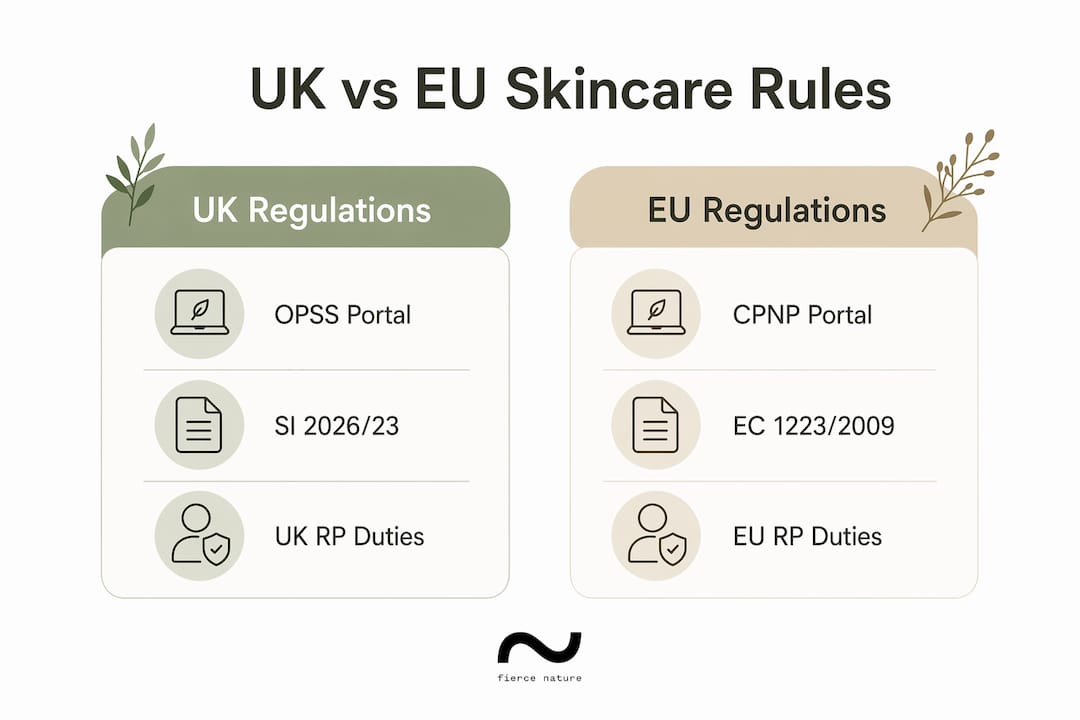
The UK’s framework is governed by the UK Cosmetics Regulation, enforced by the OPSS. The EU continues under EU Regulation (EC) No 1223/2009, enforced by national competent authorities across member states. Both require pre-market safety assessments, but they apply different ingredient lists, different thresholds, and different timelines for change.
One of the clearest structural differences is the notification system. The UK uses the OPSS portal for product notifications, while the EU uses the Cosmetic Products Notification Portal (CPNP). These systems have no mutual recognition, meaning a product notified in the EU cannot simply be placed on the UK market without a separate UK notification. This applies to every single product, regardless of how long it has been on sale in Europe.
Here is a quick comparison of the two frameworks:
| Feature | UK Cosmetics Regulation | EU Regulation (EC) No 1223/2009 |
|---|---|---|
| Notification portal | OPSS portal | CPNP |
| Enforcement body | Office for Product Safety and Standards | National competent authorities (EU member states) |
| Responsible Person location | Must be based in Great Britain | Must be based in the EU |
| Product Information File | Held at UK RP address | Held at EU RP address |
| Ingredient updates | Independent UK statutory instruments | EU amending regulations |
The territorial scope matters too. Northern Ireland sits in a unique position, remaining aligned with EU cosmetics rules under the Windsor Framework. Great Britain (England, Scotland, and Wales) follows the UK Cosmetics Regulation exclusively. This means a brand selling across the whole of the UK must understand two different compliance environments within one country.
Key structural differences at a glance:
Ingredient compliance is where the skincare regulation differences become most visible and most consequential for your skin. The UK now conducts independent scientific assessments before changing its restricted or banned ingredient lists, rather than automatically adopting EU amendments. This means the two systems can reach different conclusions about the same ingredient, at different times, with different permitted thresholds.

The most significant recent example comes from SI 2026/23, which introduces new restrictions effective from mid-2026. Under this statutory instrument, new CMR substance bans take effect on 15 august 2026. CMR substances are those classified as carcinogenic, mutagenic, or toxic to reproduction. Their restriction in cosmetics is non-negotiable under both UK and EU rules, but the specific substances listed and the effective dates now differ between the two regimes.
One particularly important threshold change affects formaldehyde-releasing preservatives. Under SI 2026/23, the permitted limit for these preservatives drops from 0.05% to 0.001% effective 15 july 2026. That is a fifty-fold reduction. Formaldehyde releasers are found in many conventional preservative systems, so this change forces reformulation across a wide range of products sold in Great Britain.
The EU has its own timeline for similar restrictions, but the dates and thresholds do not always match. A product compliant in France or Germany may not meet the UK’s updated limits, and vice versa. This is regulatory drift in practice, and it is accelerating.
Key ingredient compliance differences to understand:
Pro Tip: If you are checking whether a product is safe for UK skin, look for confirmation that it has been assessed under the UK Cosmetics Regulation specifically, not just EU compliance. Ask brands directly whether their safety assessment references UK-specific annexes and SI 2026/23.
We at Fierce Nature believe this independent assessment process is genuinely protective. When the UK takes time to evaluate an ingredient against its own market conditions, that is science working for you, not against you. It is one reason we choose ingredients that meet the most stringent standards on either side of the Channel.
Regulatory divergence has real, tangible effects on what you find on UK shelves and what those products contain. Brands are updating formulations and labels specifically for the UK market, independently from EU deadlines and requirements. This is not a minor administrative exercise. It changes what goes into the products you use every day.
The most direct consumer impact is formulation change. A product you loved buying from a European brand may arrive in the UK with a slightly different formula, because the UK-specific ingredient restrictions require it. This is not a quality reduction. It is the UK’s pre-market safety system doing exactly what it should.
Labelling is another area where differences in skincare standards show up clearly. UK labelling rules require English language compliance and evidence-backed claims substantiation specific to the UK market. A product carrying a claim like “clinically proven” or “dermatologist tested” must have documentation supporting that claim under UK rules. The EU has its own claims regulation, but the substantiation requirements and enforcement approach differ.
Here is what these differences mean for you as a consumer:
Pro Tip: When shopping for skincare, check whether the brand has a named UK Responsible Person listed. Reputable brands make this information available. If you cannot find it, that is worth questioning before you buy.
The Responsible Person (RP) is the legal cornerstone of cosmetics compliance in both the UK and EU. The role carries full legal accountability for product safety, accurate labelling, and regulatory compliance. The critical difference is that a UK-based RP is legally required for any product sold in Great Britain, and this role cannot be fulfilled by an EU-based RP.
This is not a technicality. It is a fundamental structural requirement that shapes how brands operate across both markets. Here is how the two RP roles compare:
| Requirement | UK Responsible Person | EU Responsible Person |
|---|---|---|
| Location | Must be based in Great Britain | Must be based in an EU member state |
| Market coverage | Great Britain only | EU member states only |
| PIF location | Held at UK RP address | Held at EU RP address |
| Notification duty | Registers product on OPSS portal | Registers product on CPNP |
| Legal accountability | UK Cosmetics Regulation | EU Regulation (EC) No 1223/2009 |
The practical steps a brand must follow to maintain dual compliance are substantial:
For you as a consumer, the RP system is your safety net. It means there is always a named, legally accountable party in Great Britain responsible for every product on UK shelves. If something goes wrong, the enforcement chain is clear. The OPSS can act swiftly because the RP is local and legally bound to cooperate.
The regulatory drift between UK and EU frameworks presents a genuine challenge for brands who must monitor two independent systems. For consumers, though, it means the UK market has its own robust safety net, not one borrowed from Brussels.
UK skincare regulations differ from EU rules because post-Brexit legislative independence created separate frameworks for ingredient safety, product notification, Responsible Person accountability, and labelling compliance that have no mutual recognition.
| Point | Details |
|---|---|
| Separate notification systems | UK uses the OPSS portal; EU uses CPNP, with no cross-recognition between them. |
| Independent ingredient updates | SI 2026/23 introduces UK-specific CMR bans and formaldehyde preservative limits from mid-2026. |
| Distinct Responsible Person rules | UK RP must be based in Great Britain; one RP cannot legally cover both UK and EU markets. |
| Two separate PIFs required | An EU Product Information File does not satisfy UK compliance; brands must maintain both. |
| Strong consumer protection | UK pre-market safety requirements and claims substantiation deliver high protection standards for UK shoppers. |
Here is my honest view, shaped by years of working with ingredients and watching how regulation shapes what ends up on people’s skin. The post-Brexit split in cosmetics regulation is not simply red tape. It is the UK choosing to be accountable for its own safety decisions, and that matters more than most people realise.
The EU’s scientific committees do excellent work. But a regulation designed for 27 member states, with vastly different supply chains and market conditions, will always involve compromise. The UK’s independent assessment process means decisions can be made with the UK consumer specifically in mind. The formaldehyde-releasing preservative threshold reduction in SI 2026/23 is a good example. The UK moved to a fifty-fold stricter limit because its own assessment concluded that was the right level of protection. That is science serving the consumer directly.
What concerns me more is the gap between what regulations require and what consumers actually know. Most people buying skincare have no idea whether their product has a UK Responsible Person, whether its safety assessment references current UK annexes, or whether its claims are substantiated. The rules are strong. The awareness is not.
My advice is simple. Ask questions. Look for brands that are transparent about their UK compliance, their ingredient sourcing, and their safety assessments. If a brand cannot tell you who their UK Responsible Person is, or what safety assessment underpins their formula, that silence tells you something. At Fierce Nature, we choose ingredients that would meet the most stringent standards in any market, because we believe your skin deserves nothing less. You can read more about choosing organic skincare in the UK and what the regulatory changes mean for your routine.
— Fierce Nature
At Fierce Nature, every product we make is crafted in the UK, compliant with the UK Cosmetics Regulation, and built on ingredients we would put on our own skin without hesitation. Our tallow-based formulas use pure organic tallow as their foundation, an ingredient with centuries of safe use and extraordinary bioavailability. We do not hide behind complex ingredient lists or unsubstantiated claims. What you see is what you get: nourishing, restorative skincare that works with your skin, not against it. Our unscented tallow bar is a wonderful place to start if you want to experience genuinely clean, UK-compliant skincare. For those who want a complete natural routine, explore our natural beauty collection and find products made with integrity, from land to skin.
The UK Cosmetics Regulation is the domestic legal framework governing cosmetic product safety, labelling, and market access in Great Britain, enforced by the Office for Product Safety and Standards. It originated from retained EU law but is now amended independently through UK statutory instruments.
Yes. Products notified on the EU’s CPNP portal require a separate notification on the UK’s OPSS portal and a UK-based Responsible Person before they can legally be sold in Great Britain.
A Responsible Person is the legally accountable entity based in Great Britain who ensures a cosmetic product complies with the UK Cosmetics Regulation, maintains the Product Information File, and handles safety reporting to the OPSS.
SI 2026/23 introduces new CMR substance bans effective 15 august 2026 and reduces the permitted limit for formaldehyde-releasing preservatives from 0.05% to 0.001% effective 15 july 2026, requiring reformulation of many conventional products for the UK market.
Both the UK and EU apply pre-market safety assessments and comprehensive ingredient restrictions, making them significantly more stringent than the US FDA’s post-market regulatory approach, which does not require pre-market approval for most cosmetic products.